
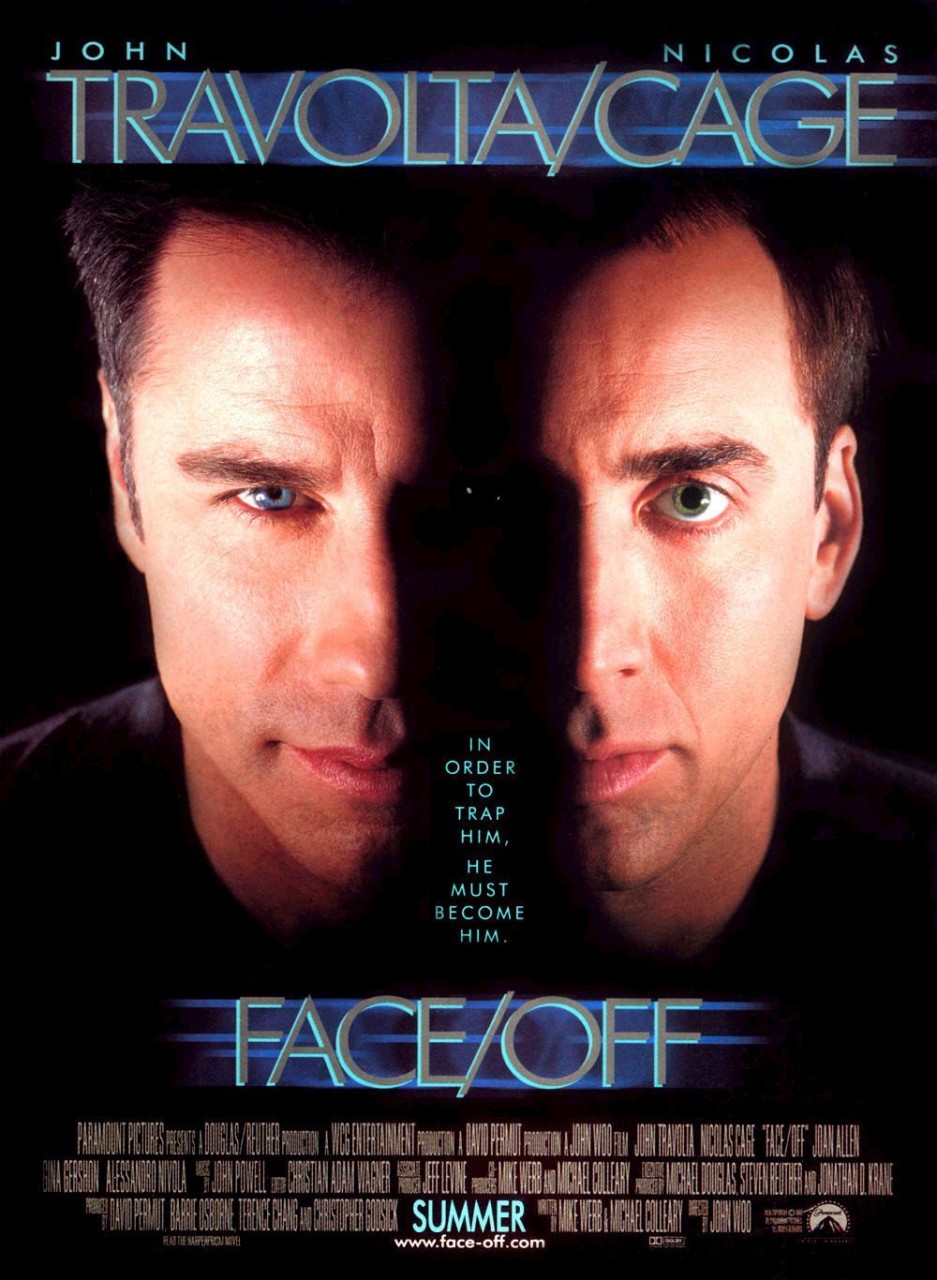
USA. 1997.
Crew
Director – John Woo, Screenplay – Michael Colleary & Mike Werb, Producers – Terence Chang, Christopher Godsick, Barrie M. Osborne & David Permut, Photography – Oliver Wood, Music – John Powell, Visual Effects Supervisors – Richard Hollander & Boyd Shermis, Special Effects Supervisor – R. Bruce Steinheimer, Makeup Effects – Kevin Yagher, Production Design – Neil Spisak. Production Company – WCG Entertainment/Paramount.
Cast
Nicolas Cage (Castor Troy), John Travolta (Sean Archer), Joan Allen (Eve Archer), Alessandro Nivola (Pollux Troy), Dominique Swain (Jamie Archer), Gina Gershon (Sasha Hassler), Nick Cassavetes (Dietrich Hassler), Harve Presnell (Victor Lazzaro), C.C.H. Pounder (Hollis Miller), Colm Feore (Dr Malcolm Walsh)
Plot
Sean Archer, head of the FBI anti-terrorism taskforce in L.A., is obsessed with capturing terrorist Castor Troy who was responsible for killing his son six years earlier. Archer tries to apprehend Troy in a massive shootout at the airport, but this ends with Troy left in a coma. A disc is found in Troy’s belongings containing the schematics for a bomb. Interrogation of Troy’s associates reveals only the date the bomb is supposed to go but not the whereabouts. Archer’s superior comes up with an idea – that advanced laser grafting techniques be used to surgically remove Troy’s face and transplant it onto Archer’s so that he can go into prison and fool Troy’s brother into giving up the location of the bomb. Archer undergoes the transplant and is sent into the prison. Troy then comes out of his coma. When he finds what has happened, Troy forces the surgeons to transplant Archer’s face onto him and then eliminates everybody who knows about the operations, leaving Archer trapped in prison. Troy then proceeds to take over Archer’s life. In doing so, he makes a number of changes with Archer’s family, while using his knowledge of the criminal underworld to become an acclaimed anti-terrorist agent. Meanwhile, Archer makes an escape from prison and comes after Troy, determined to get his own identity back.
John Woo became a cult director in his native Hong Kong with crime/action films A Better Tomorrow (1986), The Killer (1989), Once a Thief (1990) and Hard-Boiled (1992), which rapidly developed a cult reputation in the West. Woo’s Hong Kong films are filled with an urgency and balletic kinesis that is genuinely exhilarating.
Unfortunately, since Woo’s move to the US just before Hong Kong’s handover back to China, his films have become perfect examples of the Hollywood films that could be pointed to show exactly what his Hong Kong films were not. Some of his American films retain the distinctive Woo stylism, notably Hard Target (1993) and Mission: Impossible II (2000) – both were fun but definitely pale in comparison to any of his Hong Kong fare.
On the other hand, other Woo films like Broken Arrow (1995), Windtalkers (2002) and Paycheck (2003), like Face/Off, are sadly indistinguishable from any other of the mindless big-budget action films out there. In all of these, there is the feeling that the vitality and urgency that set John Woo’s Hong Kong films head and shoulders above the rest of the crowd and made Woo seem the most invigorating director to hit the action genre in the 1990s has become drowned by big-budget formula. More recently, Woo returned to China to make historical dramas like Red Cliff Part I (2008), Red Cliff Part II (2009), The Crossing (2014) and The Crossing 2 (2015).
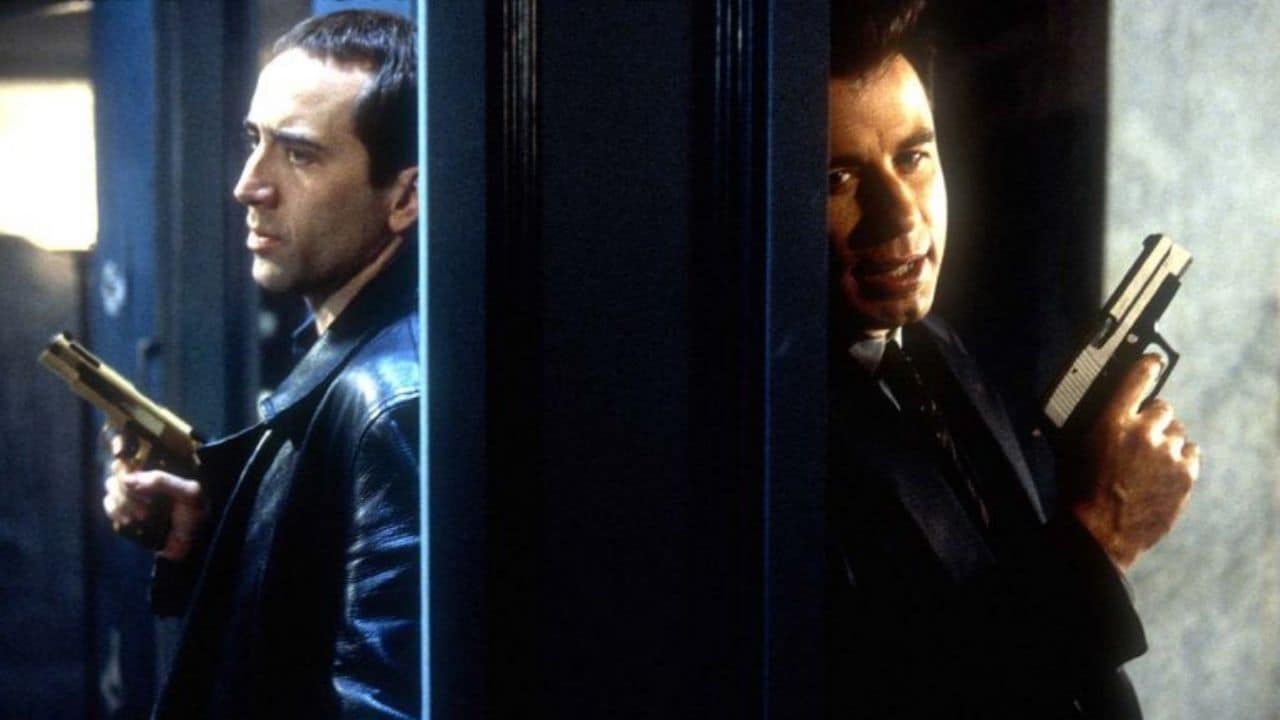
Face/Off arrives with the same disappointment. Certainly, there are a couple of standout sequences where John Woo shines – the opening with John Travolta bringing down an airplane by ramming it with a helicopter, a high-speed speedboat chase at the climax – but these are formulaic set-pieces in comparison to any other big-budget action film. By now, Woo’s trademark stylistic touches – Nicolas Cage’s coat flapping up behind him in the breeze in slow-motion, he handing over money in a fanged gold money clip and, in particular, a ridiculously overdone shootout in a church filled with dozens of doves fluttering about and multiple Mexican standoffs between about six people in a circle – are starting to verge on unintentional self-parody.
Face/Off has a potentially interesting premise of an action hero and a criminal swapping identities – unfortunately, one soon realises, an action film is the wrong genre for such a concept. The way the idea ends up, it is no more than a novelty gimmick. There is no plausibility or believability to the basic premise – the surgery on display is utterly preposterous – it is impossible to accept the degree of indistinguishable believability that the script requires us to believe of the operation.
Moreover, Woo only handles the idea in the most formulaic of ways. A far more interesting film – and certainly one that would not be beyond the film’s stretch of imagination – would have told it as a psychological story rather than as an action film. There are moments where the script suggests more – like where, after exchanging identities, both the hero and villain end up bettering the relationships in the other’s life – the villain loosening John Travolta’s life up and bringing back the passion his wife is missing, the hero bringing humanity to the thugs in Nicolas Cage’s life. However, Woo has no real interest in the human element and just as quickly is off to another explosive gun battle.
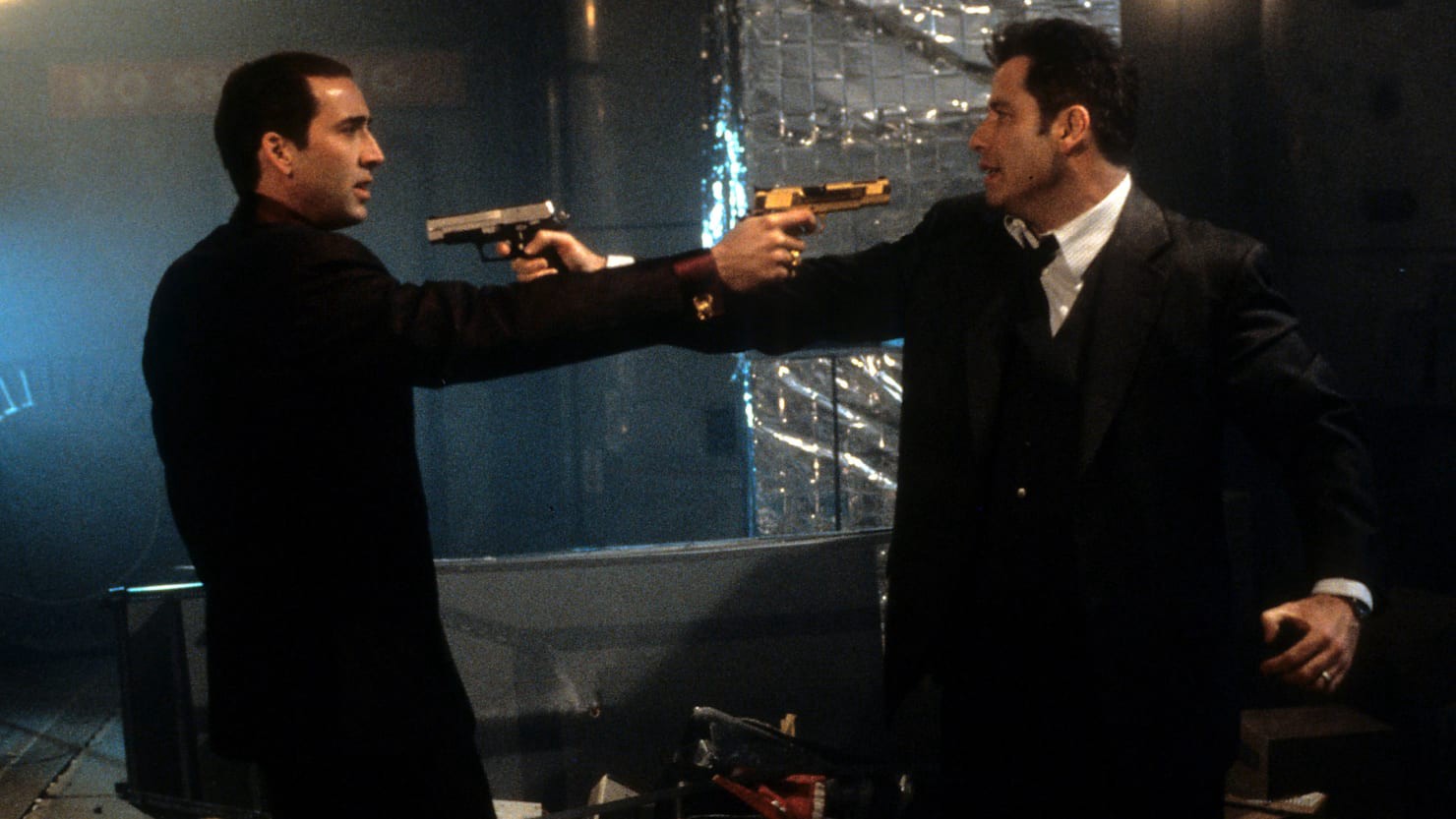
The sad truth about John Woo’s American films it seems is that no matter what type of film he is making – be it a war film (Windtalkers), a spy caper film (Mission: Impossible II), a reality-bending sf film (Paycheck) or an identity exchange film (here) – the balletically charged action movie seems to be the only kind of film he is capable of making. One wishes that Woo would find some other game to play as he is starting to seem like a one-trick pony.
Nicolas Cage and John Travolta are clearly having fun playing taking turns playing hero and villain. These bodyswap films usually either sink or swim depending on either actor’s ability to imitate the other’s mannerisms. However, the crucial failure is that neither convinces that they are inhabiting the other’s body in any way.
John Woo’s other genre films are:- the human hunting film Hard Target (1993); the nuclear hijacking film Broken Arrow (1995); Mission: Impossible II (2000); and the Philip K. Dick adaptation Paycheck (2003). Woo also directed the tv pilot The Robinsons: Lost in Space (2004) and has produced Western Wu Xia film Bulletproof Monk (2003), the anime Appleseed Ex Machina (2007) and the Wu Xia Reign of Assassins (2010).
Trailer here