
Crew
Director – Don Taylor, Screenplay – David Ambrose, Gerry Davis, Thomas Hunter & Peter Powell, Story – David Ambrose, Thomas Hunter & Peter Powell, Producer – Peter Vincent Douglas, Cinematography – Victor J. Kemper, Music – John Scott, Visual Effects – Maurice Binder, Special Effects – Louis Schwartzberg, Production Design – Fernando Carrere. Production Company – Sigma Co.
Cast
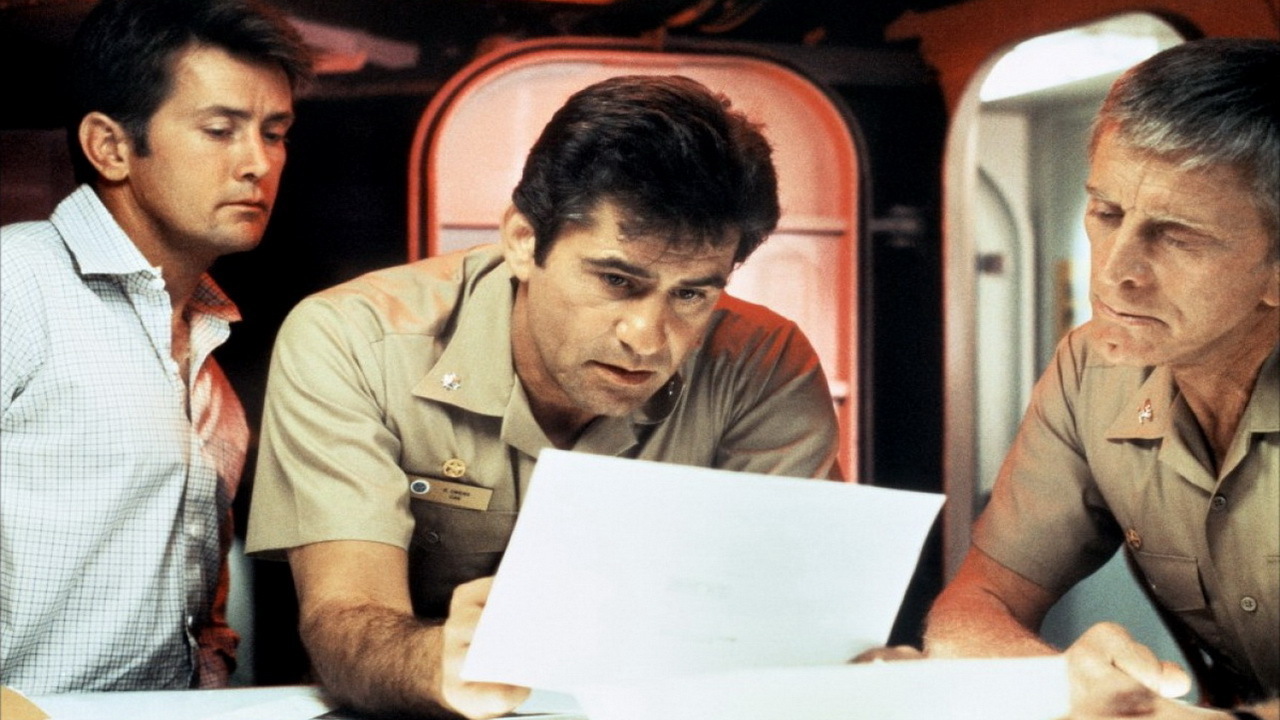
Kirk Douglas (Captain Matthew Yelland), Martin Sheen (Warren Lasky), James Farentino (Commander Richard Owens), Charles Durning (Senator Charles Chapman), Katharine Ross (Laurel Scott)
Plot
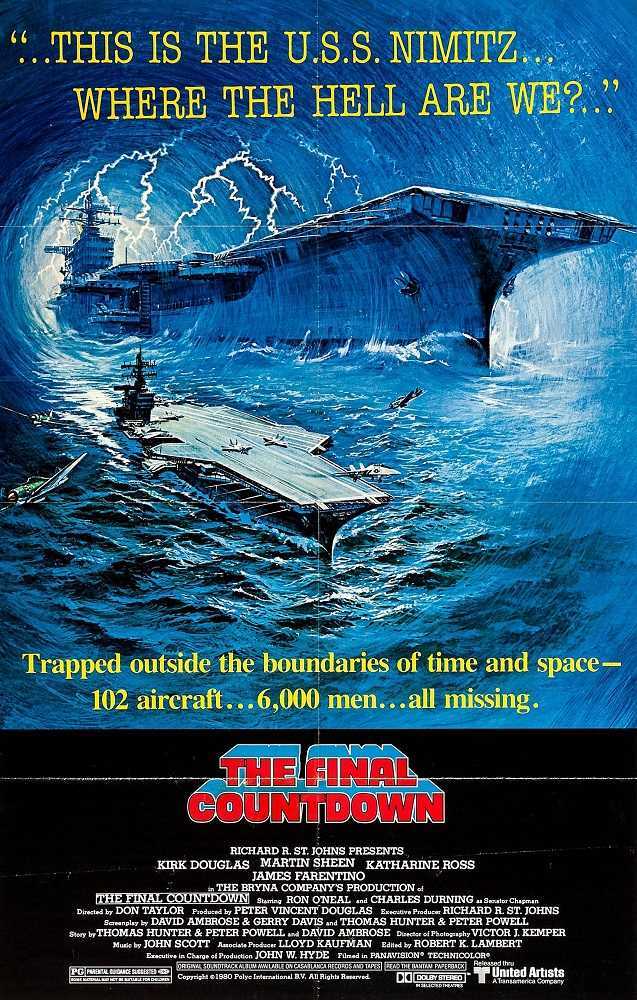
The US aircraft carrier Nimitz departs from Pearl Harbor on manoeuvres under Captain Matthew Yelland. The ship is then caught in a mysterious storm that appears out of nowhere and then equally mysteriously disappears again. Afterwards, the crew find that all naval communications have disappeared – they are only able to pick up is old-time radio broadcasts and low-band transmissions in Wartime Naval code. A reconnaissance flight over Pearl Harbor shows ships that were destroyed in the Japanese bombing still in existence and they realise that the storm has transported them back in time to December 5th, 1941, on the eve of the Japanese attack. The question that now arises is whether they should intervene and use the Nimitz’s superior firepower to obliterate the Japanese fleet and alter the course of history.
There are not many times when the entire ending of a film can make the difference between what could have been one of the great science-fiction films of its decade and thorough mediocrity. Not even the greatness of Blade Runner (1982) is dented by a lame ending. The Final Countdown is one such case – it is sad to watch the opportunity it had to be a great science-fiction film slipping through its hands.
The story sets up an idea that resonates with great possibilities – what if a modern aircraft carrier were transported back in time to the eve of Pearl Harbor where it could affect the outcome of the battle and history? The film sets this up well. It does serve up cliche discussions on grandfather paradoxes and conveniently just happens to have a historian specialising in the period aboard. However, the scenes puzzling over Jack Benny reruns on the radio and especially with Charles Durning wondering why the Nimitz is named after an admiral who is not even dead yet create a believable picture of the situation.
Unfortunately, the film’s trailer and poster have given the scenario away before the audience enters the theatre. This served to kill off all the suspense of the concept – the scenes puzzling over what happened hold no unfolding thrill for an audience, it merely becomes a matter of waiting for the characters on screen to catch up with where the audience knows they are and to then answer the big question – will they or won’t they thrash the Japanese?
[PLOT SPOILERS] However, this question – the ethical debate surrounding whether the crew have the right to change history and the intriguing possibilities of alternate history scenarios that then emerge – is completely avoided by the mother of all cop-out endings, which simply has the storm return before the Nimitz crew can arrive at any decision and whisk them back to the present. It is not only a cop-out, it is an ending that speaks intellectual cowardice, of the film having raised an audacious idea and then having completely retreated from it and failed to explore its possibilities on every account. The minor twist that comes in the end of the tale is no recompense for such failure of imagination.
In The Final Countdown‘s favour it is important to remember that up until then, apart from occasional episodes of Star Trek (1966-9) or Doctor Who (1963-89, 2005– ) – a series on which co-writer Gerry Davis had worked during the 1960s where he was most known as co-creator of The Cybermen – time travel themes had never been dealt with with any particularly challenging rigour – the past and future were merely places to have adventures in, not unlike other planets, or would occasionally produce visitors from for culture clash stories. That said, a script entitled Tomorrow and the Stars had been written for the proposed 1970s Star Trek tv revival in which Captain Kirk is thrown back in time to just before Pearl Harbor.
If The Final Countdown had only been made five years later after the maturation of time travel themes wrought by the twin successes of The Terminator (1984) and Back to the Future (1985), it is entirely possible that this might have emerged as far more challenging science-fiction than it does. (For a more detailed listing see Time Travel Films).
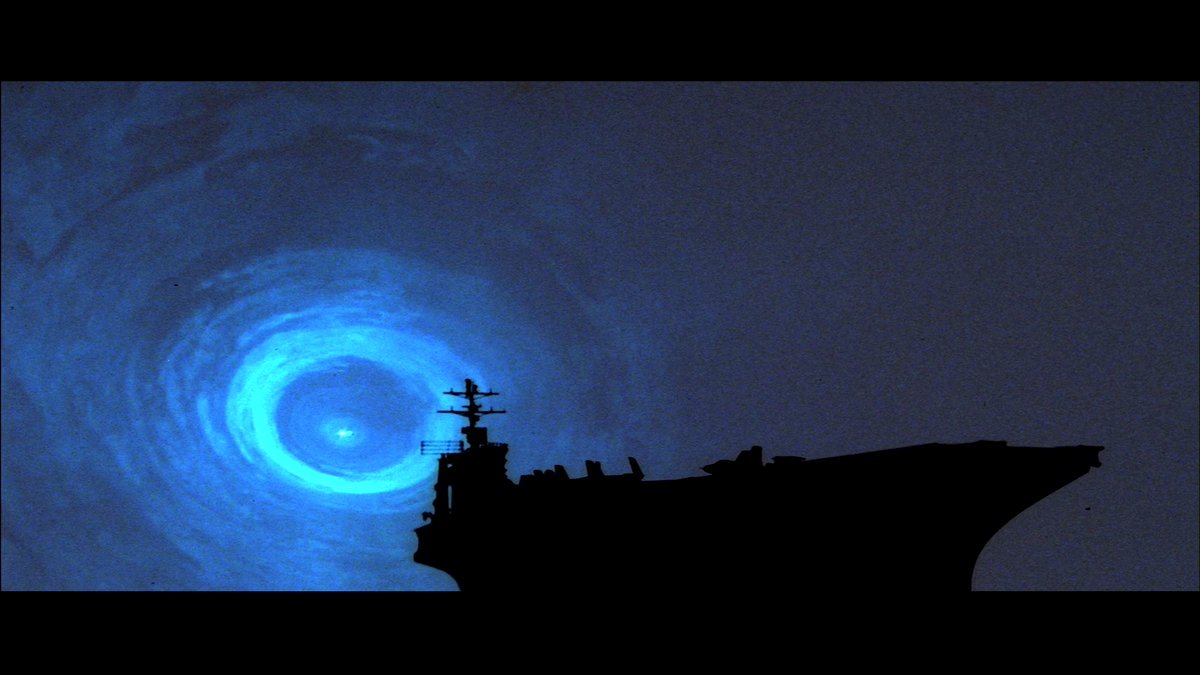
The film is more interesting for the impressive scenes set around the real aircraft carrier Nimitz. In a casting coup, the filmmakers were allowed to go on board the Nimitz and shoot while it was at sea on training manoeuvres – and the scenes of the huge ship in operation are impressive. The flying scenes are exhilarating, not to mention magnificently scored by John Scott. In fact, they diminish the poor effects work – the storm effects (from Maurice Binder who created the distinctive credits sequences for the James Bond films) are only represented by a very unconvincing model Nimitz silhouetted against a smoke-filled laser tunnel.
Director Don Taylor (1920-98) was a former actor who moved in to tv direction. He had a modest career in genre films, having also made the likes of Escape from the Planet of the Apes (1971), The Island of Dr Moreau (1977) and Damien: Omen II (1978).