

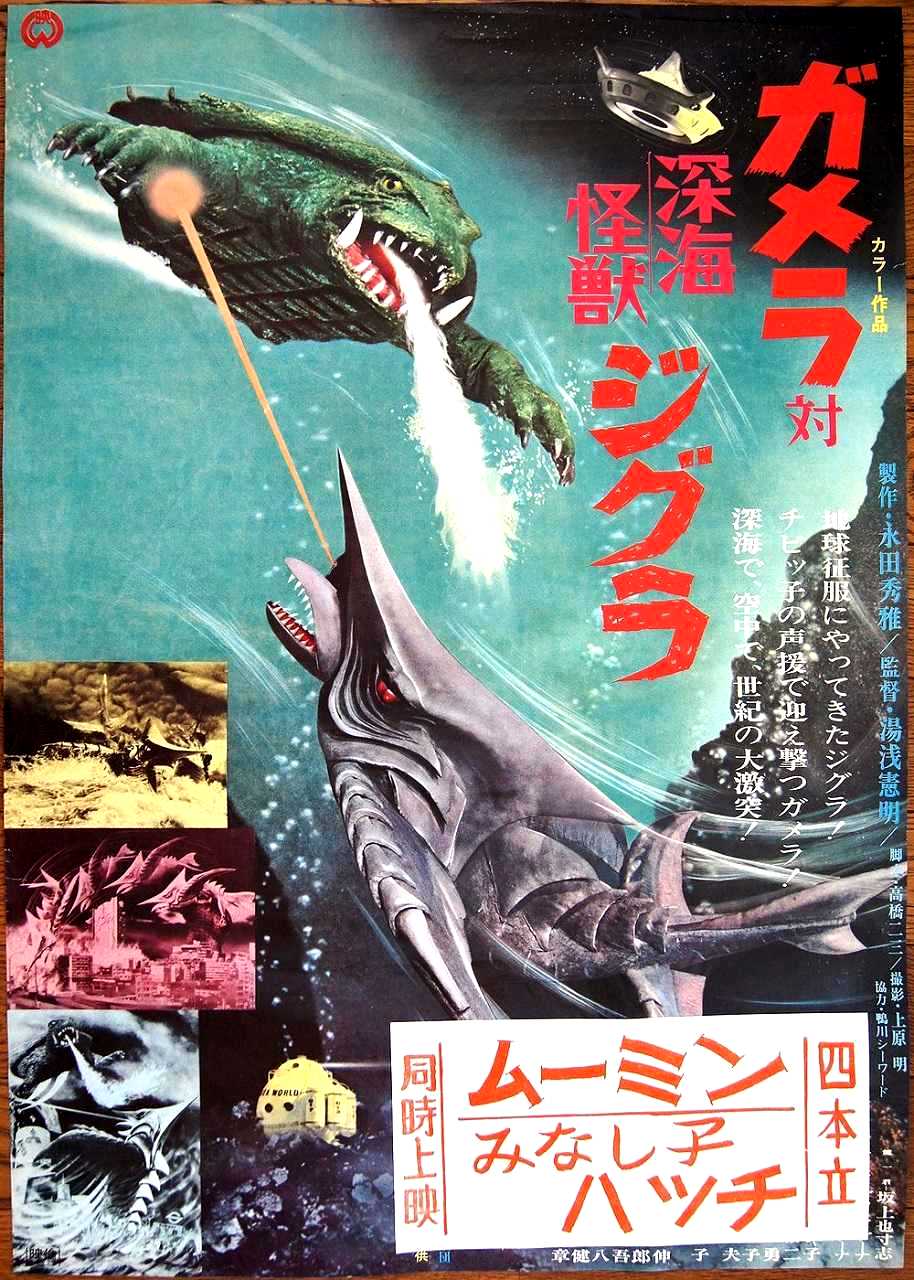
(Gamera Tai Shinkai Kaiju Jigura)
Japan. 1971.
Crew
Director – Noriaki Yuasa, Screenplay – Niisan Takahashi, Photography – Akira Uehara, Music – Shinsuke Kikuchi, Special Effects Photography – Kazufumi Fujii, Art Direction – Tomohisa Yano. Production Company – Daiei.
Cast
Eiko Yanami (Lady X/Lorelei), Yasuchi Sakagami (Kenichi Ishikawa), Arlene Zoellner (Helen Wallace), Koji Fujiwara (Dr Tom Wallace), Samu Saeki (Dr Ishikawa), Gloria Zoellner (Marjie Wallace)
Plot
Two marine biologists at the Kanogawa Sea World sneak away from work to go fishing and are secretly followed by their two young children Kenichi and Helen. A UFO from the planet Zigra then appears from underwater and snatches up their dinghy. A humanoid woman who is used as a mouthpiece by the Zigra entity informs them that the oceans on Zigra’s home planet have become polluted and that Zigra now wants to inhabit Earth and feed upon humans. Zigra then causes a series of earthquakes and disasters as demonstration of its powers. The children manage to free their fathers who have been hypnotised by Zigra and make an escape. It is up to Gamera, the friend of all children, to defend Earth against Zigra.
Gamera vs. Zigra was the seventh of the Japanese studio Daiei’s Gamera films, which began in 1965 with Gammera the Invincible (1965). (See below for the other Gamera films). The Gamera films were always a knockoff of rival studio Toho’s Godzilla films. Both the Gamera and the Godzilla series followed similar paths – the central character started out as a monster in the first film and gradually mellowed until it effectively became a superhero, defending Japan against other monsters; into the mid-1960s, both series began to incorporate space opera elements and pit the monsters against invaders from other worlds, while this became superseded by environmentalist themes into the 1970s; and between the late 1960s and mid 1970s, both series progressed downhill until the films became pitched to juvenile audiences, becoming shabbier in their special effects and increasingly more puerile and child-oriented in their plots. Both series were also revived in the 1980s-1990s where much more advanced special effects techniques allowed either series to mature and turn out some of their best entries.
Gamera vs. Zigra was the last of the classic Gamera films before Daiei’s financial collapse in the mid-1970s. It is also one of the worst of the Gamera films. By this point, the series had become entirely focused on children. The two kids are wound in at every opportunity – stowing away in dinghies and bathyscaphes with their parents. The film even features a song about Gamera sung by a children’s chorus.
It is hard to tell whether it is the dubbing or the way the original script was written but the writing is infantile – lines like “Zigra will prove to all the planets of the world that Zigra is all-powerful” – or the bizarre means of dealing with the alien menace by at one point reasoning that Zigra uses sonar therefore radio can be used to undo the hypnotic conditioning of the fathers. It is also never made clear as to whether Zigra is the name of the invading alien or its homeworld, as the film seems to use both interchangeably.
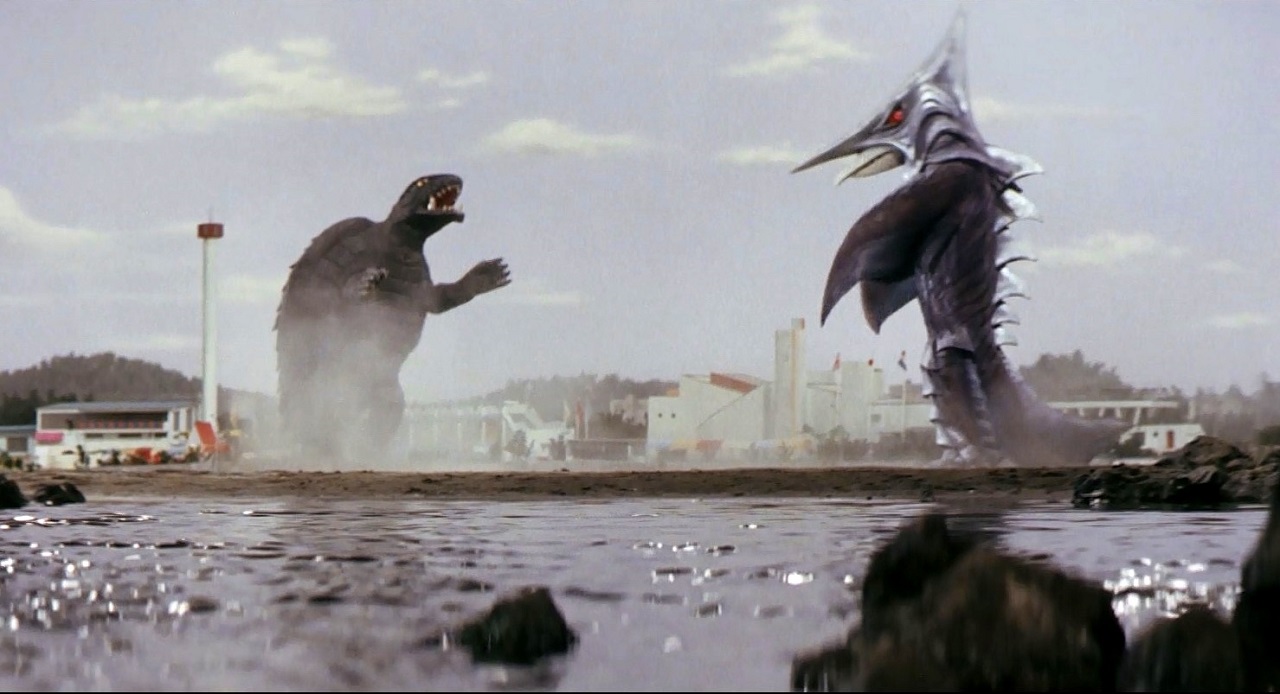
The special effects are also incredibly shabby – the Gamera model is almost entirely immobile, there are some incredibly poor models of the moonbase, while the mass destruction caused by Zigra is something that is only described but never depicted. There is also a ludicrous lack of conviction to the monsters – the Zigra spaceship looks like a metal vegetable colander filled with coloured gumballs, while the monster version is like a mechanised shark with glowing red eyes. The fight scenes become completely ridiculous – at one point, Gamera throws a rock and impales it on Zigra’s nose and in another scene uses a rock to play the xylophone along Zigra’s fins.
If Gamera vs. Zigra has an equivalent among the Godzilla films, then it feels like one of director Jun Fukuda’s entries of the 1970s – Godzilla vs Gigan/Godzilla on Monster Island (1971), Godzilla vs Megalon (1973) and Godzilla vs the Cosmic Monster (1974) – which were the Godzilla series nadir, the point where the effects and stories were at their most childish and Fukuda had stopped treating the films with the remotest shred of seriousness.
The other Gamera films are:– Gammera the Invincible (1965), Gamera vs Barugon/War of the Monsters (1966), Gamera vs Gyaos/Return of the Giant Monsters (1967), Destroy All Planets (1968), Attack of the Monsters/Gamera vs Guiron (1969), Gamera vs Jiger/Gamera vs Monster X/Monsters Invade Expo 70 (1970) and Gamera: Super Monster (1980). The series was revived in the 1990s with Gamera, The Guardian of the Universe (1995), Gamera 2: Assault of Legion (1996), Gamera 3: Revenge of Iris (1999) and Gamera the Brave (2006).
Trailer here