
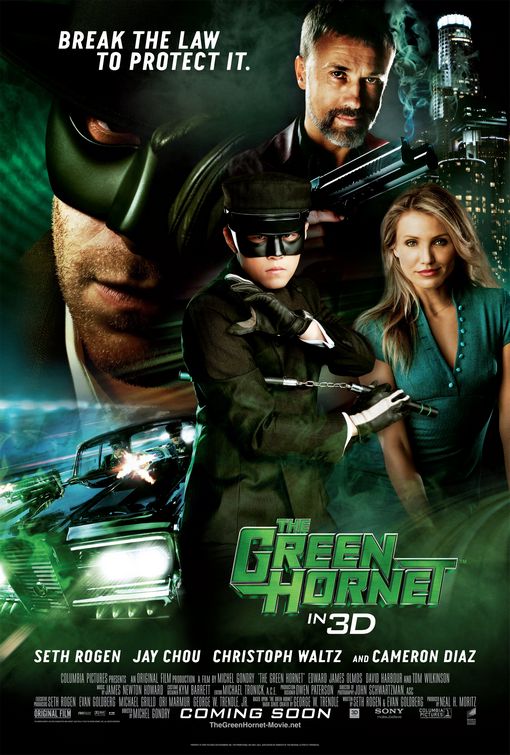
USA. 2011.
Crew
Director – Michel Gondry, Screenplay – Evan Goldberg & Seth Rogen, Based on the Radio Show Created by George W. Trendle, Producer – Neal H. Moritz, Photography – John Schwartzman, Music – James Newton Howard, Visual Effects Supervisor – Jamie Dixon, Visual Effects – CIS Hollywood (Supervisor – Gregory Oehler), CIS Vancouver (Supervisor – Mark Breakspear), Hammerhead Productions (Supervisor – Justin Jones), Luma Pictures (Supervisor – Payam Shohadi) & Pixomondo, Special Effects Supervisor – John A. Frazier, Production Design – Owen Paterson. Production Company – Original Film.
Cast
Seth Rogen (Britt Reid/The Green Hornet), Jay Chou (Kato), Christoph Waltz (Benjamin Chudnofsky), Cameron Diaz (Lenore Case), David Harbour (District Attorney Frank Scanlon), Tom Wilkinson (James Reid), Edward James Olmos (Mike Axford), Jamie Harris (Popeye), [uncredited] James Franco (Danny ‘Crystal’ Clear)
Plot
Britt Reid is the idle playboy son of James Reid, the publisher of the Daily Sentinel newspaper. Britt’s father is then killed by a bee sting and Britt suddenly inherits the Daily Sentinel, even though he has no interest in running it. Searching for the person who makes his morning coffee, Britt meets Kato, a Chinese immigrant who was employed to look after his father’s cars. Kato shows him the custom modifications he has made for some of the vehicles. Britt gets drunk with Kato and they sneak out to vandalise his father’s statue, only to see a couple being attacked by muggers, whereupon Kato drives the muggers off in an astonishing display of martial arts. Buzzed by this, Britt wants to do more. He pushes the Daily Sentinel editorial staff to capitalise on video footage of the attack, coming up with the name The Green Hornet for himself. He has the idea of portraying themselves as villains in order to give them freedom to act. Kato rebuilds one of his father’s cars into a lethally armed and armoured vehicle that he nicknames Black Beauty. Adopting masked disguises, they head out into the streets to fight crime. Britt also employs secretary Lenore Case to predict The Green Hornet’s next movements, which they then use as a plan of action. However, their actions earn the wrath of Chudnofsky, the kingpin that runs all crime in Los Angeles, who determines to stop The Green Hornet.
Although not quite having the high profile of some of his comic-book counterparts, The Green Hornet is one of the classic masked superheroes. The Green Hornet first appeared on a self-titled radio show in 1936, which lasted until 1952 and gained a reasonable popularity in its day. The Green Hornet was created by George W. Trendle who had also created The Lone Ranger on the radio in 1933 (some versions make The Green Hornet into a descendent of The Lone Ranger). The radio show laid down the essential aspects – Britt Reid, the playboy publisher of The Daily Sentinel, who has a secret life where he dons a mask and fights crime as The Green Hornet. In all incarnations, he is accompanied by his manservant Kato who was originally Japanese but was changed to Korean after the unpopularity of the Japanese in the US following the bombing of Pearl Harbor. The Green Hornet’s first screen incarnations came in two serial adventures from Universal, the thirteen-chapter The Green Hornet (1940) starring Gordon Jones, and the fifteen-chapter The Green Hornet Strikes Again (1941) starring Warren Hull, with Keye Luke playing Kato in both of these.
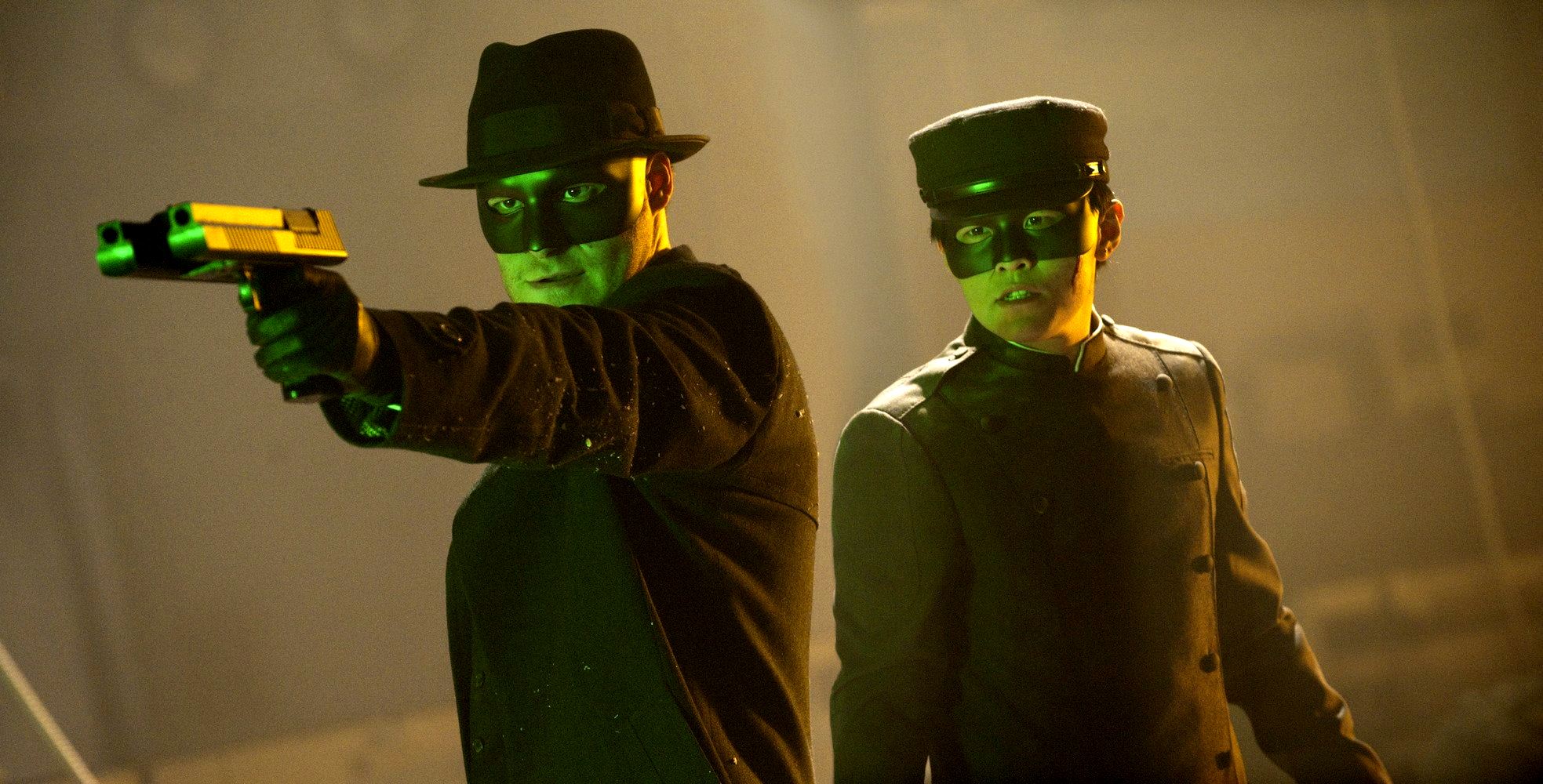
The Green Hornet’s most well remembered incarnation was in the tv series The Green Hornet (1966-7), which only lasted for one season of twenty-six episodes. This was created by producer William Dozier who had just had enormous success with the tv series Batman (1966-8) eight months earlier, which turned the original comic-book into something absurdly campy. The Green Hornet and Kato crossed over to team up with Batman and Robin in four episodes of Batman. Surprisingly, going against the prevailing trend that was started by Batman and quickly copied by other series, The Green Hornet was one superhero show of the era that took itself seriously. Van Williams played the part of Britt Reid/The Green Hornet, although the most interesting piece of casting, which gained the series a cult afterlife, was that of later-to-be martial arts superstar Bruce Lee as Kato. With Bruce Lee’s subsequent success on the big screen, episodes of the tv series were edited together into two theatrically released films The Green Hornet (1974) and Fury of the Dragon (1976), designed to highlight Lee’s presence. It is very much the tv series that The Green Hornet 2011 draws from – the film retains specific elements that were introduced there such as Black Beauty being a 1966 Chrysler Imperial Crown with its custom green headlights and battery of gadgets, the costuming, and the character of District Attorney Frank Scanlon (who is made far more evil here than in the tv series where he was an ally of The Green Hornet).
There have been plans to conduct a big-screen revival of The Green Hornet since at least the 1990s. There was the interestingly touted casting of George Clooney at one point (it is hard to think of any other actor who would have been a more perfect incarnation of Van Williams). Throughout the 00s, names such as Mark Wahlberg and Jake Gyllenhaal were suggested in the role of Britt Reid/The Green Hornet, while Jason Scott Lee and later Jet Li were named as potential Katos. Far more interesting were some of the directorial names attached, including Kevin Smith, the director/writer/actor of Clerks. (1994), Mallrats (1995), Dogma (1999) and the previous Seth Rogen vehicle Zack and Miri Make a Porno (2008), who developed a script that he was intending to direct. (Kevin Smith later turned his ideas into a Green Hornet comic-book that was released concurrently with the movie here). Seth Rogen signed onto the project in 2007 where the director was then Stephen Chow, the Hong Kong director/writer and comedy star behind such comic gems as From Beijing with Love (1994), Forbidden City Cop (1996), Shaolin Soccer (2001), Kung Fu Hustle (2004). CJ7 (2008) and Journey to the West: Conquering the Demons (2013), who was attached to both direct the film and star as Kato.
The film finally ended up in the hands of French director Michel Gondry (who had also been assigned to one of the earlier incarnations of The Green Hornet in the 1990s). Gondry became a cult music video director with eccentric and highly creative videos for artists such as Beck, Bjork, The Chemical Brothers, Daft Punk, Foo Fighters, Massive Attack, Kylie Minogue, Radiohead, The Rolling Stones, Sinead O’Connor, Kanye West and The White Stripes. Gondry made his directorial debut with Human Nature (2001) and then had the acclaimed worldwide hit of the memory-bending Eternal Sunshine of the Spotless Mind (2004). Gondry next went onto The Science of Sleep (2006), an appealingly delightful mix of romance, dreams and wacky surrealism, the Interior Design segment of the anthology Tokyo! (2008), the comedy Be Kind Rewind (2008) wherein Jack Black makes ultra-low-tech copies of popular films, and subsequent to the charmingly surrealistic romantic whimsy Mood Indigo (2013) and the non-genre Microbe and Gasoline (2015).
The real head-scratcher of a name toplining the film and even acting as co-writer and co-producer is Seth Rogen. Rogen’s name has risen in the last few years due to his association with the Judd Apatow entourage in films such as The 40 Year Old Virgin (2005), his breakout role in Knocked Up (2007), Superbad (2007), Pineapple Express (2008) and Funny People (2009). Less well known is that Seth Rogen has also written a number of the scripts for the films he has appeared in, including Superbad, Pineapple Express and the Apatow produced Drillbit Taylor (2008), all the way back to the Judd Apatow tv series Undeclared (2001-3), as well as the subsequent alien invasion comedy The Watch (2012). He has even written episodes of Da Ali G Show (2003-4). Rogen co-writes The Green Hornet with his regular writing partner Evan Goldberg. The two later combined as writers/directors of the extremely funny End of the World film This is The End (2013), which went some way to redeem what they do with The Green Hornet, and the controversy-laden The Interview (2014), as well as produced the comic-book adapted tv series Preacher (2016-9), the time travel comedy Future Man (2017-20), the superhero series The Boys (2019- ) and the horror film Cobweb (2023), and wrote/produce and voice the animated Sausage Party (2016) and Teenage Mutant Ninja Turtles: Mutant Mayhem (2023) and produced An American Pickle (2020) with Rogen as a Jewish immigrant from 1919 awoken in the present.
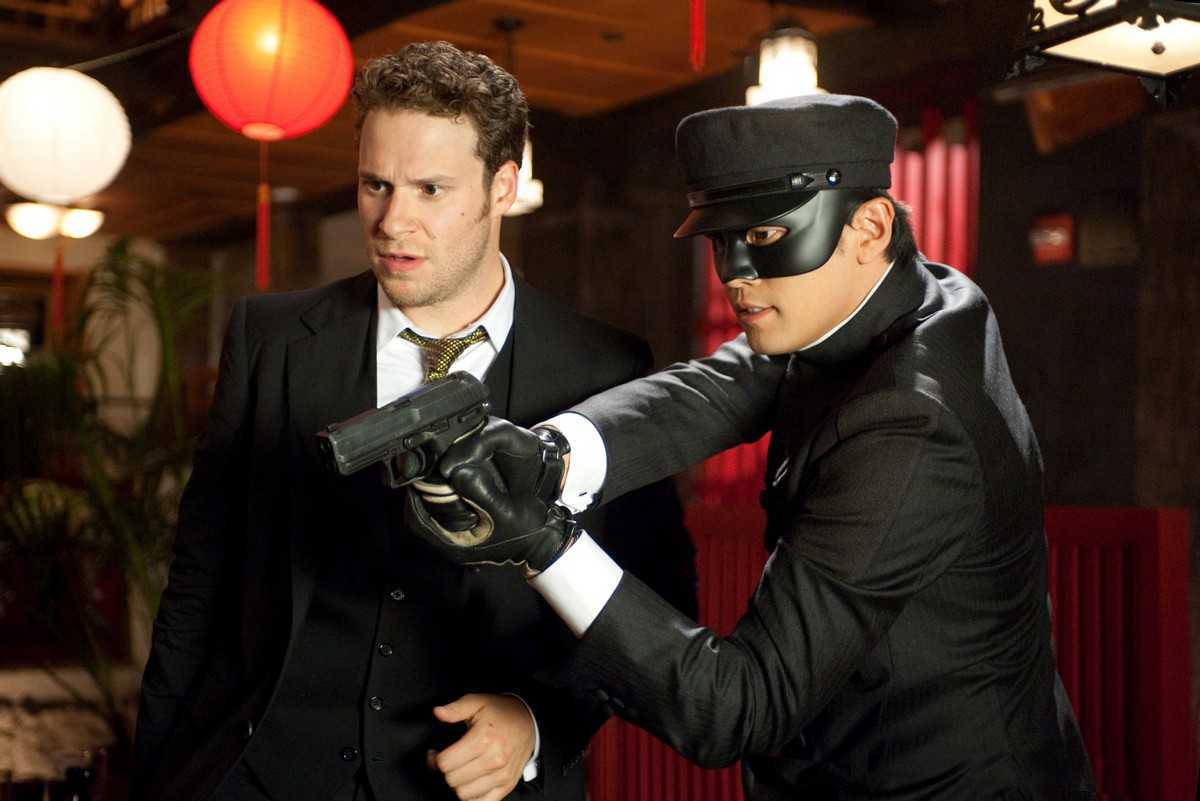
I had major problems with The Green Hornet 2011 from about the point the first trailer went online. I kept trying to get my head around the various mismatched elements the film was trying to bring together – the revival of a classic superhero; a role that was originally played by the dashingly handsome Van Williams recast with Seth Rogen, a pudgy curly-haired guy best known for comedies in which he plays good-natured chumps – the place that Rogen gives the impression he is most at home is in a university frat party after at least a dozen beers; and Michel Gondry, an acclaimed director whose work to date has not to been in the action and effects driven blockbuster but in quirky, highly individualistic films that allow his eccentric genius room to flower. The trailer appeared to give us the agonising idea of the Britt Reid and Kato relationship reconceived as a bromance – the genre in which Seth Rogen found his name – and everything played for laughs.
The film also underwent a pointless conversion to 3D, which is something guaranteed to switch me off. The Green Hornet joined a host of other fake 3D films come out in 2010 – Alice in Wonderland (2010), Clash of the Titans (2010), Gulliver’s Travels (2010), The Last Airbender (2010), My Soul to Take (2010) – that were converted in post-production to capitalise on the 3D fad following the success of Avatar (2009). One went in with the hope that trailers are sometimes misleading and that the presence of Michel Gondry would triumph over the marketing department.
Unfortunately, it is not long into The Green Hornet before one realises that one’s worst expectations about the film come true. Seth Rogen writes and plays the entire film in Party Dude mode. Originally, the Green Hornet was a masked crimefighter in black with a crusading sense of purpose that favourably placed him in the company of other heroes such as Batman, The Lone Ranger and Zorro. Britt Reid was also one of the first wealthy playboys who had a secret crime-fighting alter ego – in fact, The Green Hornet acted as Bob Kane’s inspiration for Batman’s Bruce Wayne.
By contrast, The Green Hornet 2011 is about an idle rich kid who gets drunk with his new best buddy and thinks it an utterly hilarious lark to put on a mask and costume and go out into the streets and bumble around playing at fighting crime. This seems to be about the sum conception of the film. Seth Rogen appears to have stipulated in his contract that he had to have some comedy routine going on in every scene – even when scenes are meant to be played serious, he manages to turn them into comic antics, constantly tripping over his own feet or playing loud and raucous. The scenes introducing the Green Hornet’s gadgets, for instance, come with much in the way of Seth Rogen and Jay Chou fooling around with knockout gas or Rogen going “whoooarh” as each new piece of armament is unveiled.
Some months earlier, Seth Rogen made much in saying how he was intending to play the film as comedy and that comedy and the superhero film were not mutually exclusive. Yeah, whatever. I am sure the people who also remade other serious works in a comedy vein such as King Kong (1976), Starsky and Hutch (2004) and Land of the Lost (2009), not to mention other comic-book/superhero adaptations such as Modesty Blaise (1966), Doc Savage – The Man of Bronze (1975) and Batman & Robin (1997), also said exactly the same thing. Wake up and smell the coffee instead of making jokes about the espresso machine Rogen. Turning a serious source work into a frat rat comedy is not reinventing the superhero film – it’s ridiculing the material and not taking it seriously. Pointing at funny scenes in other superheroes films as justification for playing the work for laughs seems to be blurring a line in a way that is only self-justifying sophistry.
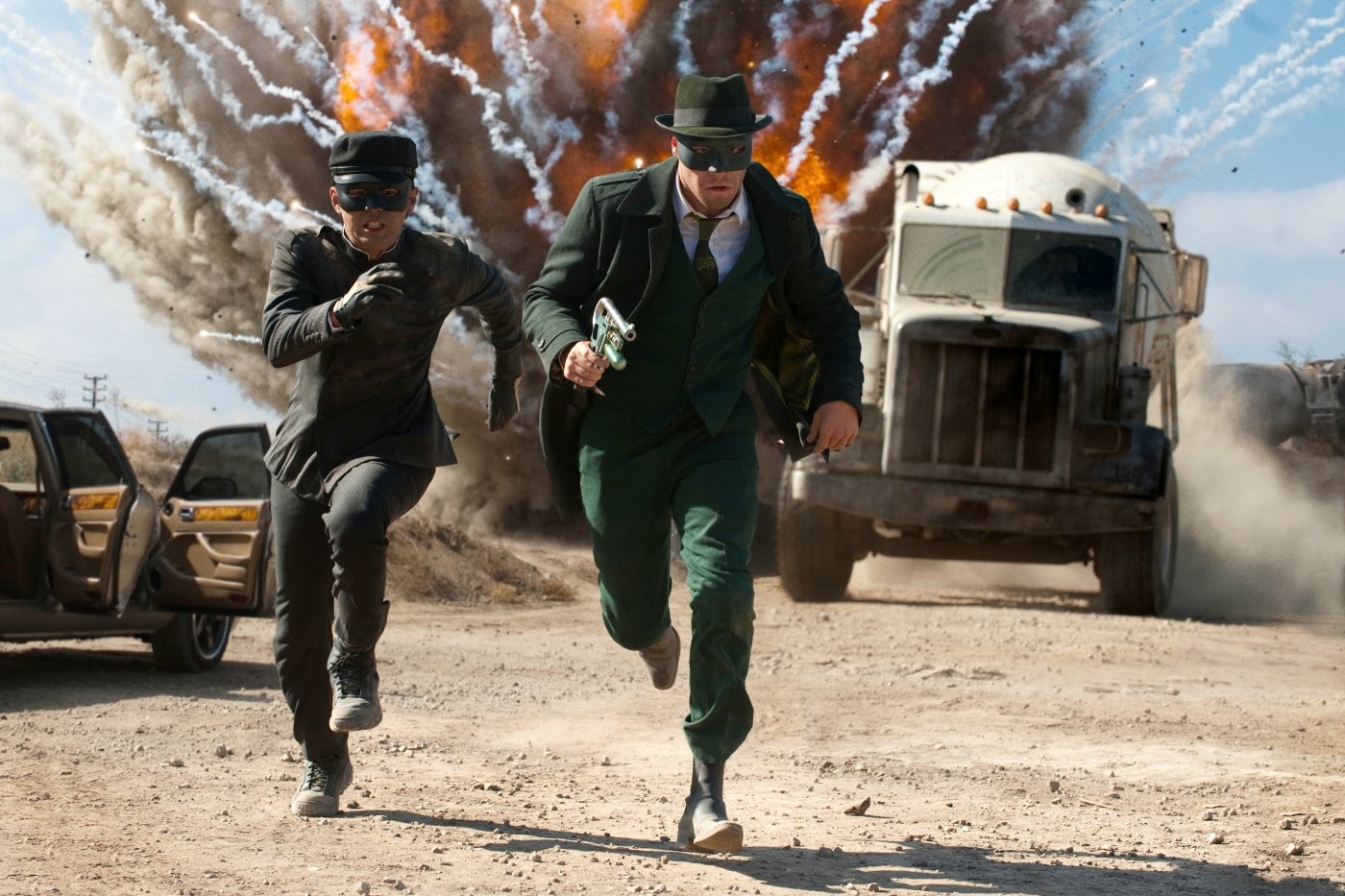
The thing that Rogen, Gondry et al do not seemed to have studied is the history of their product or its genre. When The Green Hornet tv series was made, it was one of the few superhero works to play it straight up against the prevailing campy approach of its parent, the 1966-8 Batman tv series. Today the Batman tv series has a certain camp amusement among fans but is looked down on by any serious fan of the comic-book. Batman was reclaimed on the big screen during the 1980s/90s by Tim Burton’s dazzling Batman (1989) and Batman Returns (1992), which discovered amazing dark psychological depths inside the comic-book characters and treated them with respect. These became highly regarded by fans, although the series was then wrecked by Joel Schumacher failing to understand the material and playing everything as camp again in Batman Forever (1995) and Batman & Robin, as well as the subsequent disaster of Catwoman (2004), before Batman was treated with respect and given new life on the big screen again by Christopher Nolan in Batman Begins (2005), The Dark Knight (2008) and The Dark Knight Rises (2012), which in turn became fan favourites.
Can you see a pattern emerging here? When comic-book adapted films treat the source material with respect and make an adult film out of it, audiences respond and love the works; when you look down on the work, fail to take it seriously or treat the idea of a comic-book superhero as silly and camp it up, audiences hate the work. I am sure there are those who enjoy Schumacher’s Batman films or Catwoman but they are in a minority or else are kids in their single digit age range who know no better. I tried to think of what the audience for The Green Hornet 2011 would be and eventually realised the only people likely to respond favourably are the same frat boy crowd that identify with Seth Rogen’s persona.
I also fail to understand how a smart and creative director like Michel Gondry could have gone astray like this. The Green Hornet is a big-budget action vehicle, not the sort of the quirky, personal film that Michel Gondry specialises in. The big-budget process seems to have wrung much of Gondry’s distinctiveness out of the film – what there is on screen could have been handled by any generic big-budget director for hire.
It soon becomes clear that Gondry’s forte is not action scenes. He displays remarkably little interest in these – unless one wants to count a ridiculous scene where Seth Rogen and Jay Chou engage in a fight that wrecks much of the mansion, including such camp images as Rogen playing table football with Chou’s face. The martial arts sequences end up being disrupted by Gondry’s visual gimmicks – targeting point-of-view digital displays or shots that cause vehicles to multiply replicate as Jay Chou runs along them and flying bodies to leave vapour trails. The result falls somewhere between Robert Downey Jr’s mathematically calculated fight scenes in Sherlock Holmes (2009) and the visual silliness of Scott Pilgrim vs. the World (2010). Either that or Kurt Wimmer’s daft Gun Kata moves in Equilibrium (2002) and Ultraviolet (2006). These fail to work principally because they are just visual gimmicks and Gondry never seems to have much idea why they are there.
Part of the problem is also that the superhero film has become a good deal more superheroic since the 1960s. When you have Spider-Man, Iron Man and the X-Men tearing up the skies with superheroic battles in full effects glory, a film based on an old 1960s tv series where the heroes have a cool car and no powers seems a little lacking in comparison. Action films regularly get around this and inflate things to a gritty or highly kinetic level, but Michel Gondry fails to enliven the film with anything more exciting than a few perfunctory martial arts scenes filled with silly visual gimmicks, or action set-pieces with overturning concrete mixers.
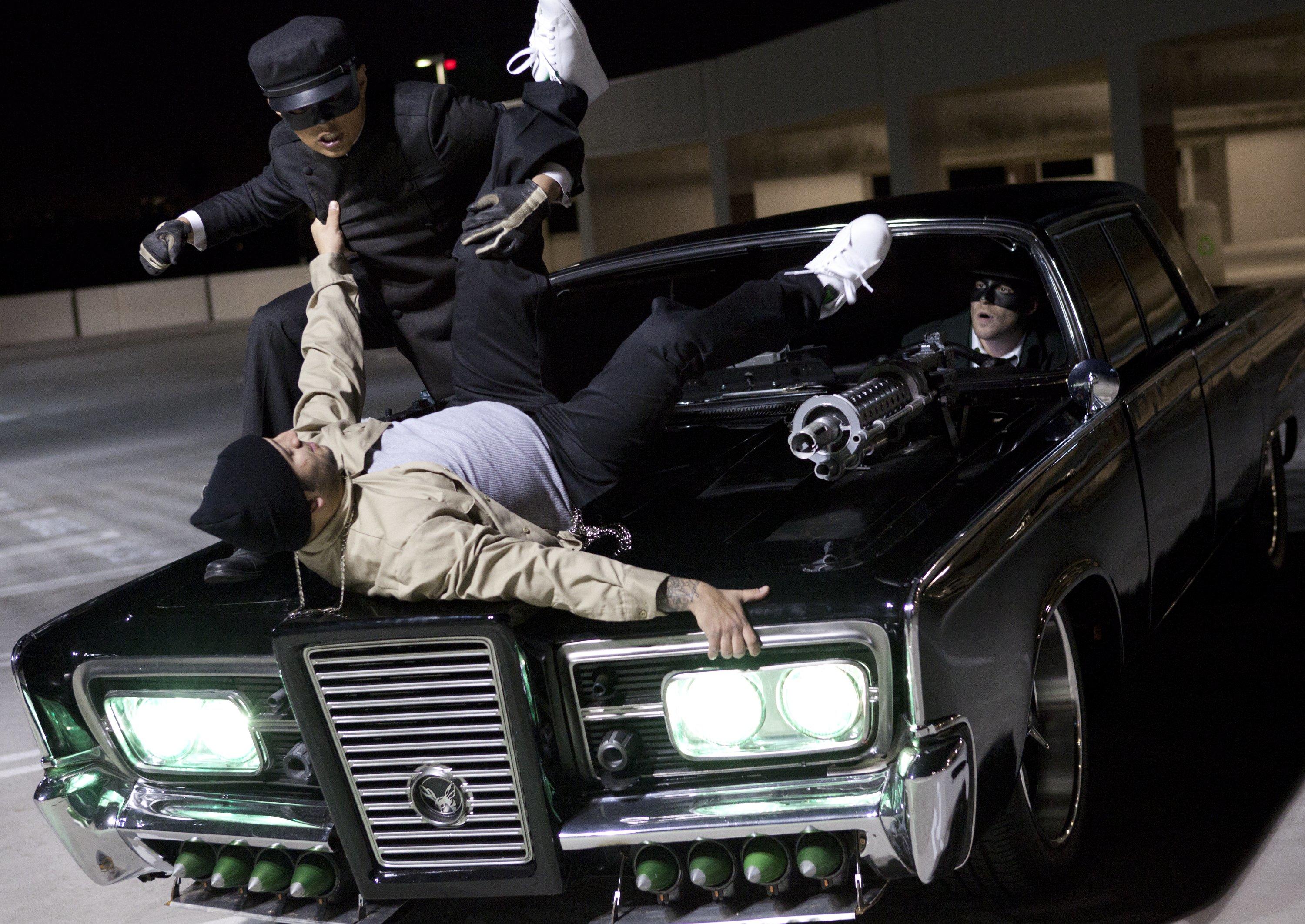
The sole sequence that Michel Gondry does get it together is the climax involving vehicles pursuing the Black Beauty through the streets shooting at it with heavy artillery, crashing into the Daily Sentinel building, followed by the Black Beauty being cut in two as it they try to ride it up in an elevator and driving through, blasting the crap out of the newspaper’s offices. Finally here, at the very end of the film, The Green Hornet does kick in with some of the kinesis it feels like it should have had all along. As with most of the fake 3D films listed above, the 3D gimmick adds nothing whatsoever and is there for no other purpose than to steal an extra $3-5 from you at the box-office.
I stretch my mind trying to think of any other example in recent genre history when an actor is least suited to being cast in a well-known part than Seth Rogen is here and scratch my head at a loss. The only superhero role I can even vaguely conceive of for someone like Seth Rogen to play is surely the title role in Defendor (2009). In fact, the film’s greatest mistake was allowing Seth Rogen on board at all, let alone giving him creative control. It is a bad case of the film being entirely wrecked by a star warping the material out of shape to fit their persona.
Far more successful is Taiwanese pop star Jay Chou in the role of Kato. Chou gets some lithe moves and, while a little blank, steals much of the show out from under Rogen. The relationship between the two has now been reconceived as one of equals rather than of playboy and manservant, no doubt in order to cleanse the film of any whiff of racial condescension that the original has been accused of. Jay Chou does a far better job than Seth Rogen of taking the role seriously and emerges as the more interesting character on screen.
Christoph Waltz takes the role of Chudnofsky off the back of his Academy Award Best Supporting Actor performance in Quentin Tarantino’s Inglourious Basterds (2009). That Christoph Waltz has great talent there is no denying; what he is doing in a role like this is a good question. It is surely a role better suited to a prize over-actor who could inflate the part – Nicolas Cage was once touted in the part and would have been perfect. The role suffers from weak, meandering writing. Most of Waltz’s routine is a series of lines questioning his own tough guy image – there is a mildly cute uncredited cameo from James Franco as a nightclub owner in the opening scene – but the self-consciously ironic dialogue feels like a grating attempt to copy Tarantino and falls flat every time Waltz launches into one of his monologues. Cameron Diaz seems increasingly determined to become the living embodiment of a blonde airhead joke with each performance she gives. Fine actors such as Edward James Olmos and Tom Wilkinson are present but given very little to do.
Trailer here