
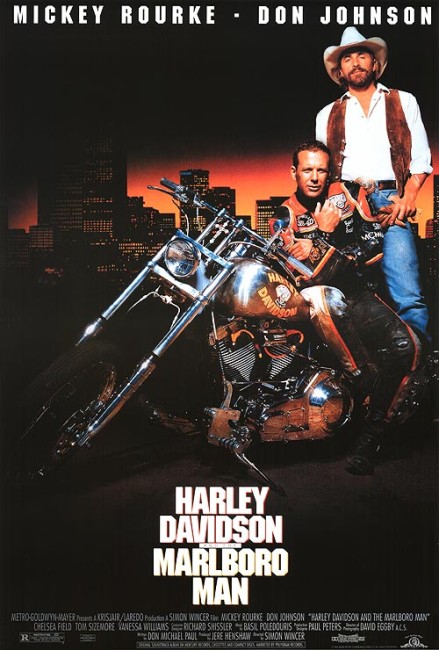
Crew
Director – Simon Wincer, Screenplay – Don Michael Paul, Producer – Jere Henshaw, Photography – David Eggby, Music – Basil Poledouris, Music Supervisors – Peter Afterman & Diane Louise Wessel, Visual Effects Supervisors – Michael Fink & Robert Grassmere, Special Effects Supervisor – Terry Frazee, Production Design – Paul Peters. Production Company – Krisjair/Laredo.
Cast
Mickey Rourke (Harley Davidson), Don Johnson (Marlboro Man), Daniel Baldwin (Alexander), Chelsea Field (Virginia Slim), Tom Sizemore (Chance Wilder), Giancarlo Esposito (Jose), Julius Harris (Old Man)
Plot
It is the year 1996. Harley Davidson rides back into Burbank and meets up with his old friend The Marlboro Man. They visit their old haunt The Rock’n’Roll Bar-and-Grill only to find that it is about to be demolished – the site suddenly having become valuable property since the announcement of an international airport being built nearby. Harley devises a plan to get the $2.5 million needed to stop the Great Trust Bank from foreclosing on the bar by robbing an armoured truck belonging to the bank. Instead they inadvertently steal a shipment of Crystal Dream, a highly addictive designer drug, from the armoured car. The bank now brings in a hired assassin to get the drugs back and eliminate those responsible.
Harley Davidson and the Marlboro Man is a film that has been constructed as a studied conflation of cinematic textures – it is a biker movie (although probably the first biker movie made on an A-budget); the plot comes straight from the book of generic Westerns, while the background is appropriated directly from Cyberpunk science-fiction.
The film swims along as an efficient cobbling of images and proves entertaining enough as an actioneer – so long as no one expects any substance of it. However, anything more than that seems a pose that is only paper-thin – from the dialogue that is a string of cliches regurgitated without any meaning, to Mickey Rourke’s baby-faced, macho tough-guy role (although co-star Don Johnson is notably relaxed and less irritably egotistic than usual).
The Cyberpunk setting reads like a cliche written from a cursory genre reading of William Gibson – Japanese cartels, the shady dealings of sinister and omniscient business corporations, designer drugs, vague references to the disappearing ozone layer. Even the principal characters are all named after cigarette brands. However, it is empty, the plot is not even interested in the science-fiction angle – for all it matters, the background could have been anything from a Western to a swashbuckler.
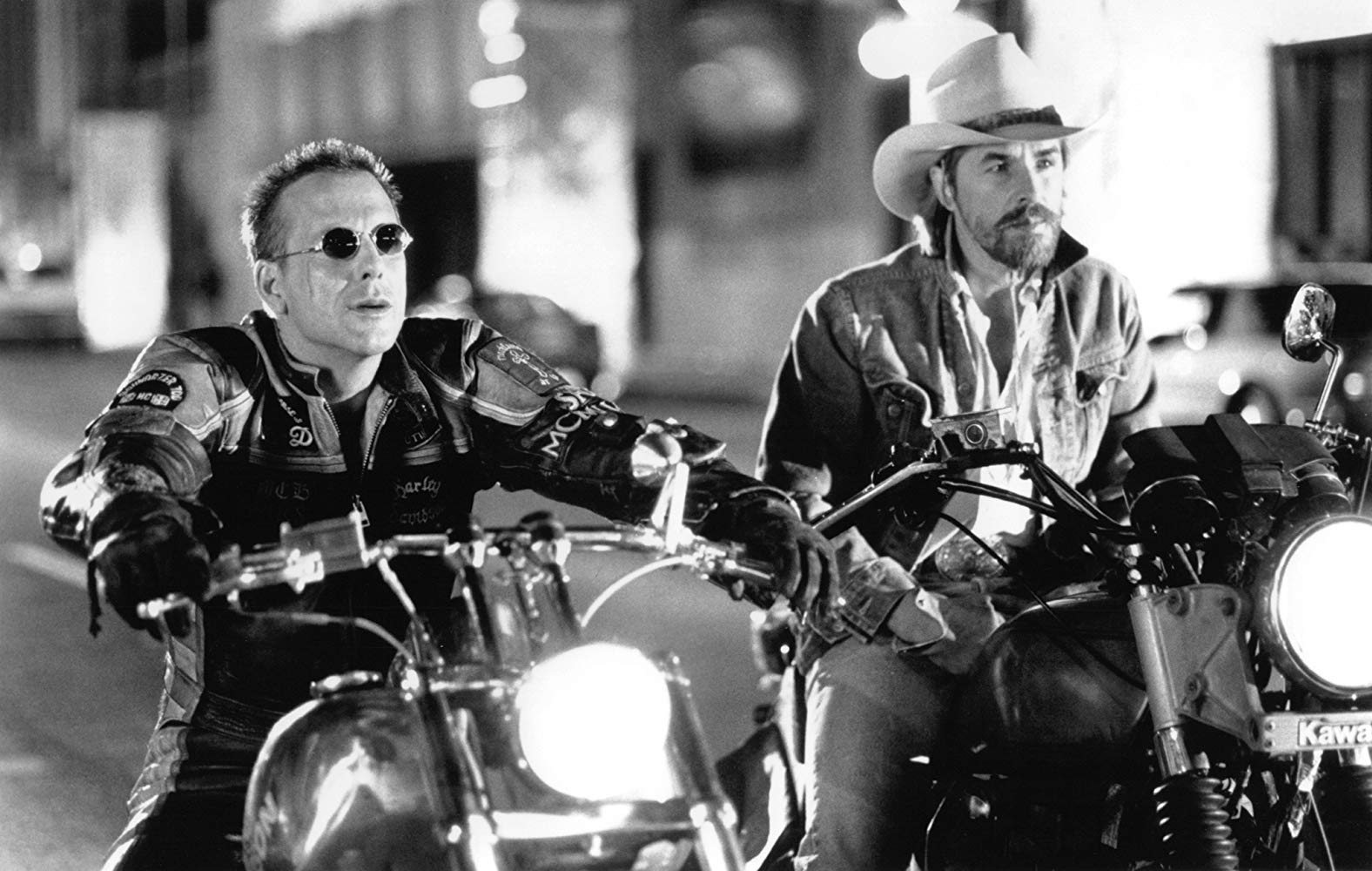
The action frequently teeters on the absurd – it is impossible to believe anybody could survive a ten story dive into a standard swimming pool; in another scene, a line of bad guys are done in by a biker jumping off his bike, allowing it to skid along while trailing petrol, which he then ignites with a lighter; and there is an all-too-obvious running joke throughout of Don Johnson’s holed boots, which naturally take until the climax when the villain of the piece is holding onto them while teetering on the edge of a skyscraper before finally giving way.
Harley Davidson and the Marlboro Man was made Australian director Simon Wincer, best known for films such as Free Willy (1993) and Crocodile Dundee in Los Angeles (2001). Wincer’s other genre films include the stalker film Snapshot/The Day After Halloween (1979), the fascinating Harlequin (1980) about an enigmatic magician, the android boy film D.A.R.Y.L. (1985) and the comic-book superhero adaptation The Phantom (1996).
The script comes from Don Michael Paul who had a career as an actor and then debuted as director of the Steven Seagal film Half Past Dead (2002) and has a made a handful of dvd-released action films, mostly sequels to other people’s films. These include the likes of Lake Placid: The Final Chapter (2012) Company of Heroes (2013), Jarhead 2: Field of Fire (2014), Sniper: Legacy (2014), Tremors 5: Bloodlines (2015), Kindergarten Cop 2 (2016), Sniper: Ghost Shooter (2016), Death Race: Beyond Anarchy (2018), Tremors: A Cold Day in Hell (2018), Scorpion King: Book of Souls (2018), Jarhead: Law of Return (2019), Bulletproof 2 (2020) and Tremors: Shrieker Island (2020).
Trailer here