
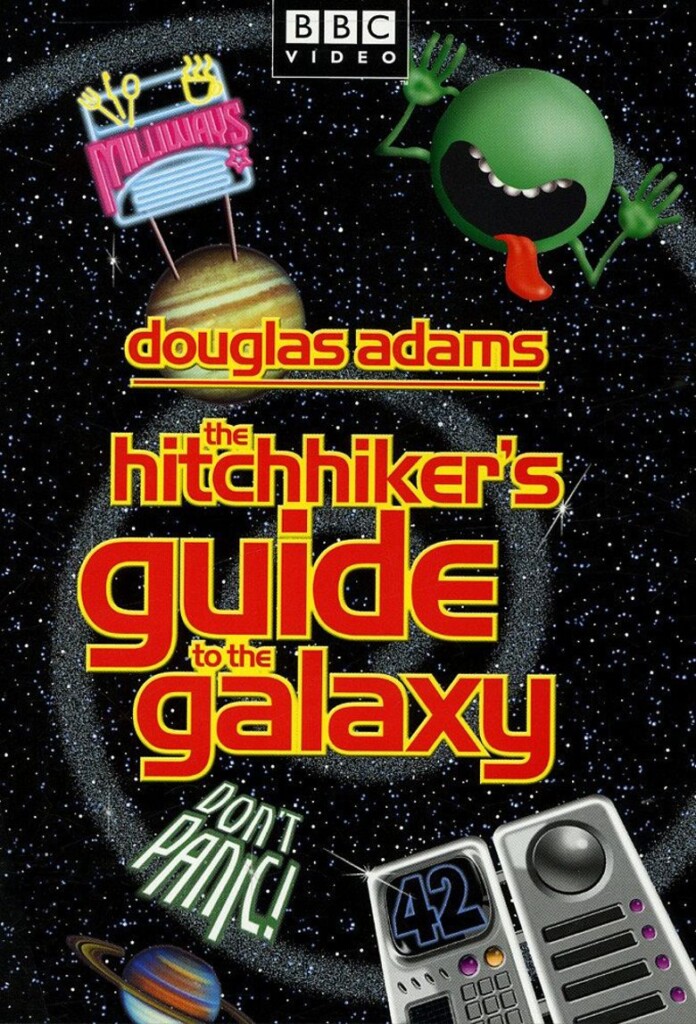
UK. 1981.
Crew
Director – [none listed], Teleplay – Douglas Adams, Based on His Radio Series, Producer – Alan J.W. Bell, Title Music – Tim Souster, Radiophonic Music – Paddy Kingsland, Visual Effects Design – Jim Francis, Animation – Rob Lord, Makeup Design – Joan Stribling, Production Design – Andrew Howe-Davis. Production Company – BBC.
Cast
Simon Jones (Arthur Dent), David Dixon (Ford Prefect), Mark Wing-Davey (Zaphod Beeblebrox), Sandra Dickinson (Trisha ‘Trillian’ MacMillan), Peter Jones (Voice of The Book), David Learner (Marvin), Stephen Moore (Voice of Marvin and The Whale), Richard Vernon (Slartibartfast), Aubrey Morris (Golgafrinchan Captain), Martin Benson (Vogon Prostetnic Jeltz), Michael Cule (Vogon Guard), Valentine Dyall (Voice of Deep Thought), Colin Jeavons (Max Quordlepleen), Joe Melia (Foreman), Peter Davison (The Dish of the Day)
Plot
Arthur Dent wakes up one morning to find that workmen have arrived to demolish his house. Arthur attempts to lie in front of the bulldozer to stop them but is interrupted by his good friend Ford Prefect who drags him to the pub. There Ford reveals that he is in fact an alien from Betelgeuse and informs Arthur that the Earth is about to be demolished in 12 minutes to make way for a hyperspace bypass. Ford now uses an intergalactic hitchhiking device to teleport he and Arthur aboard the Vogon constructor fleet just before they blow the Earth up. However, they are found by the Vogons, one of the most obstreperous and bureaucratic races in the galaxy, and the captain has them ejected from an airlock. Seconds before they expire, they are picked up the Heart of Gold, an experimental spaceship that is powered by an Infinite Improbability Drive, which charts its way through events of increasingly unlikelihood. The ship has been stolen by Ford’s cousin, the two-headed Zaphod Beeblebrox, who travels in the company of an Earth girl Trillian and Marvin, a robot with a depressed genuine people personality. Zaphod has discovered the whereabouts of Magrathea, the mythical world of custom planet builders. Arriving on Magrathea, they learn from the cryogenically reactivated builder Slartibartfast that the Earth was in fact a giant computer that had been built by a race of hyper-intelligent white mice from another dimension and designed to calculate the question that goes with the answer to life, the universe and everything.
It is almost impossible to discuss the The Hitch Hikers Guide to the Galaxy tv series outside of the rest of the The Hitch Hiker’s Guide to the Galaxy phenomenon – that it to say the Hitch Hikers Guide to the Galaxy radio series, the lps, the trilogy of books in five parts, the play, the computer game and the film. All of it, in coming from a single creative force, seems only a series of slightly different faces on the same coin and it is hard to regard one part of it as a separate entity. More to the point, one also has to dissociate any discussion of The Hitch Hikers Guide to the Galaxy from the fannish hagiography that has surrounded it – hearing so many sections of Hitch Hikers being endlessly quoted at university parties and science-fiction conventions inevitably leaves one with a certain jadedness.
The series had its origins in the mind of British writer Douglas Adams (1952-2001). A graduate from Cambridge, Douglas Adams began writing skits for stage and British radio, becoming an associate of several Monty Python alumni including Graham Chapman and Terry Jones. Adams then came up with The Hitch Hikers Guide to the Galaxy, which he claims he found the inspiration for while lying drunk in the middle of a field in Belgium during a hitchhiking tour of Europe. The series was produced as a six-part serial for BBC Radio in 1978, with a further six-part series following in 1980. Adams then rewrote both series, altered somewhat, and published them as two novels – The Hitch Hiker’s Guide to the Galaxy (1979) and The Restaurant at the End of the Universe (1980). The books were followed by this tv adaptation for the BBC, which aired in six half-hour episodes in 1981. The tv series also condenses, eliminates and re-arranges the elements of the first two books. In between this, Douglas Adams had also served as script editor for a single season of Doctor Who (1963-89), writing two-and-a-half episodes – The Pirate Planet and City of Death (the half being the legendary Shada, which was partially filmed but was never completed due to strike action).
The tv series was about the time that the Hitch Hikers Guide to the Galaxy phenomenon went meteoric. Its popularity was extraordinarily widespread. Phrases like “life the universe and everything” have gone into common parlance, while AltaVista appropriated the term Babel Fish for use as their online language translation guide. However, subsequent to the success of the phenomenon, Douglas Adams became the caricature of the writer who produced a single great idea and spent the rest of his career trying to recapture its heights. He seemed to spend the rest of his time milking the success of Hitch Hikers Guide in every possible way. He wrote three increasingly mediocre book sequels – Life, the Universe and Everything (1982), So Long and Thanks for All the Fish (1984) and Mostly Harmless (1992), along with The Salmon of Doubt (2001), a work that was released uncompleted following his death and may or may not have been material for a further Hitch Hikers book – and eventually confessed that he kept churning out the books solely to make money.
The Hitch Hikers Guide to the Galaxy phenomenon was spun out into almost every conceivable medium – the radio series was re-edited and released as a set of records; there was a play that first appeared in 1979; Adams collaborated on a primitive text computer game version of Hitch Hikers released by Infocom in 1984; the original radio scripts were released in print editions; there is a wiki website h2g2.com; there was a third BBC radio series in 2004, which adapted Life, the Universe and Everything; and a movie version that had been talked about since the mid-1980s, which finally culminated with the disastrously unfunny The Hitchhiker’s Guide to the Galaxy (2005).
Outside of milking The Hitch Hikers Guide to the Galaxy, Douglas Adams seemed lacking when it came to finding new ideas. Indeed, Adams was so notoriously laggardly when it came to meeting deadlines that he was reputed to have been locked in a hotel room by his publisher and ordered to finish his manuscripts. Elsewhere Adams wrote the exceedingly lacklustre Dirk Gently series – Dirk Gently’s Holistic Detective Agency (1987) and The Long Dark Tea-Time of the Soul (1988) – which seemed like a handful of good ideas in search of a plot (and even then were rehashed from two of his Doctor Who stories); and other works like The Meaning of Liff (1983), a comedic dictionary; Last Chance to See (1991), a book about endangered species; as well as developed various computer games such as Bureaucracy (1987) and Starship Titanic (1999). The Dirk Gently books were later posthumously adapted by the BBC into a tv series Dirk Gently (2010-2) that only last for five episodes and more successfully with the tv series Dirk Gently’s Holistic Detective Ageny (2016-7).
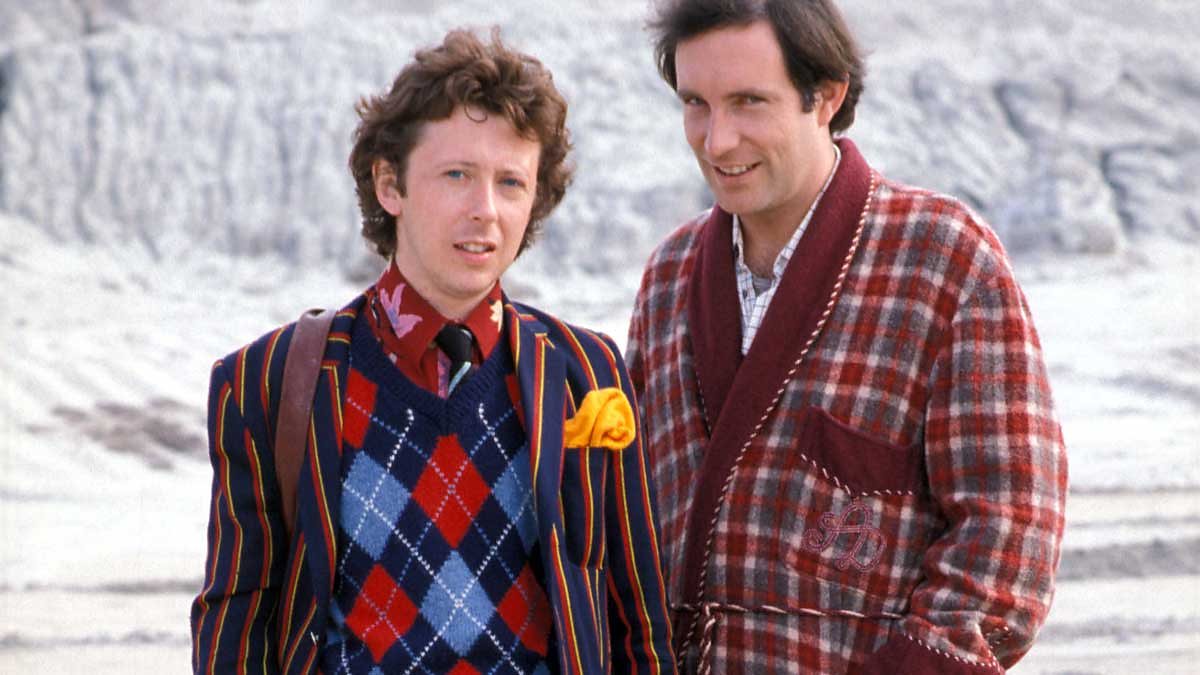
Douglas Adams is certainly one of the modern inheritors of the acerbic British comedy tradition as formed by the likes of The Goon Show and the Monty Pythons. There are all the familiar targets of British humour present in The Hitch Hikers Guide to the Galaxy – the inherent cruelty of a seemingly indifferent universe; the railing against the stupidity of pompous and petty-minded bureaucrats; the peculiarly British understatement in the face of adversity (Arthur Dent greets the imminent destruction of the Earth with “I think I’ll have a little lie down”, while wandering through the entire show outfitted in a dressing gown and searching for a cup of tea); and erudite Stage 101 Cosmology and Philosophy jokes about God disproving himself in a puff of logic and the debate over the question and answer to the meaning of life.
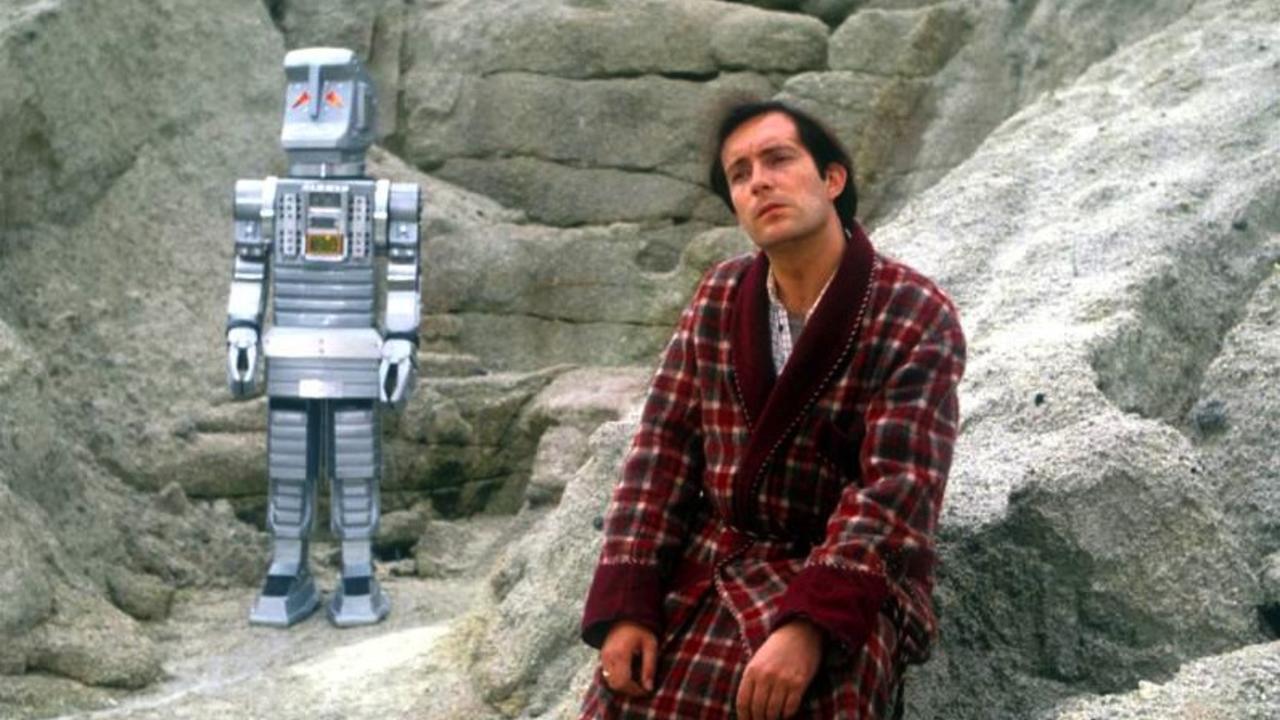
In science-fiction terms, this makes Douglas Adams an inheritor of the absurdist universes popularised by writers such as Harry Harrison, Robert Sheckley, John Sladek and in particular Kurt Vonnegut Jr. Adams has hysterical fun in applying the characteristic sense of British absurdism to the conventions of science-fiction – the Earth is destroyed (in the opening scenes) not out of a dire cataclysm but because bureaucrats have deemed it necessary to the building of a hyperspace bypass; in a parody of planets where all the inhabitants speak English, Adams comes up with the notion of the Babel Fish, which telepathically translates all dialogue into the hearer’s own language; in lieu of the usual hyperspatial drives of science-fiction, he comes up with the notion of The Infinite Improbability Drive, which charts a course through events of increasing impossibility; instead of robots struggling over what it means to be human, he gives us Marvin the Paranoid Android who comes with a Genuine People Personality that is terminally depressed.
The series is packed with numerous little jokes and asides that are positively side-splitting – the nonsensical throwaway scene with a bowl of petunias and the whale that struggles to understand the meaning of existence as it materialises over Magrathea; The Earth revealed to really have been a computer designed to calculate the meaning of Life, the Universe and Everything – or rather here the answer proves easy to calculate, but the real difficulty is in trying to find the question that goes with the answer, which nobody thought to ask; the encounter with the rock star who is spending a year dead for tax purposes; the idea that a planet has persuaded its most useless people to hop aboard a space ark and sent them to crash on another planet and the subsequent scenes on a prehistoric Earth where we then see people trying to market research the wheel and fire for optimal design; and the hysterically funny encounter in the restaurant with the intelligent Dish of the Day (played by no less than the fifth Doctor Who, Peter Davison), which offers up its rump and then cheerfully volunteers to go off and shoot itself.
Certainly, as Douglas Adams continued cynically milking the The Hitch Hikers Guide to the Galaxy phenomenon, his weaknesses only became more apparent – the non-sequitir jokes and self-consciousness of the narrative form became more obvious and his ideas felt more like first drafts that were in search of a good editor. Of the various The Hitch Hikers Guide to the Galaxy incarnations, what one could perhaps say is that (at least up until the film version), the tv series was probably the least effective of the mediums for it. Between the radio series, the books and the tv series, Douglas Adams endlessly rearranged the same gags and scenes in slightly different ways.
Clearly here, and elsewhere, linear narrative was never one of his strong points. The tv series often reads like a series of scenes that could be placed in fairly much random order. Case in point being the way the plot jumps everywhere during the latter half. The scene transitions are often exceedingly sketchy – an exploding computer on Magrathea somehow propels the heroes to the Restaurant at the End of the Universe; after creation has ended they exit the Restaurant in Hotblack Desiato’s ship to contrarily find the universe very much alive; and then teleport out of the ship onto the Golgafrinchan ark, where they have somehow also travelled back in time just as the ship lands on a pre-civilised Earth.
One of the big plus points about the series was the cutely rendered animated graphic excerpts from the Guide. These are clever and witty, although occasionally in being rendered visually rather than audially (in the radio series, the Guide functioned as a narrator), they seem overly literal – when an argument is called a load of dingo’s kidneys, the Guide then has to show an animated anatomical display of a dingo’s kidney; when it is mentioned how rude humans are that they never invite their ancestors to dinner, the cutaway then unnecessarily shows an ape at a dinner-party and so on. The director (who is not credited but is believed to be British tv director Alan J.W. Bell) is poor – scenes often descend into silly physical comedy and slapstick with characters running around in different directions in an hysteric panic.
With the exception of Simon Jones’s marvellous incarnation of a British twit, the cast all overdo their performances badly, particularly Mark Wing-Davey’s annoyingly strung-out hip version of Zaphod Beeblebrox and Sandra Dickinson offering up a bimbo interpretation of Trillian with an irritatingly high-pitched voice that tires about five minutes after we meet her. (With the exception of David Dixon and Sandra Dickinson, all of the rest of the cast were actors who had played the same roles in the radio series). In a trivia note, one can see Douglas Adams himself at the start of the second episode as the man who throws all his money away and walks naked into the sea.
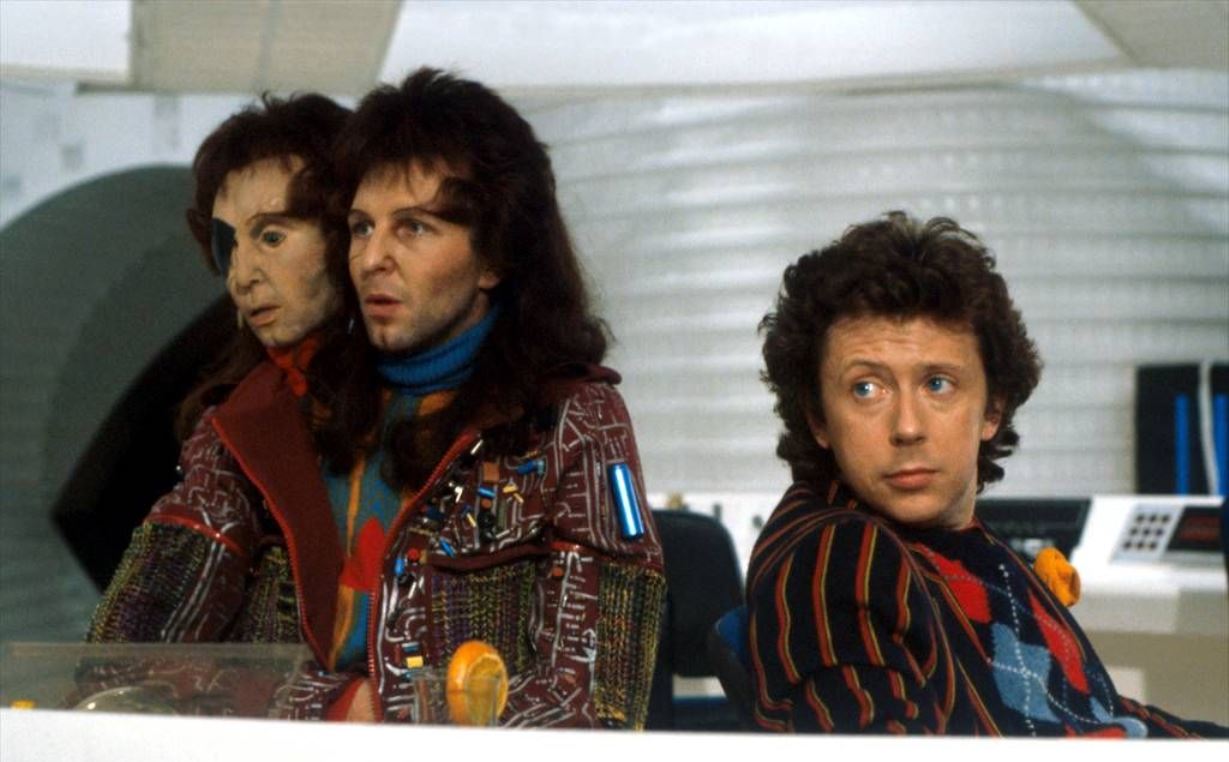
The sets and effects are routine – the costumes are cheap looking and have a 1980s science-fiction tackiness that is somewhat garish to look at today. Two of the tattiest aspects of the series are the clunky and unconvincing Marvin robot that stumbles along at a snail’s pace and, worst of all, Zaphod Beeblebrox’s second head, which just sits on Mark Wing-Davey’s shoulder with its mouth wide-open like a papier-mâché mould.
Fan trailer here