
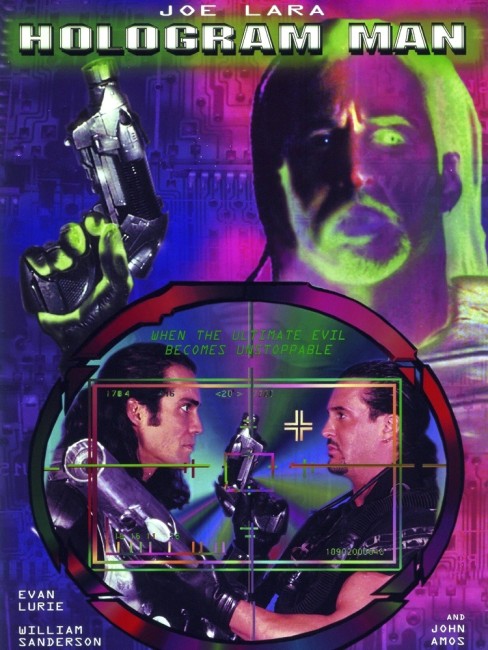
Crew
Director – Richard Pepin, Screenplay – Evan Lurie & Richard Preston Jr, Story – Evan Lurie, Producers – Richard Pepin & Joseph Mehri, Photography – Ken Blakey, Music – John Gonzalez, Visual Effects – AI Effects Inc (Supervisor – Frank H. Isaacs), Special Effects Supervisor – Larry Roberts, Makeup Effects – Adam Brandy, Makeup/Special Props – Makeup & Effects Lab Inc (Supervisors – Allan A. Apone & John R. Fifer), Production Design – Chris Anthony Miller. Production Company – PM Entertainment Group Inc
Cast
Joe Lara (Captain Decoda), Evan Lurie (Norman ‘Slash’ Gallagher), Arabella Holzbog (Dr Natalie Stern), William Sanderson (Manny O’Donnell), Nicholas Worth (One-Eye), Michael Nouri (Edward Jameson), John Amos (Captain Wes Strickland), Anneliza Scott (Andie Carradine), Derek McGrath (Secretary Culkin), Joseph Campanella (Dr Stern), Alex Cord (Governor Hampton), Tiny ‘Zeus’ Lister Jr (Eightball)
Plot
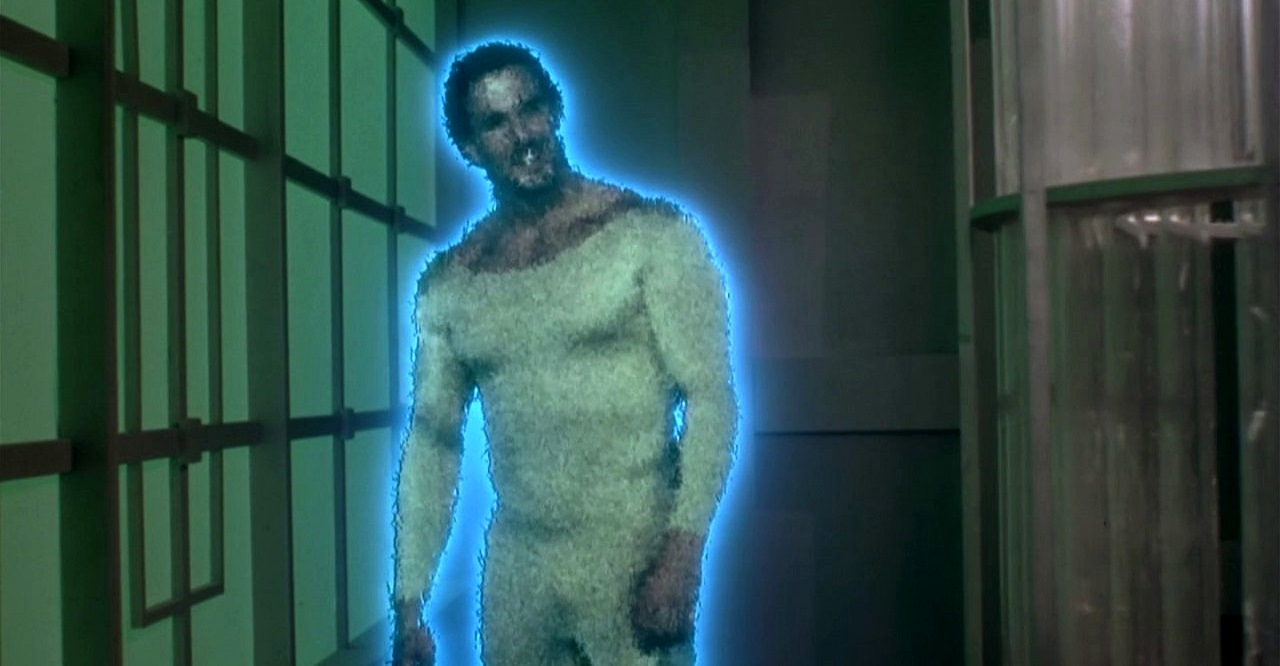
Terrorist Slash Gallagher is arrested and sentenced to imprisonment in holo-stasis, where his body is dematerialised and encoded as a hologram. At the parole hearing, his men hack in and allow Slash to escape in a hologram body. Invincible and untouchable, Slash now begins a new reign of crime.
Even if you did not know such from the credits, it is easy to spot Hologram Man as a film by Richard Pepin, the director who also made sf/action hybrids such as Cyber Tracker (1994), Dark Breed (1995), The Silencers (1996) and The Sender (1997). (See below for Richard Pepin’s other films). Hologram Man opens in the midst of a massive shootout between gangs and police that would in almost any other film be enough to serve as the climactic set-piece. This promptly cuts to a wholly gratuitous sex scene and then straight back to a massive car and bus chase-come-armed shootout and a game of Russian Roulette using hostages. Some fifteen minutes of screen time have passed before the film slows down and deigns to let us know what is going on. It is a typical opening for a Richard Pepin film, who conceives his sf/action hybrids as having to have a large-scale shootout, a car chase or an explosion at regular intervals without ever concerning himself overly much with any connecting rationale.
In the case of Hologram Man, this may well be a good thing as the film’s premise has a silliness that goes beyond absurdity. The idea of a futuristic penal system where criminals are translated into holograms is preposterous. The film is laughably ill-informed on what a hologram is. A hologram is no more than a three-dimensional slide projection but the film gives its holograms electrically-charged physicality and allows them to trade fisticuffs.
The film also cheats on the gimmick by getting it out of the way as quickly as possible, coming up with some nonsense about polymer skins, thus providing a convenient way to skimp on the effects sequences of people walking around as phantoms and allowing them to be played by actors again. Even buying its tenuous explanation of how the polymer skin is meant to work, a scene where the heroine spraypaints Joe Lara’s eyes on is laughable. Scriptwriter Evan Lurie also appears as the holographic villain of the show, something at which he displays about as much aptitude as he does at scripting, playing with a wooden macho stolidity that is terrible.
Hologram Man is mildly interesting in terms of its imagined social background – a future where the state of California is being run by a corporation. The corporation is clearly portrayed as a villain, cold-bloodedly shooting hostages and the like. Pitted against them is the holographic villain who, interestingly enough, is fighting for what would seem to be quite reasonable social freedoms. There is a distinct mixed signal as to which side the film seems to regard as right.
This is even further muddied by the ending where hero Joe Lara, having just despatched villain Evan Lurie, also blows up corporation CEO Michael Nouri in his car, saying that he and Lurie are “just two sides of the same coin.” The hypocritical absurdity of such is that if Lurie and Nouri are simply ‘two sides of the same coin’ for their employment of ruthless methods to obtain their objectives then Joe Lara’s hero can be no more than a third side to the coin, the film seeming to sanction the ultra-violent despatch of Michael Nouri on the sole assumption that he is the hero.
Richard Pepin’s other films of genre note are:– Cyber Tracker (1994), Firepower (1994), Cybertracker 2 (1995), Dark Breed (1995), T-Force (1995), The Silencers (1996), The Sender (1997), Y2K/Terminal Countdown (1999), Mindstorm (2001) and Caved In (2006). PM Entertainment has produced some 80 plus films, almost all being action films. Their other genre productions include Death By Dialogue (1988), Hollow Gate (1988), The Art of Dying (1991), Alien Intruder (1993), CIA: Code Name Alexa (1993), CIA II: Target Alexa (1994), The Power Within (1995), Steel Frontier (1995), Rage (1996) and Sutures (2009), as well as the children’s films Storybook (1995), Two Bits and Pepper (1995) and Little Bigfoot (1997).
(Winner in this site’s Worst Films of 1995 list).