
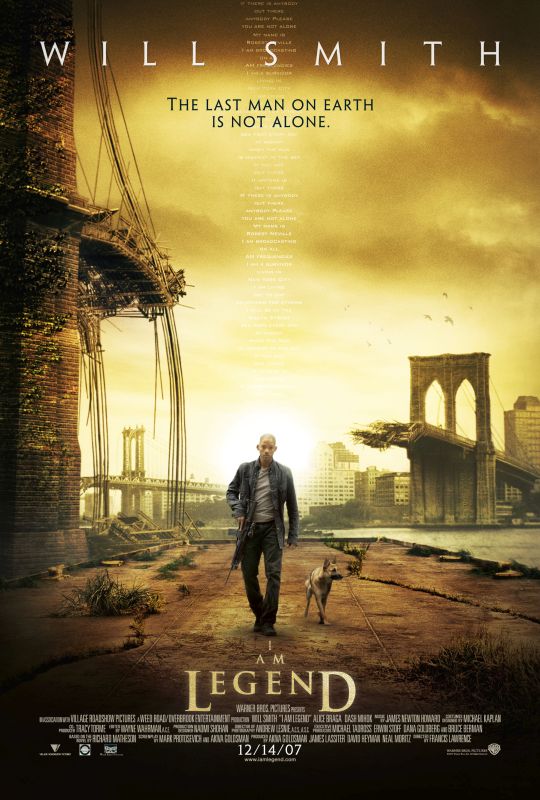
USA. 2007.
Crew
Director – Francis Lawrence, Screenplay – Akiva Goldsman & Mark Protosevich, Based on The Omega Man (1971) Written by John William Corrington & Joyce Hooper Corrington and the Novel I Am Legend (1954) by Richard Matheson, Producers – Akiva Goldsman, David Heyman, James Lassiter & Neal H. Moritz, Photography – Andrew Lesnie, Music – James Newton Howard, Visual Effects Supervisor – Janek Sirrs, Visual Effects – CIS-Hollywood (Supervisor – Gregory D. Liegey) & Sony Pictures Imageworks (Supervisor – Jim Berney), Creature Effects – Creature FX (Supervisors – Mark Rappaport & Shaun Smith) & Patrick Tatopoulos Designs (Supervisor – Patrick Tatopoulos), Miniature Effects – New Deal Studios, Special Effects Supervisor – Conrad W. Brink Jr, Production Design – Naomi Shohan. Production Company – Weed Road Pictures/Overbrook Entertainment.
Cast
Will Smith (Lieutenant-Colonel Robert Neville), Alice Braga (Anna), Salli Richardson (Zoe Neville), Willow Smith (Marley Neville), Charlie Tahan (Ethan), [uncredited] Emma Thompson (Dr Alice Krippen)
Plot
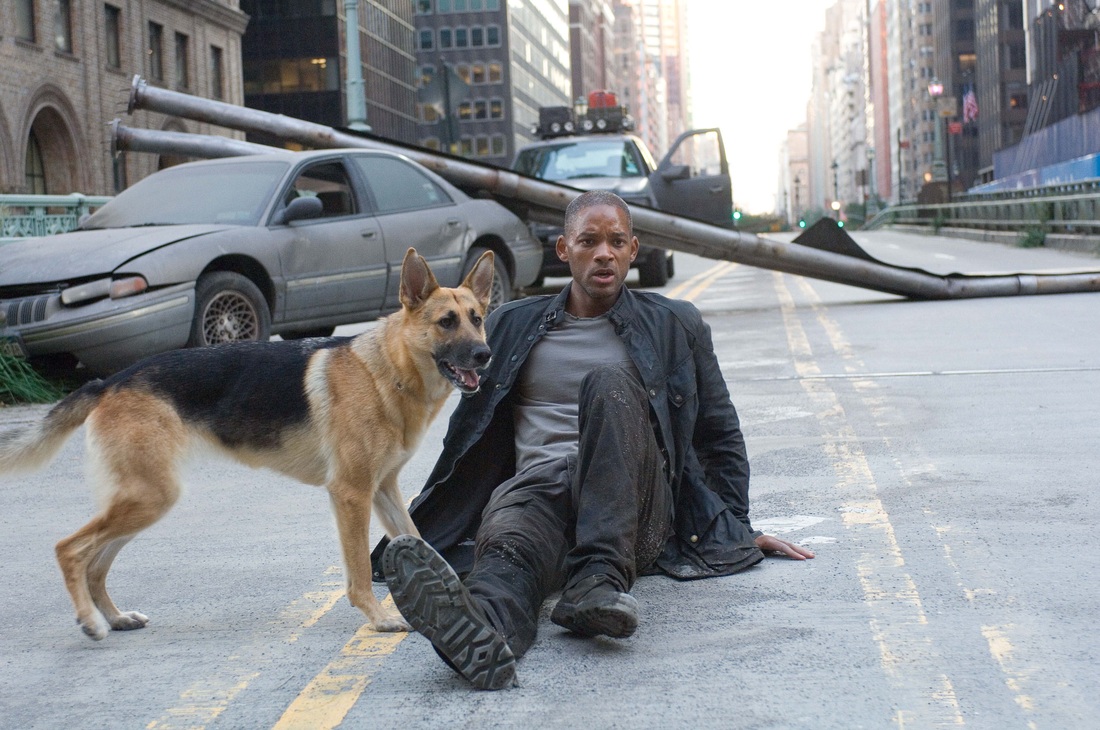
New York City in the year 2012. Robert Neville is the last man left alive in the world. A reengineered virus that was designed to eliminate cancer has instead killed the entire population. Neville has an immunity, due to his having taken an antidote. He wanders the ruins of Manhattan with his dog Sam, searching for other survivors. In the darkness, there hide creatures that are the remnants of survivors that have mutated into zombified creatures that shun sunlight.
Richard Matheson’s novel I Am Legend (1954) is a classic of both science-fiction and horror. In the novel, the central character is Robert Neville, the last man on Earth, who huddles in his home as the survivors who have been mutated into vampires gather outside each night, entreating him to come out to them. By day, Neville hunts out the vampires’ lairs and stakes them, while obsessively searching for an antidote and trying to work out the cause of his immunity. At the end of the story, he is captured and sentenced to be executed by the vampires. In so doing, he understands that he has become to them the same kind of legendary figure that the classic image of the vampire was to humans. The book’s last line is his realisation “I am legend.”
I Am Legend has been announced as a film production fairly much ever since it was published. In 1957, Hammer Films intended to shoot an adaptation entitled Night Creatures but this was abandoned after the British censorship board decided that the film as planned would have to be banned. This eventually went ahead as the Italian-American produced The Last Man on Earth (1964) starring Vincent Price. Richard Matheson co-wrote the screenplay but was dissatisfied with the results and substituted the name Logan Swanson on the credits. The Last Man on Earth suffers from a crippling dullness, although to its credit is the only of the film adaptations of I Am Legend that follows the novel, especially when it comes to retaining the idea of the last man on earth fighting vampires and the twist ending. Next came The Omega Man (1971) starring Charlton Heston, which replaced the vampires with albinoid mutants and pumped up the action element.
This third version was announced way back at the start of the 1990s and has remained in development limbo ever since then. Things began in earnest in 1997 with a screenplay by Mark Protosevich, the screenwriter who also wrote The Cell (2000), Poseidon (2006), Thor (2011) and Oldboy (2013). (Mark Protosevich’s original script is available online and would have made for a strong, intelligent and well worthwhile adaptation, even if it too changes the ending). The project was taken up by Ridley Scott, director of science-fiction classics like Alien (1979) and Blade Runner (1982), and mounted as a project for Arnold Schwarzenegger. (One of the interesting ideas in this version was that the first hour of the film would be without dialogue). This was dumped by Warner Brothers after the budget topped a then sizeable $108 million. (This was the point just before the wildly over-budgeted Titanic (1997) came out and seemed to be heading for almost certain financial disaster and studios were suddenly getting panicky about big budgets). Schwarzenegger retained an interest in the project with Tracy Tormé, of Fire in the Sky (1993) and Sliders (1995-2000), writing a version.
Rob Bowman, director of The X Files (1998) and Reign of Fire (2002), attempted to mount a scaled-down version with a reworking of Mark Protosevich’s script by John Logan, writer of The Time Machine (2002) and The Aviator (2004). There was a serious attempt to remount I Am Legend in 2002 under Michael Bay, the director of Armageddon (1998) and Transformers (2007), and starring Will Smith. This version ended up being canned by the studio after the release of the low-budget 28 Days Later (2002), which stole much of I Am Legend‘s thunder. However, Will Smith continued to push the project. One of the most fascinating names attached to the Will Smith version was Guillermo Del Toro, before the project went ahead with Francis Lawrence, previously the director of Constantine (2005).
One kept cringing through the various incarnations of I Am Legend – ie. Michael Bay, one of the worst directors in the world – and hoped somewhere in all of this that the various parties might give us a faithful adaptation of the story. One supposes that they should have given up hope upon seeing that the finished film version was based on the script that John William Corrington and Joyce Hooper Corrington wrote for The Omega Man, as well as the name of Akiva Goldsman who had been employed to work over Mark Protosevich’s script. Akiva Goldsman has laid a swathe of atrocities across the genre with his scripts for the likes of Batman Forever (1995), Batman & Robin (1997), Practical Magic (1998), the previous Will Smith science-fiction outing I, Robot (2004), The Da Vinci Code (2006), Angels & Demons (2009), Insurgent (2015), The Dark Tower (2017) and Rings (2017), as well as his having produced the Will Smith follow-up vehicle Hancock (2008), Jonah Hex (2010) and several films, Deep Blue Sea (1999) and Mindhunters (2004), for the perpetually dreadful Renny Harlin, plus the terrible tv mini-series adaptation of Arthur C. Clarke’s Childhood’s End (2015) and the remake of Firestarter (2022). (See below for Akiva Goldsman’s other films).
The great disappointment is that I Am Legend has been intended far more as a remake of The Omega Man than it ever has as an adaptation of Richard Matheson’s book. The various changes that The Omega Man made to the novel have been retained – the vampires being replaced by mutants that have an allergy to light; the Christian allegory at the end where Neville’s blood ends up saving the human race; Neville being a former military officer who comes up with an antidote to the plague and survives because he injects himself with it. In that the filmmakers have allowed the title to revert to that of Richard Matheson’s book (which was changed by all the previous film versions), they cannot be unaware of how much the book was botched by The Omega Man. However, to conduct a remake and prefer to keep all the changes that The Omega Man added, rather than go back to the original conception is such a depressingly ill-conceived idea it is difficult to contemplate.
Most disappointingly, I Am Legend has dumped the vampires and replaced them with all-purpose mutants that merely have an aversion to sunlight. One of the most potent images of the novel was the image of the last man on Earth locked in his home as the vampires gathered outside each night and invoked him to come out to them. Even The Omega Man kept that. However, that is missing here. In fact, it is some 30 minutes into the film before we even get any mutants. We watch Will Smith wandering through the ruins of New York City, get flashbacks to previous life and the cause of the plague, before suddenly realising the lack of any creatures outside his door begging him to come out. Indeed, the mutants fail to even find Will Smith’s home until the very end. The core of the book is its sense of one man defending himself against the world; the film has emasculated the essence of the book and now is only a story about a man hiding and hoping that the zombies don’t find where he lives. Indeed, Will Smith’s Neville is such an all-round nice guy that this version fails to even give us any scenes of him tracking down and eliminating the mutants.
Certainly, there are some elements from the book that were not in either of the other film versions – we see Will Smith obsessively engaged in a series of painstaking experiments to find a cure to the plague. Neville does get his dog companion, although this is not the emotionally haunting section of the book about a desolate Neville trying to do anything to find some company, but simply of Will Smith with his faithful companion going into action against the mutants. It becomes the old question of – if they brought up the rights to a book and threw most of it out, then why not just write their own original work? What we have, one suspects, is I Am Legend reimagined as a copy of 28 Days Later. (Which is ironic as George Romero was inspired by the Richard Matheson novel when he created the seminal zombie film Night of the Living Dead (1968), while in turn 28 Days Later was very much a copy of Romero’s zombie films).
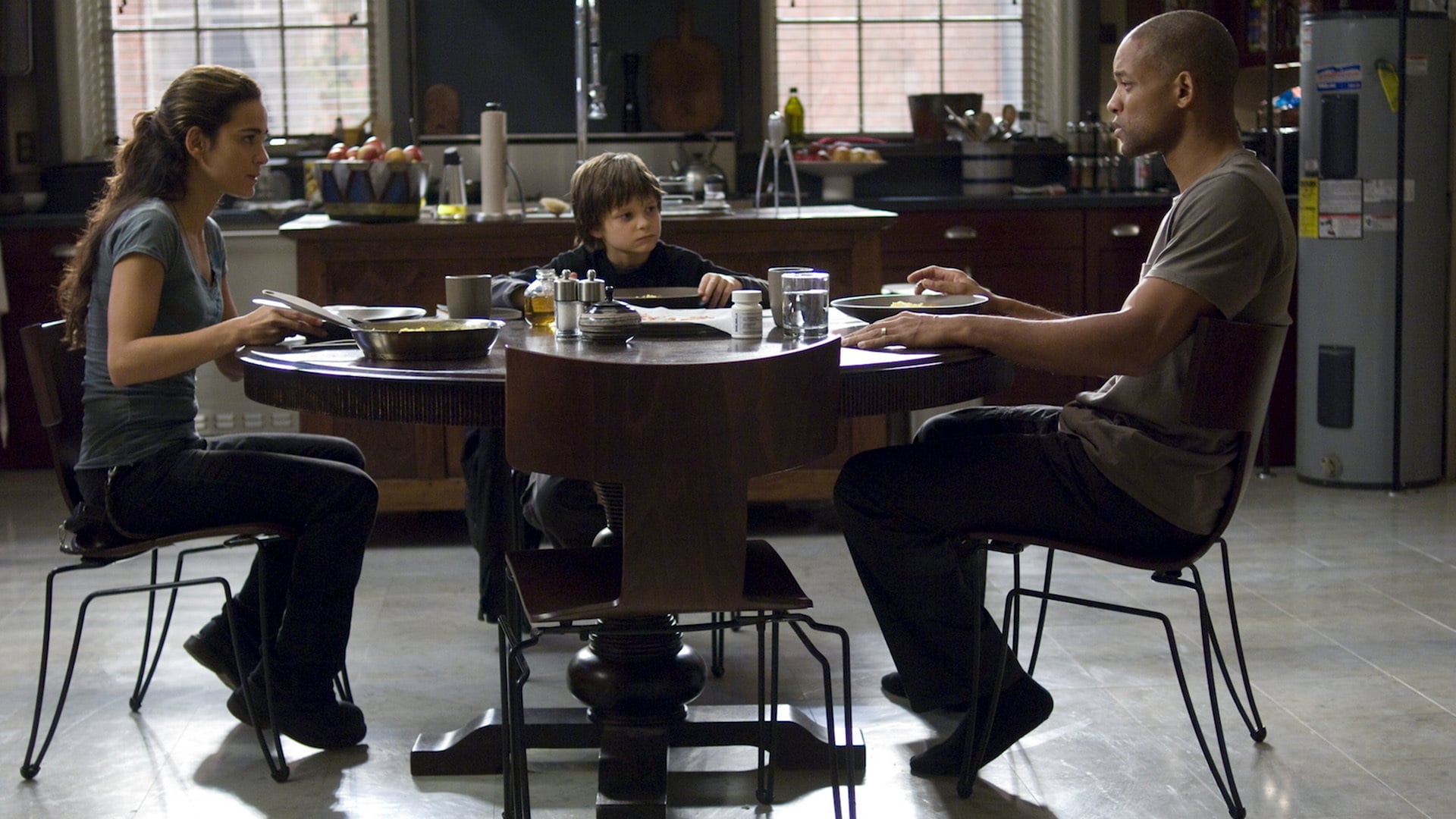
There are other sections of the film that contain pieces of writing that are just bizarre – like the attempt to use a section from Shrek (2001) with Shrek not wanting the donkey following him as a metaphor for Will Smith’s preferring his loneliness. The appearance of Alice Braga and Charlie Tahan is poor writing. One thought for a time that the film was following the book where Neville meets Ruth, a woman who appears to be a survivor but turns out to be a vampire that can survive in daylight who has been sent to seduce him. This turns out not to be the case and we get a series of not-at-all credible scenes where Alice Braga starts going on about God’s will and setting out on a quest to find survivors elsewhere (which seems entirely unbelievable in terms of the mass destruction that we have seen throughout).
The most bizarre part is the ending of the film. Richard Matheson’s ending has been thrown out. The dvds extras for the film reveal there was an alternate ending, a very soft version of the savage twist in the book, where one of the mutants comes to claim his love and Will Smith abruptly sees the error of his ways in seeing their humanity but apparently this was booed in test screestings. Now what we have is Will Smith sacrificing himself a la Charlton Heston in The Omega Man, allowing Alice Braga and Charlie Tahan to go on to find a colony where humanity has survived, taking his blood with them to provide an antidote for the rest of the survivors.
When the film ends with Alice Braga at the gates of the town and the people beyond in a perfect smalltown USA setting, it is something that seems as ludicrously false and forced an ending as it was in Damnation Alley (1977). It also makes the film into very much a post-9/11 version of I Am Legend. The action has been relocated to New York City, which is constantly referred to with loaded meaning as Ground Zero. The ending (perhaps unintentionally) becomes a perfect vision of post-9/11 bulwark America and its clinging to absurd family ideals by force – a fortress world where everything is guarded by a high, impenetrable wall and armed soldiers, while inside there is idyllic peace, an American flag flying and a church bell ringing.
One can also note that when the film explains the title ‘I Am Legend’ in the end voiceover narration, it completely reverses it from what it was meant in the book. In the book, what it meant was that Neville in his campaign to eliminate the vampires was now a legend to the new race of vampires in the same sense that Count Dracula was regarded as a mythic monster by humanity; here it is merely taken to mean that Neville is a legend in the heroic sense of having sacrificed his life to save humanity.
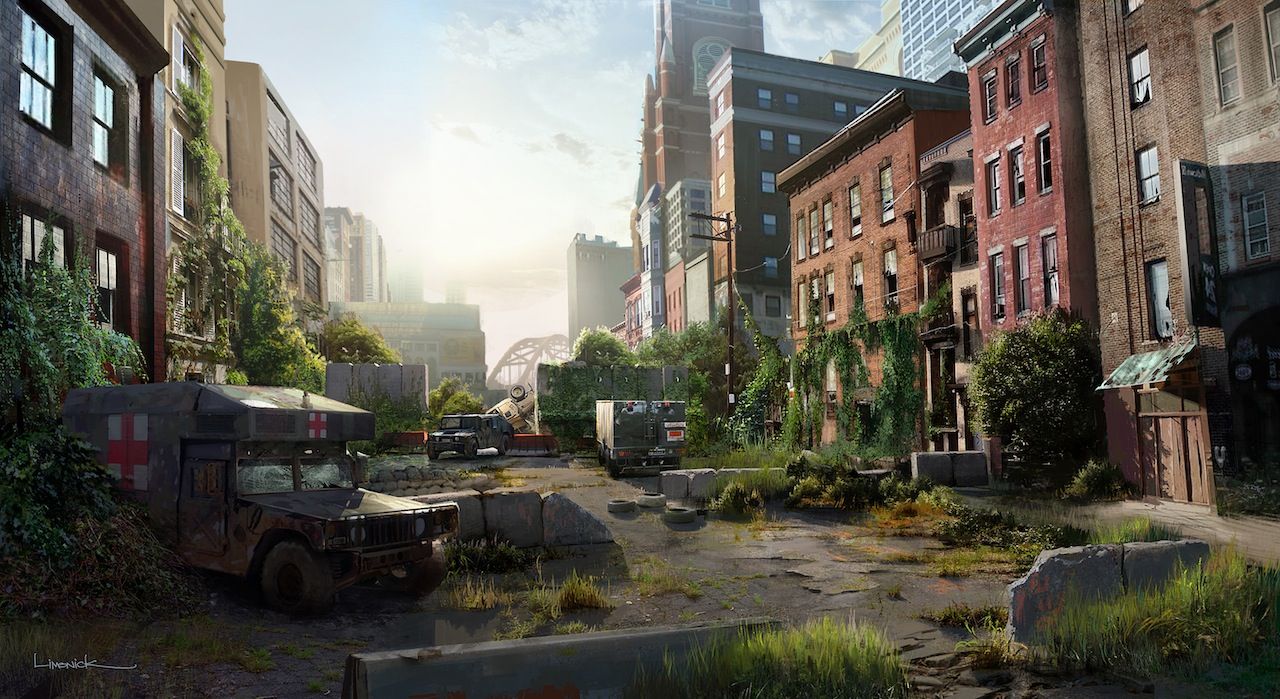
Francis Lawrence and the visual effects team take maximum opportunity to show us a devastated New York City with various landmarks lying in ruin or overgrown and lavishly staged flashbacks showing the military blowing up the Brooklyn Bridge, not to mention the glorious image of Will Smith shooting golf balls off the wing of a fighter plane on the deck of an abandoned aircraft carrier. It should be pointed out that much of this spectacle is not present in the book – Richard Matheson keeps the hero cooped up indoors and spends very little time describing the scenery of devastation (which was set in L.A. as opposed to New York). Nevertheless, Francis Lawrence’s depiction of the ruin of civilisation is imaginatively staged. Particularly captivatingly is the opening scene that Lawrence abruptly throws us into the midst of with Will Smith hunting deer with a rifle in a sports car through the streets and into Central Park, before his target is pounced on by lions – something that holds a fine sense of turning everything familiar on its head.
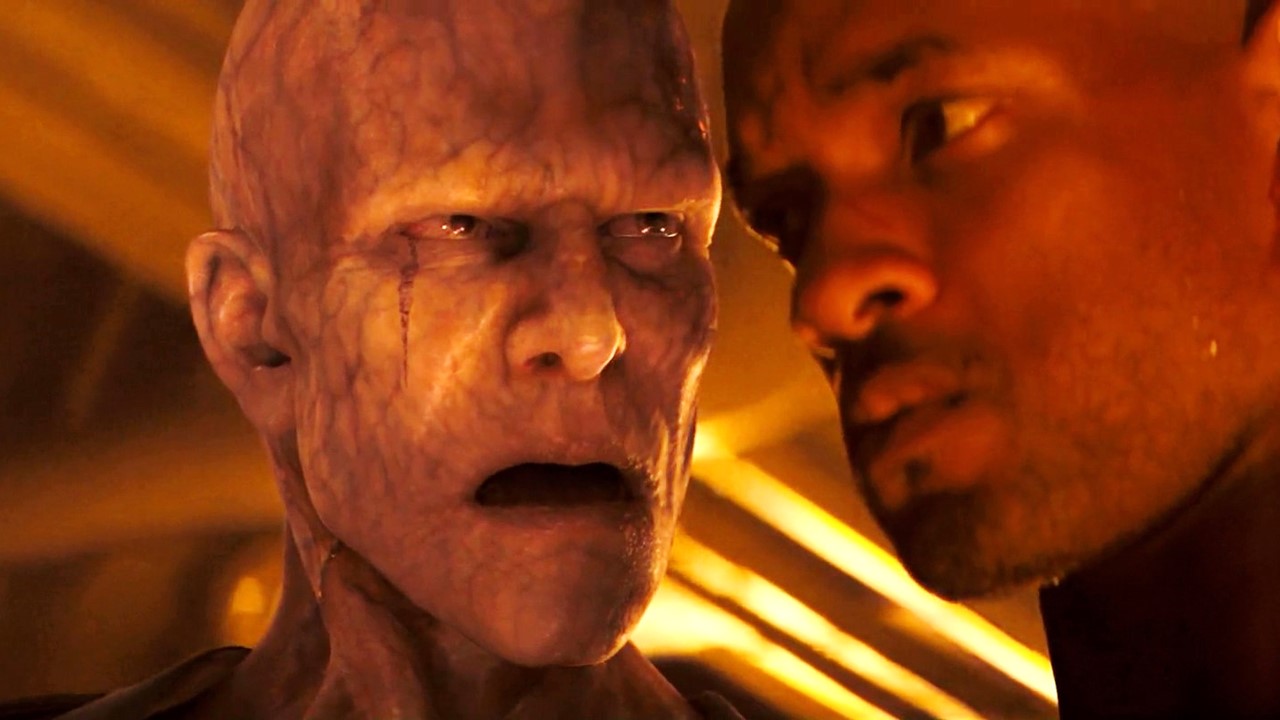
I was not a huge fan of Francis Lawrence’s debut film Constantine, which likewise demonstrated an attitude towards its source material that basically threw everything up into the air and then decided to do something completely different. There seems a constant arrogance that runs through Lawrence’s work that he knows better than the writers of the original works – in both cases, the results emerge as disastrously ill-conceived the moment you compare them to their originals. Lawrence also seemed to lack the visual style to give Constantine what it needed to work. The good news is that I Am Legend works far better directorially than Constantine did. Lawrence seems at home with the environment of big-budget special effects. More so than that, he creates a number of sequences of taut suspense – Will Smith’s venture into the underground lair to rescue the dog, the scene where he is trapped upside down in a noose as sunset comes and the mutants start to advance. Lawrence also does a fair job of depicting Will Smith’s loneliness – especially his grief during the dog’s death – although these scenes are still not a patch on the despair and madness of Bruno Lawrence in The Quiet Earth (1985).
I Am Legend was a reasonable box-office success and Will Smith has signed up to play in a prequel, although in 2014 it was announced this would not be happening. I Am Omega (2007) was a cheap copy from The Asylum.
Francis Lawrence subsequently went onto make the non-genre Water for Elephants (2011) and next took over The Hunger Games franchise with The Hunger Games: Catching Fire (2013), The Hunger Games: Mockingjay Part 1 (2014) and The Hunger Games: Mockingjay Part 2 (2015), followed by Red Sparrow (2018), the comic-strip adaptation Slumberland (2022), a return to the Hunger Games franchise with The Hunger Games: The Ballad of Songbirds & Snakes (2023) and the Stephen King adaptation The Long Walk (2025). He has also produced the alternate world political drama tv series Kings (2009) and the tv series Touch (2012-3) about a father whose son can predict the future.
Akiva Goldsman is a screenwriter who has been responsible for a great many bad genre films. Goldsman has also written the scripts for the Joel Schumacher Batman films Batman Forever (1995) and Batman & Robin (1997), the big-screen remake of tv’s Lost in Space (1998), the witchcraft comedy Practical Magic (1998), the Oscar-winning A Beautiful Mind (2001), I, Robot (2004), The Da Vinci Code (2006), Angels & Demons (2009), Insurgent (2015), The 5th Wave (2016), The Dark Tower (2017), Rings (2017) and Transformers: The Last Knight (2017). He made his directorial debut with the fantasy Winter’s Tale (2014), followed by the horror film Stephanie (2017). Goldsman has also produced Renny Harlin’s two genre outings the monster movie Deep Blue Sea (1999) and the serial killer thriller Mindhunters (2004), as well as the comic-book adaptation Constantine (2005), the paranormal investigators tv series Fringe (2008-13), the superhero film Hancock (2008), the supernatural Western comic-book adaptation Jonah Hex (2010), Paranormal Activity 2 (2010), Paranormal Activity 3 (2011), Paranormal Activity 4 (2012), the tv mini-series adaptation of Arthur C. Clarke’s Childhood’s End (2015), Guy Ritchie’s King Arthur: Legend of the Sword (2017), Doctor Sleep (2019), The Map of Tiny Perfect Things (2021), Firestarter (2022), Meet Cute (2022) and the tv series’ Star Trek: Discovery (2017-24), Titans (2018-23), Star Trek: Picard (2020-3) and Star Trek: Strange New Worlds (2022- ).
Richard Matheson’s other genre works include The Incredible Shrinking Man (1957) based on his novel, the scripts for Roger Corman’s Edgar Allan Poe adaptations The House of Usher/The Fall of the House of Usher (1960), Pit and the Pendulum (1961), Tales of Terror (1962) and The Raven (1963), the Jules Verne adaptation Master of the World (1961), the occult film Night of the Eagle/Burn, Witch, Burn (1961), the Corman-produced mortician’s comedy The Comedy of Terrors (1963), The Last Man on Earth (1964) based on I Am Legend, the Hammer psycho-thriller The Fanatic/Die, Die, My Darling (1965), the classic Hammer occult film The Devil Rides Out/The Devil’s Bride (1968), the historical biopic De Sade (1969), Steven Spielberg’s first film Duel (1971), The Night Stalker (1972) and The Night Strangler (1973) tv movies, the haunted house film The Legend of Hell House (1973), the tv adaptation of Dracula (1974), the tv movies Scream of the Wolf (1974), The Stranger Within (1974), Trilogy of Terror (1975), Dead of Night (1977) and The Strange Possession of Mrs. Oliver (1977), the tv adaptation of Ray Bradbury’s The Martian Chronicles (1980), the time travel romance Somewhere in Time (1980) from his own novel, Jaws 3-D (1983), Twilight Zone – The Movie (1983), and numerous classic episodes of The Twilight Zone, Thriller and Star Trek. Works based on his novels and stories are The Omega Man (1971) from his I Am Legend, the afterlife fantasy What Dreams May Come (1998), the fine ghost story Stir of Echoes (1999), The Box (2009) and Real Steel (2011).
Trailer here