

Crew
Director – Jack Smight, Screenplay – Howard B. Kreitsek, Based on the Short Stories The Veldt, The Long Rains and The Last Night of the World from the Short Story Collection by Ray Bradbury, Producers – Howard B. Kreitsek & Ted Mann, Photography – Philip Lathrop, Music – Jerry Goldsmith, Special Effects – Ralph Webb, Makeup – Fred Blau, Tattoos – James E. Reynolds, Production Design – Richard Sylbert. Production Company – Warners/SKM Productions.
Cast
Rod Steiger (Carl), Robert Drivas (Willie), Claire Bloom (Felicia), Tim Weldon (John), Christie Matchet (Anna)
Plot
During The Depression, a drifter Willie hitchhikes across country. As he settles down for the night in the open, Willie comes across Carl, a strange and brooding man who wears an overcoat and gloves despite the heat. The man opens his coat to reveal that he has tattoos, or ‘skin illustrations’ as he prefers to call them, from head to foot. While Carl sleeps, Willie sits and watches the illustrations as they come to life to tell stories. The Veldt:– Two parents buy a nursery that simulates different environments for their children to play in. They become concerned when the children demonstrate a preference for an African veldt scene and then start feeding the lions, even though there are no lions in the program. The Long Rains:– Four astronauts trek across Venus from the site of their crashlanding to a survival shelter. However, tensions within the party and the maddening effect of Venus’s ceaseless rain endanger the journey. The Last Night of the World:– Everybody has a dream that the world is going to end that night. It is decided that all the children will be given suicide pills to prevent them suffering. One couple give the pills to their children, but elect not to take them themselves.
The works of science-fiction writer Ray Bradbury (1920-2012) have never fared very well on screen. Part of the problem is Bradbury’s writing itself. Screen science-fiction is often construed as being planets, robots and spaceships and little more than adventure stories. Ray Bradbury’s work swims in poetic allegory and densely laden imagery that doesn’t quite fit into what most people construe science-fiction to be. Ray Bradbury is the science-fiction equivalent of Walt Whitman – he pines for a forgotten smalltown American childhood summer and a time before progress and technology made the world a less complicated place. Even a hard dystopian work of Bradbury’s like Fahrenheit 451 (1953) seems less an ideological polemic than one that that nostalgically mourns a loss of the literary imagination.
There have been occasions where Bradbury has worked on screen well, usually when he pens the piece himself – the film adaptation of Something Wicked This Way Comes (1983), the tv series The Ray Bradbury Theater (1986-92) – and those where he has definitely ended up badly mangled – such as the tv mini-series The Martian Chronicles (1980) and A Sound of Thunder (2005). (See below for a full list of Ray Bradbury’s genre adapted works).
The short story is a form where Ray Bradbury tends to work best rather than at novel length. The Illustrated Man is a film that adapts several of the short stories from Ray Bradbury’s 1951 short story collection of the same title. However, the film is a disappointment. While its ambitions are in the right place, the film attaches itself to Bradbury with a singularly pedestrian regard.

With the first episode The Veldt the filmmakers do the near impossible – they take a foolproof story and screw it up. The premise of the story is deadeningly simple – parents get virtual playroom for the kids, kids become obsessed with the African scenario and in a twist ending the parents fatally find out that the lions are real. The twist is something that should come with either a piquant drollness or else as a sinister surprise but the episode here gives the twist away from the start.
The adaptation is clod-fisted and the piece moves toward the ending devoid of suspense or build-up. The episode is padded out with dull lectures where characters stand about and tell each other what future life is like – and considering that this is a standard issue antiseptic white vacuform plastic future, this proves dreary. The episode does feature what must be the very first screen appearance of the concept of Virtual Reality, even before such a term was ever coined.
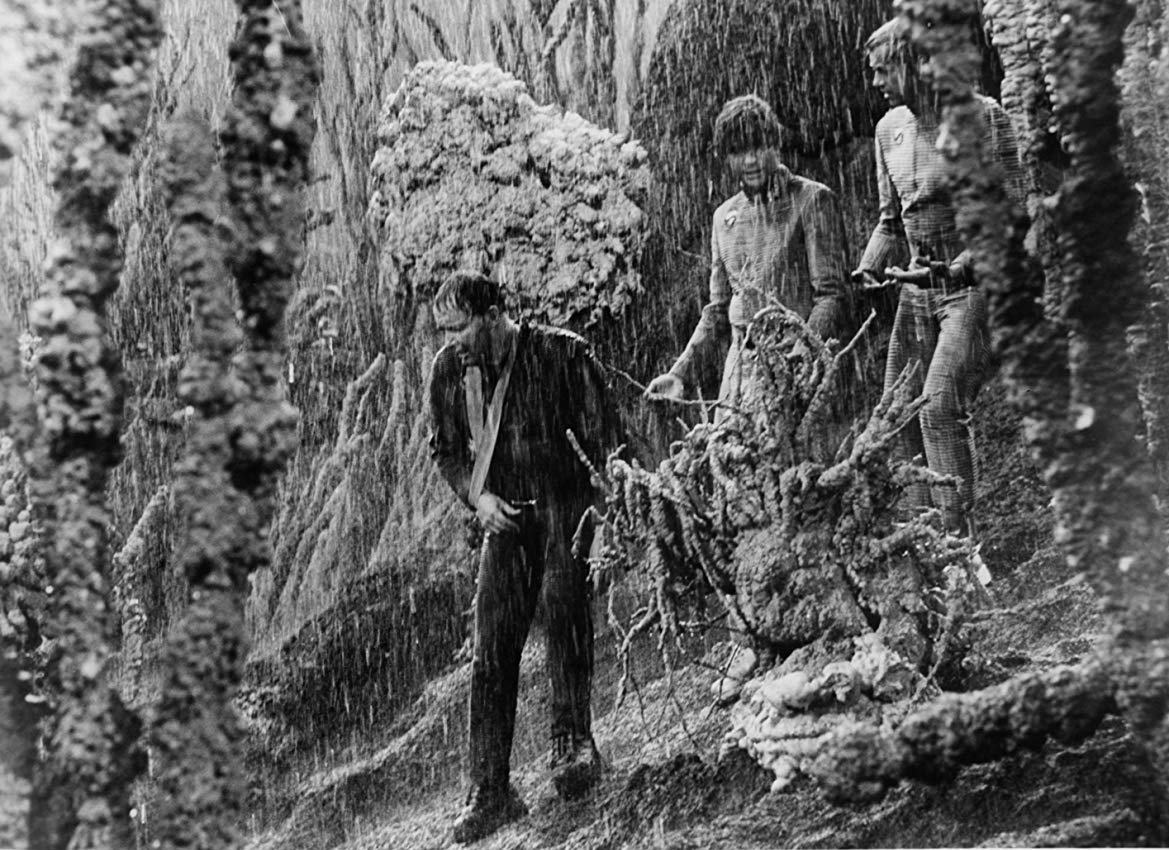
The Long Rains, the second story, is the best episode mainly by default. Venus looks unworldly, all twisted roots and rocks and photographed in monochrome grey. The monotonous downpour of rain on the soundtrack wears on one’s nerves – in this regard, the episode does an effective job of portraying the fraying effect the rain has on the astronauts’ sanity.
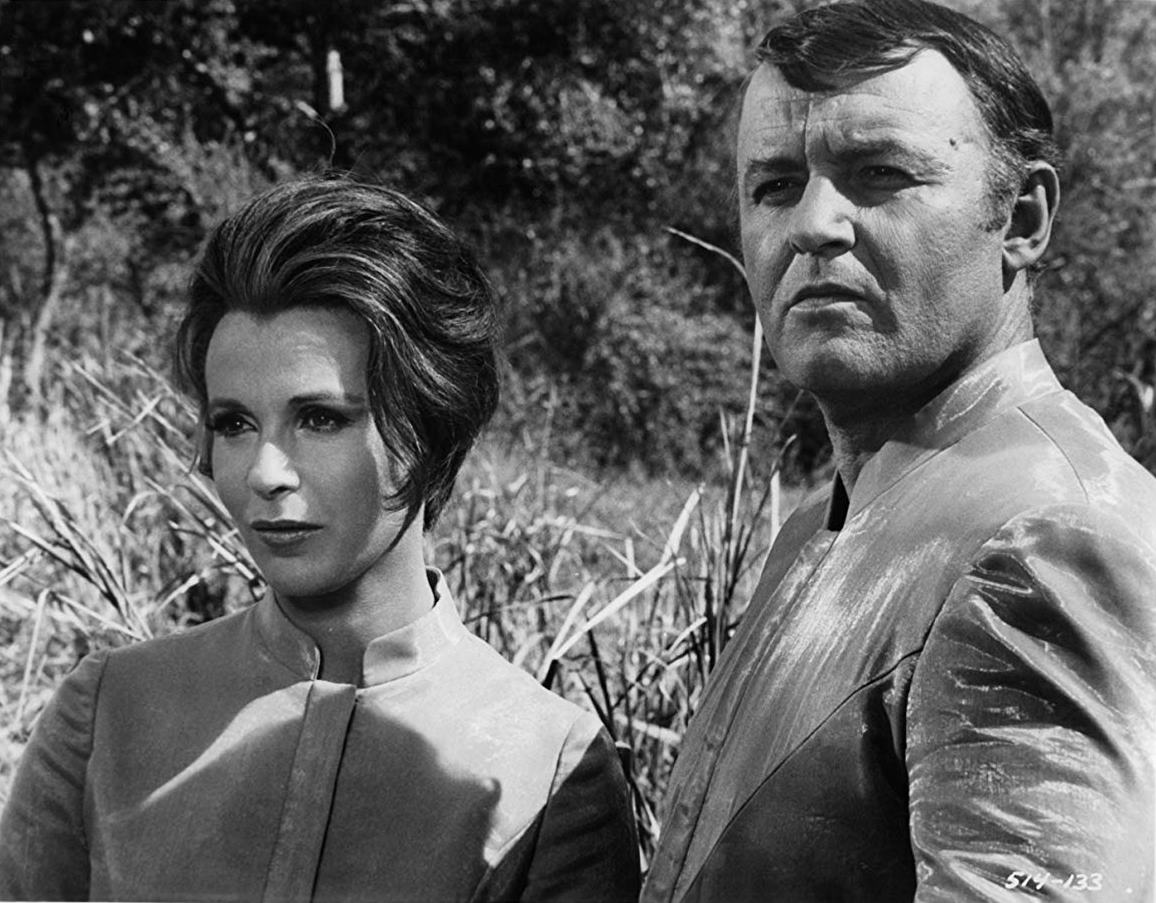
The story is only flawed by having to work Claire Bloom in at the end (all the characters in each story are played by the same actors) – What is she doing there in the survival shelter? Is she from another expedition? A prostitute? If the latter, as seems to be the case, it seems difficult to conceive why someone would stay on such an inhospitable world beset by so few expeditions purely for the astronauts’ pleasure.
The third episode, The Last Night of the World, is so slight it seems forgotten by the time the film is over. The pastorality of it is incredibly bland – people live in a tent, herd animals graze outside and everyone wears flowing silks and Grecian-styled costumery. Amid this, the sight of Rod Steiger prancing about in boxer shorts looks faintly ridiculous. You also wonder why doesn’t Robert Drivas appear – if The Long Rains was altered out of shape to include Claire Bloom then why couldn’t he have been wound in here as a neighbour come to discuss the situation or some such? That said, the story’s fault is more Ray Bradbury’s than the film’s – it was a very slight idea on the page and probably an ill choice for an adaptation.
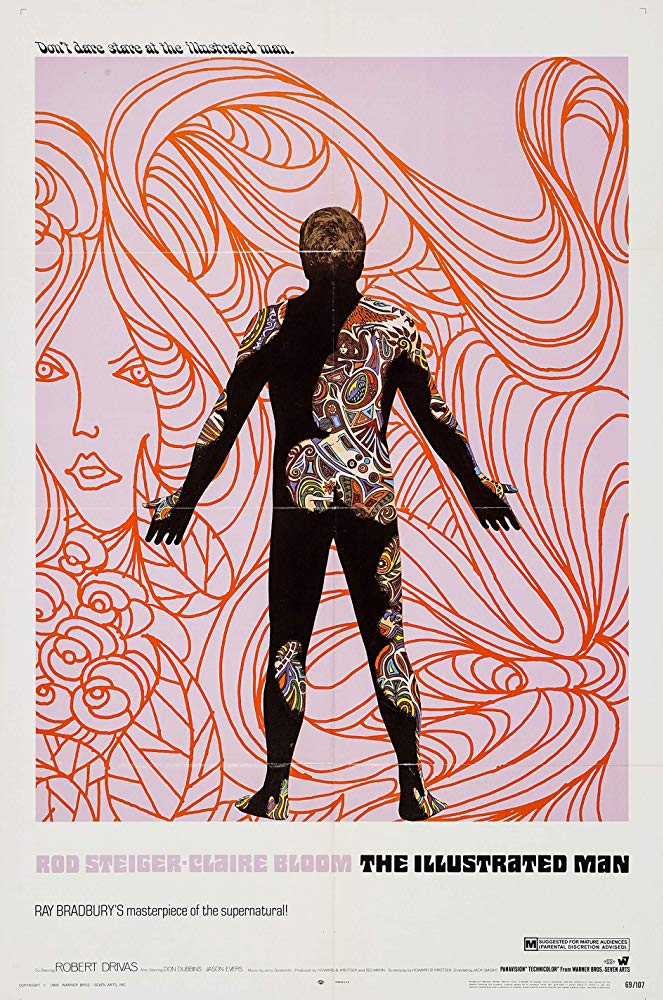
The most interesting part of the film is actually the linking story. The dialogue is good and Rod Steiger gives a gruff, brooding performance in the title role. In fact, the film gives the linking idea much more substance than Ray Bradbury did on the page. The idea of the illustrated man was a slim concept in the book – the framing device takes up less than two pages – and it has been considerably embellished here. The illustrations, which required something like an eight-hour makeup job for Rod Steiger, are beautifully stylized. In the end though, The Illustrated Man is a failure – in adapting the stories the poetic essence of Ray Bradbury is missing and all the filmmakers have added is a lumbering heavy-handedness.
Other Ray Bradbury screen adaptations are:– The Beast from 20,000 Fathoms (1953) from his short story The Foghorn; the alien invader classic It Came from Outer Space (1953) from his original screenplay; Francois Truffaut’s adaptation of Fahrenheit 451 (1966); the dreary tv mini-series The Martian Chronicles (1980) from his classic book; the tv movie The Electric Grandmother (1980); the screenplay for the fine Something Wicked This Way Comes (1983) from his own novel; his screenplay for the animated adaptation of the classic comic-strip Little Nemo: Adventures in Slumberland (1989); the tv anthology series The Ray Bradbury Theater (1986-92) where he adapted his own stories and hosted the series; the screenplay for the animated children’s film The Halloween Tree (1993); Stuart Gordon’s adaptation of The Wonderful Ice Cream Suit (1998) about a seemingly magical suit; A Sound of Thunder (2005) based on Bradbury’s classic time travel story; Chrysalis (2008) where a man mutates into another lifeform; and the tv movie remake of Fahrenheit 451 (2018) based on a Bradbury short story.
The Veldt later became the framing device around which another Ray Bradbury anthology, the Russian-made The Veldt (1987), was set. The Veldt and The Long Rains later received superior adaptations as episodes of The Ray Bradbury Theater. A potential remake of The Illustrated Man has been announced in the 2000s by Zack Snyder.
Jack Smight also directed the serial killer black comedy No Way to Treat a Lady (1968), the worthwhile Frankenstein adaptation Frankenstein: The True Story (1974) and the post-holocaust film Damnation Alley (1977). Jack Smight is probably otherwise best known for the Paul Newman thriller Harper (1966) and big-budget films of the 1970s such as Airport 1975 (1974) and Midway (1977).
Trailer here
Clip from the film here:-