
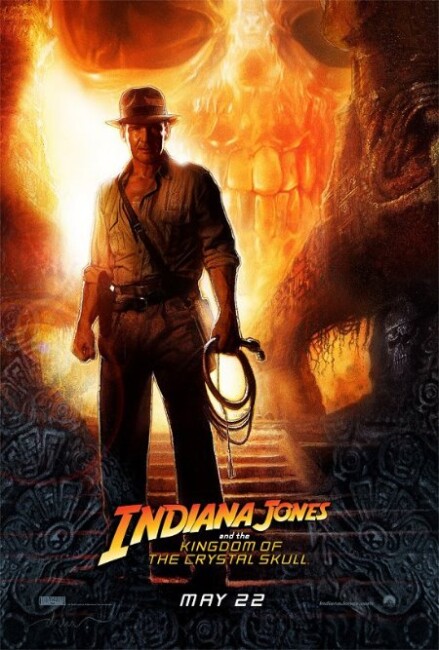
USA. 2008.
Crew
Director – Steven Spielberg, Screenplay – David Koepp, Story – George Lucas & Jeff Nathanson, Producers – Frank Marshall, Photography – Janusz Kaminski, Music – John Williams, Visual Effects Supervisor – Pablo Helman, Visual Effects – Industrial Light and Magic, Special Effects Supervisor – Dan Sudick, Production Design – Guy Hendrix Dyas. Production Company – Lucasfilm/Paramount.
Cast
Harrison Ford (Indiana Jones), Shia LaBeouf (Mutt Williams), Cate Blanchett (Colonel Doctor Irina Spalko), Karen Allen (Marion Ravenwood), Ray Winstone (George ‘Mac’ McHale), John Hurt (Professor Harold Oxley), Igor Jijinke (Colonel Dovchenko), Jim Broadbent (Dean Charles Stanford), Alan Dale (General Ross)
Plot
It is 1957. Colonel Irina Spalko, an expert from the Soviet psychic research department, leads a troupe of Russian soldiers as they shoot their way into Area 51 with Indiana Jones a prisoner in order to steal a crate containing an artifact that was found at Roswell in 1947. In making an escape, Indiana is caught in the midst of a detonation at an A-bomb test site but survives by hiding inside a lead-lined refrigerator. Accused by the FBI of abetting the Russian raid, Indiana is forced to take a sabbatical from his teaching position. He is approached by young Mutt Williams who asks help in saving Indiana’s old friend Professor Harold Oxley. Indiana decodes a letter from Oxley that leads the way to El Dorado, the legendary city of gold and the kingdom of the crystal skill, which Oxley was obsessed with finding. The trail takes Indiana and Mutt to Peru, pursued by Colonel Spalko and Russian soldiers. There Indiana is reunited with his old love Marion Ravenwood and surprised to find that Mutt is his son. The quest takes them into an Inca tomb and to the discovery of artifacts left by alien beings.
George Lucas is without a doubt one of the most influential figures in modern fantastic cinema. This is the man who made Star Wars (1977) after all. The sad truth when one examines George Lucas’s career more closely is that it is only founded around a couple of films that were true successes – Star Wars and Raiders of the Lost Ark (1981). Everything else that Lucas has produced has either been a financial flop – Howard the Duck (1986), Willow (1988), Radioland Murders (1994), Red Tails (2012) and Strange Magic (2015) – or has involved marketing the Star Wars and Indiana Jones films through an industry of sequels, prequels, tv spinoffs, not to mention toy, book and video-gaming tie-ins. The last time that Lucasfilm produced an original film was the disastrous flop of Radioland Murders back in 1994 and before that Francis Ford Coppola’s quite reasonable Tucker: The Man and His Dream (1988). By contrast, during the same period, Indiana Jones co-creator Steven Spielberg’s Amblin production company spearheaded a string of box-office hits, including Gremlins (1984), Back to the Future (1985) and Who Framed Roger Rabbit? (1988) to name a handful.
Raiders of the Lost Ark was inspired by Steven Spielberg and George Lucas’s mutual love of serial adventures of the 1930s and 40s. It brought back a sense of old-fashioned adventure and was the top grossing film of its year. This led to two successful sequels with Indiana Jones and the Temple of Doom (1984) and Indiana Jones and the Last Crusade (1989). Lucas, sans Spielberg, later followed these up with a tv series The Young Indiana Jones Chronicles (1992-3) where the role was played by three actors representing Indiana as a child, a teenager and as an old man. Although, in the tv series the adventure aspect of the films had given way to what was little more than a series of illustrated history lectures with Indiana improbably encountering various notable historical personages during his travels every week.
Though both the Star Wars and Indiana Jones series hit their mutual peaks with an original trilogy during the 1980s, they enjoyed an enormous fan afterlife. It was this fan interest that eventually mandated that further entries would be made. However, it would be an inordinate length of time before George Lucas returned to either series – long enough for the original fans to have given way to a new generation. It took Lucas 16 years to return to the Star Wars series with the universally underwhelming Star Wars Episode I: The Phantom Menace (1999) and sequels. This fourth Indiana Jones entry took nineteen years. Every second year between 1989 and 2008, Indiana Jones 4 was announced either as an on or off project. Scripts were commissioned from everybody from Jeffrey Boam, Frank Darabont, Tom Stoppard and purportedly M. Night Shyamalan (!) but were rejected by George Lucas before Harrison Ford put the rush on the operation by saying that if they could not get the production moving before 2008 then he would be too old and they should consider dropping it. Subsequently however, Ford returned for Indiana Jones and the Dial of Destiny (2023), although this was made without Spielberg directing.
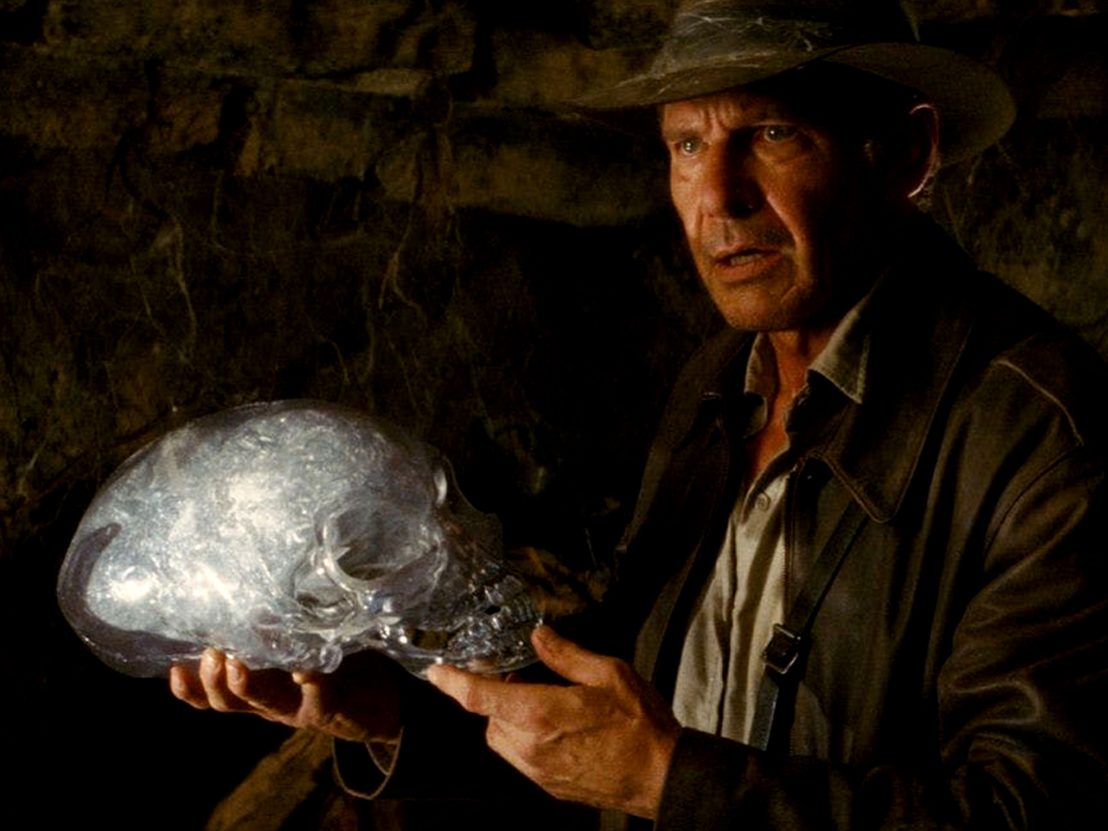
With The Kingdom of the Crystal Skull, Indiana Jones joins a host of other 1980s heroes who have been treading the comeback trail in recent years – Arnold Schwarzenegger in Terminator 3: Rise of the Machines (2003), Sylvester Stallone in both Rocky Balboa (2006) and Rambo (2008), Bruce Willis reviving John McClane in Live Free or Die Hard (2007) and A Good Day to Die Hard (2013), Men in Black 3 (2012), as well as reboots of other franchises like the Batman, James Bond, Superman and Ghostbusters. What is noticeable as Harrison Ford picks up the bullwhip and puts the fedora back on for Kingdom of the Crystal Skull is that he is now 65 years old. Ford is always an actor who has managed to look a lot younger than he is – in Star Wars, he played a part written for someone in his early 20s at the age of 35 – but even here he cannot help but come across as at least someone in his fifties.
Lucas, Spielberg and screenwriter David Koepp have at least not pretended that Harrison Ford’s age isn’t a factor and have updated the series from the 1930s to 1957 consummate with the period of time that has passed in the real world. However, the 1950s does seem a jarring setting for Indiana Jones to be operating in. Spielberg invokes the iconic imagery of the era far more so than he did with the 1930s in the original trilogy – A-bomb tests, a rock’n’roll soundtrack, greasers and bobbysockers, even Shia LaBeouf fitted out to resemble Marlon Brando in The Wild One (1951) during his first appearance.
The 1950s is also an era that seems a good deal less innocent than the 1930s. In the 1930s, heroes were solid jawed, of black and white morality and the edges of the known world still contained unexplored exotic realms that were ripe for adventure. By contrast, the 1950s was the era that stood in the shadow of the A-bomb and the fear of Communism. The adventure thrills that the Indiana Jones series is based on do not sit easily amid the Cold War and McCarthyist paranoia about Reds Under the Bed – the two eras operate on a completely different set of moral values. Thus Indiana gets retconned so that he has a history as a war hero who fought against the Red Menace and then, in one twist that bends the character out of shape, falls under suspicion of the FBI, thus raising the spectre of the McCarthyist witch-hunts.
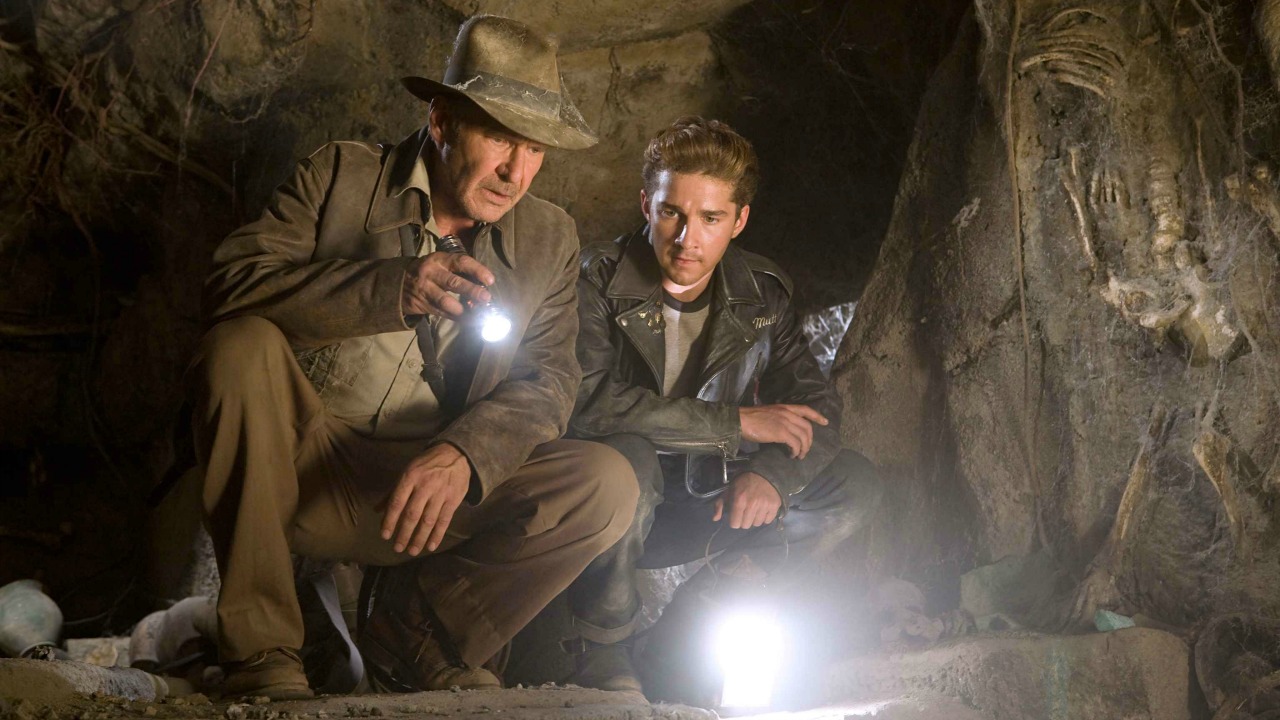
More than anything, Indiana Jones and the Kingdom of the Crystal Skull is a film about getting old. Harrison Ford gives the impression of being like an aging prize fighter who puts the gloves back on and gets into the ring with a younger opponent to still show that he has the same mojo he did in the old days but can be seen wheezing in between rounds. Shia LaBeouf has been written in for no other reason it seems than that they needed someone younger to be doing the stunts alongside Harrison Ford and not make it so obvious that he was aging. While the original films had a sense of wild adventure, what informs Indiana Jones and the Kingdom of the Crystal Skull is a sense of the glory days of one’s life having passed – Jim Broadbent has a line to the effect that as one gets older life is less about opportunities than it is about things that one misses, while Harrison Ford makes quips about “this isn’t as easy as it used to be”. In the original films, Harrison Ford was surrounded by women in a constantly argumentative relationship; here Karen Allen makes a return but it is with the child that was the result of Indy’s wild oats and there is less the sparring relationship they had first time than a grudging realization of missed opportunities. The final scene with the two being married is very much symbolic of an Indy who has come to an awareness of his middle age and is giving up adventure for settling down. Shia LaBeouf is clearly being set up to inherit the bullwhip and fedora and is almost but not quite allowed to at the fadeout. (Which may well be a wise decision as you think – Mutt Williams and the Temple of Doom, Mutt Williams and the Kingdom of the Crystal Skull? – does it really have the same sort of box-office drawcard name that would have audiences flocking in?)
Indiana Jones and the Kingdom of the Crystal Skull is very much an Indiana Jones film where everyone involved seems tired and past it. An apt symbol of Kingdom of the Crystal Skull‘s shortcomings can surely be seen in the opening image. Where the original Indiana Jones films all had the Paramount mountain logo transforming into a mountain, here the logo with some kind of ironic diminished return transforms into a gopher hill. Watching the Indiana Jones sequels again just before seeing Indiana Jones and the Kingdom of the Crystal Skull, I was surprised about how the modern action film has accelerated the adrenalin rush to the point that many of the action sequences I remembered now seem a little slow and old-fashioned.
That said, Kingdom of the Crystal Skull has failed to take the 19 years between films to come up with any earth-shattering new sequences. The pace is less full-speed than it is sporadic. Indeed, it is over an hour-and-a-quarter before Kingdom of the Crystal Skull manages to launch into anything approaching a full-blooded action sequence that holds a candle to the originals. There are a couple of minor sequences with Harrison Ford racing through the Area 51 warehouse and he and Shia LaBeouf engaged in a motorcycle chase through the grounds of the university but these seem forgettable in comparison to the original films.
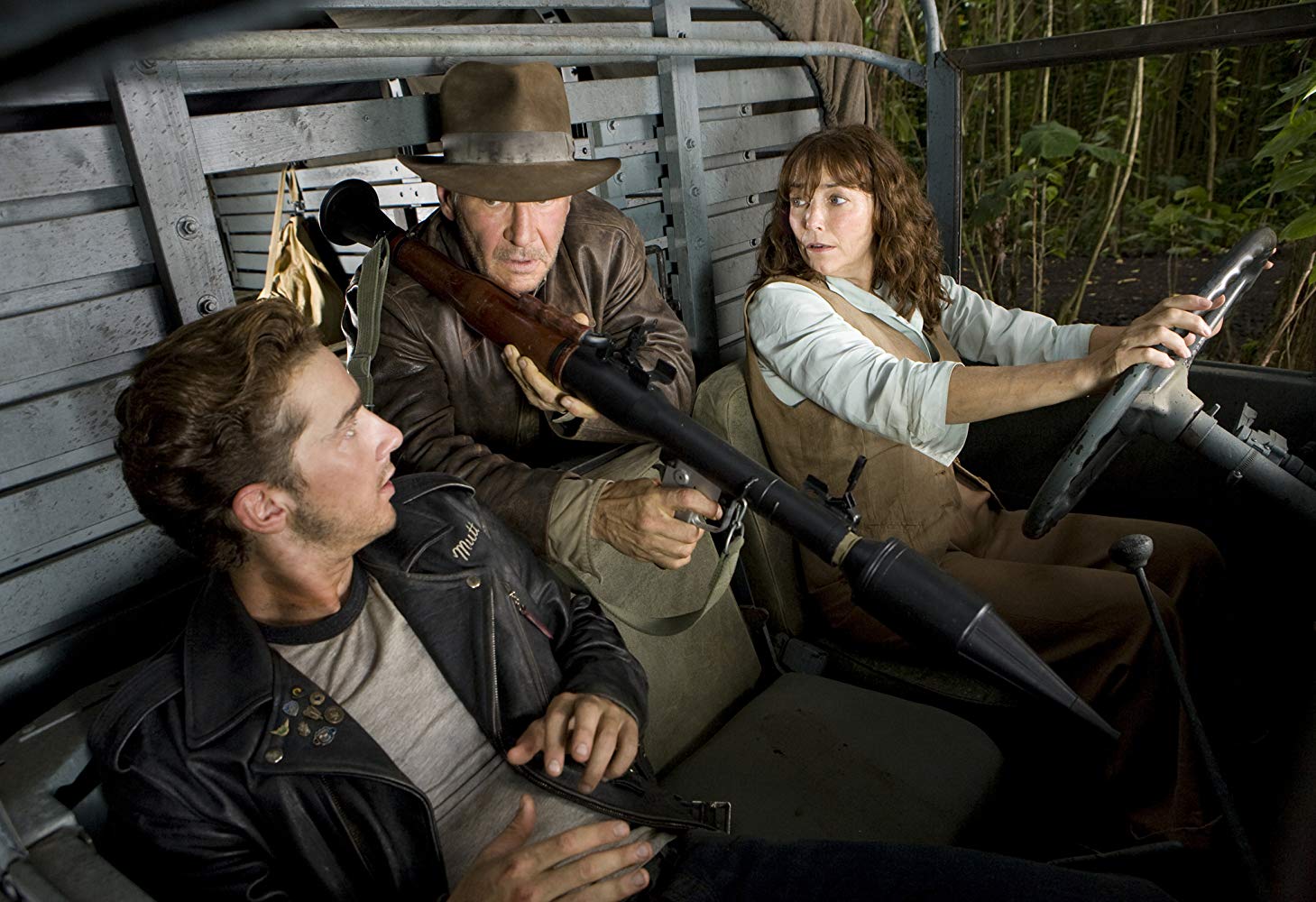
Certainly, when it comes to the sequence racing through the jungle and fighting between jeeps and then dealing with an infestation of ants, Steven Spielberg finally starts to get the film right, even if the sequence if far too reliant on CGI, which the originals never were. The subsequent sequences venturing down into the temple hold a degree of thrill and excitement. It is still a long way from anything that holds a candle to the wall-to-wall pace of Indiana Jones and the Temple of Doom, probably the series most breathlessly paced kinetic thrill ride in the series.
There is then the completely absurd scene where Harrison Ford survives a ground zero nuclear explosion by hiding in a lead-lined refrigerator. David Koepp seems to be confusing the fact that lead can protect one from radiation with the belief that it can offer protection from an entire nuclear explosion. In reality, Harrison Ford would have been incinerated as easily as a paper napkin dangled in front of a flame thrower. It is an “oh yeah, riiiiiiiiiiiight” eyebrow-raising scene that surely tops the parachuting out of a plane in an inflatable life raft scene in Indiana Jones and the Temple of Doom for sheer defiance of an audience’s credulity. (One of the more unusual facts is that this was actually a climax that had been intended Back to the Future (1985), which Spielberg had produced). The sequence is at least capped by the glorious image of Harrison Ford walking up over a hill to stand silhouetted against a blossoming mushroom cloud.
David Koepp’s script makes a bewildering attempt to mix the Roswell myth and Ancient Astronauts into the series. For a start, you are not entirely sure how the tying in of Roswell sits alongside Indiana Jones. If the claims made by conspiracy theory buffs that anything happened at Roswell are true, then evidence of an alien crash was covered up by a military operation acting on behalf of the government. So why an archaeologist would be tied up in the midst of this is a mystery – the film throws in some garbled explanations about Indy being corralled in to help by the military and not being told anything but fails to adequately justify the connection. David Koepp also throws in a heavy dose of Erich von Daniken. In his book Chariots of the Gods (1968), von Daniken made the claim that various artifacts of history – The Pyramids, Stonehenge, the drawings on the Plains of Nazca, the heads at Easter Island – were evidence that in the past Earth had been visited by alien beings who had given primitives aid to build artifacts that were far in advance of the technology of the time. Though popular during the 1970s, von Daniken’s books have been widely ridiculed by any serious historian or archaeologist. Nevertheless, these ideas have infiltrated through to a number of films and tv shows such as Starship Invasions (1977), the original Battlestar Galactica (1978-9), Hangar 18 (1980), The Pumaman (1980), Sky Bandits/Sky Pirates (1985), Stargate (1994), AVP: Alien vs. Predator (2004), 10,000 BC (2008), The Fourth Kind (2009), Stonehenge Apocalypse (2010), Killer Mountain (2011), Prometheus (2012), Prisoners of the Sun (2013) and Phoenix Forgotten (2017), while there was also a von Daniken documentary with Chariots of the Gods (1970). (For more details see Films About Ancient Astronauts). Here though the ideas fail to do anything more than lead to yet another variation on the climax where the villain of the show’s head is melted down.
Indiana Jones and the Kingdom of the Crystal Skull was parodied in Disaster Movie (2008). An episode of South Park (1997– ) dealt with the fan disappointment, depicting George Lucas and Steven Spielberg as rapists of people’s childhoods.
Steven Spielberg’s other genre films as director are:– Duel (1971), Jaws (1975), Close Encounters of the Third Kind (1977), Raiders of the Lost Ark (1981), E.T. – The Extra-Terrestrial (1982), Twilight Zone – The Movie (1983), Indiana Jones and the Temple of Doom (1984), Indiana Jones and the Last Crusade (1989), Always (1989), Hook (1991), Jurassic Park (1993), The Lost World: Jurassic Park (1997), A.I. (Artificial Intelligence) (2001), Minority Report (2002), War of the Worlds (2005), The Adventures of Tintin (2011), The BFG (2016) and Ready Player One (2018). Spielberg has also acted as executive producer on numerous films – too many to list here. Spielberg (2017) is a documentary about Spielberg,
Trailer here