

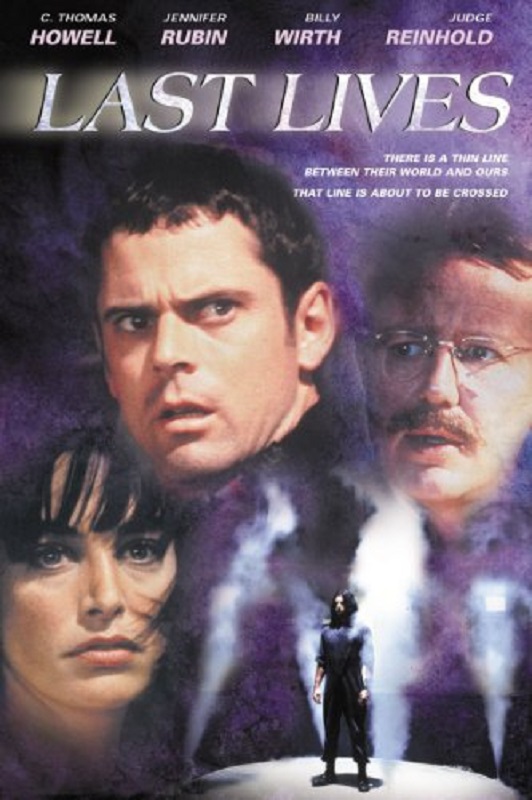
Crew
Director – Worth Keeter, Screenplay – Dan Duling, Producer – Steve Beswick, Photography – Kent Wakeford, Music – Greg Edmonson, Visual Effects Supervisor – Jaison Stritch, Special Effects Supervisor – Greg Hull, Production Design – C. Daniel Hall & David Rawlins. Production Company – Promark Entertainment Group/Videal Gmbh/C.E.G. Productions.
Cast
C. Thomas Howell (Aaron), Jennifer Rubin (Adrienne), Billy Wirth (Malakai), Judge Reinhold (Merkhan), David Lenthall (Benza), Robert Pente (Khafar), J.C. Quinn (Lieutenant Denny Parks), Richard Fullerton (Roma)
Plot
The scientist Merkhan perfects a device that can allow travel between parallel worlds. He chooses the convicted murderer Malakai as his test subject because of Malakai’s singular fixation with finding his dead wife. Malakai successfully crosses over and momentarily visits the bedroom of Adrienne, this world’s counterpart of his wife. Just as he is about to be executed, Malakai escapes, crosses over and abducts Adrienne from the midst of her wedding ceremony to Aaron. Merkhan follows but is fatally wounded in a shootout. Before he dies, Merkhan gives Aaron several armbands that can revive the wearer from the dead and will allow him to defy death in his pursuit of Malakai.
This sf-action hybrid is a silly effort. The plot set-up is a blatant steal from the recently released Twelve Monkeys (1995) – in both films, a criminal is chosen as a pioneer in a temporal experiment because of their fixation on a particular woman who they in due course end up abducting. Needless to say, Last Lives does it with considerably less imagination than Twelve Monkeys did. The same year also saw Crossworlds (1996), a much better film on alternate world hopping themes.
As an action film, Last Lives is competent enough and has some reasonably exciting car chase sequences. However, as a science-fiction film, Last Lives is extremely silly. It is hamstrung by the daft gimmick of having the hero armed with a collection of bracelets that can revive him from the dead. As a result, is filled with a series of contrived and absurd sequences that have hero C. Thomas Howell being shot in the head, thrown from balconies, crisped in car crashes, and at the climax dealing with the villain’s goons variously by grabbing electric fences as they catch him and then blowing himself and they up in a shed filled with explosives.
As the scientist, Judge Reinhold seems awkward and embarrassed. Jennifer Rubin, in an unbecoming haircut, looks drab and neurotic and delivers a performance that appears to be under the influence of major tranquilisers. The incredibly handsome Billy Wirth cuts what at first seems an interestingly romantic villain, although this is unfulfilled, and he spends the rest of the time mooning over Jennifer Rubin in a series of telepathic romantic longeurs that seem to go on forever.
Director Worth Keeter, sometimes billed as Worth Keeter III, began as an exploitation director in the 1970s, turning out drive-in films for Earl Owensby with efforts like Wolfman (1979), Lady Grey (1980), Rottweiler/Dogs of Hell (1983), Hit the Road Running (1983), Chain Gang (1984), Hot Heir (1984) and the horror anthology Tales of the Third Dimension (1984). Elsewhere, Keeter has made various B movies, including the genre likes of the spy film The Order of the Black Eagle (1987), the erotic horror Snapdragon (1993), the action film Memorial Day (1998) and the space station action film Scorpio One (1998), as well as numerous episodes of Masked Rider (1995) and the various Power Rangers tv series.