
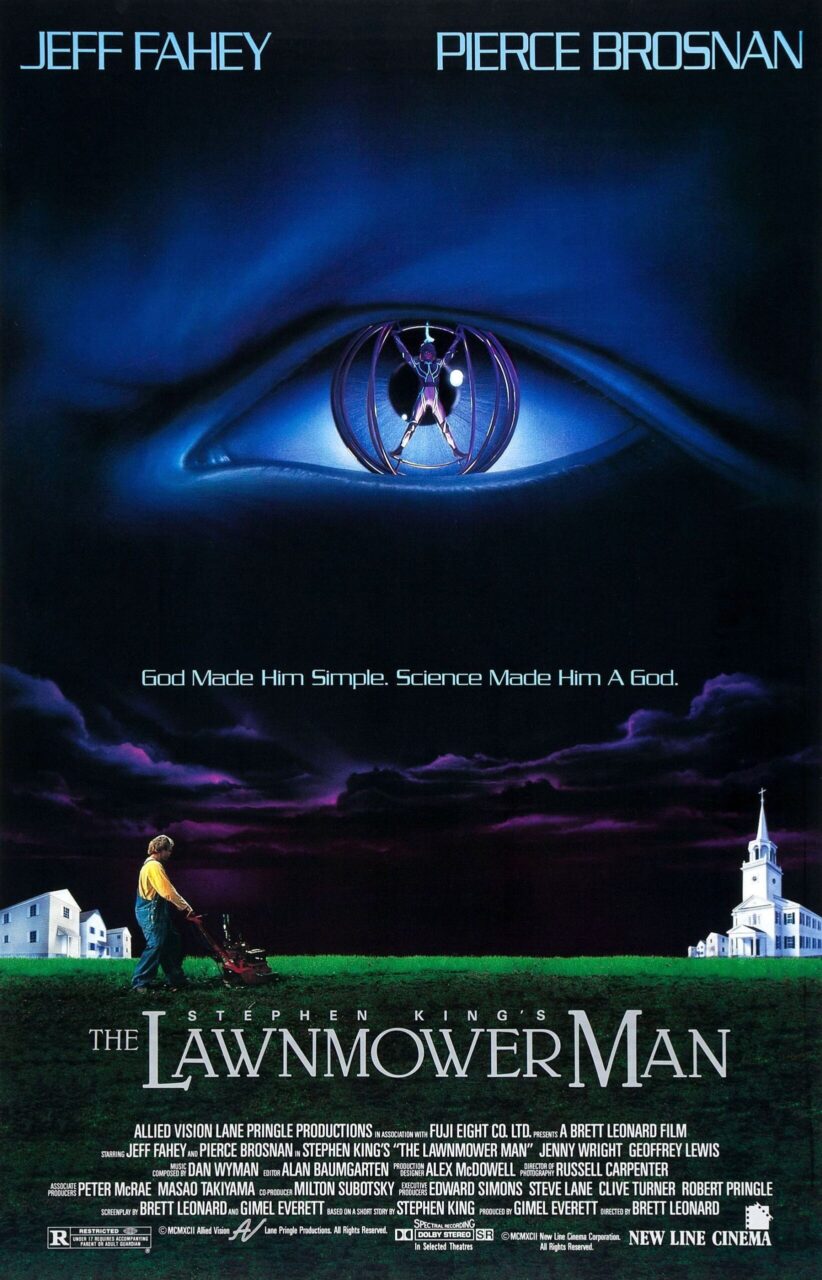
USA. 1992.
Crew
Director – Brett Leonard, Screenplay – Brett Leonard & Gimel Everett, Based on the Short Story by Stephen King, Producer – Gimel Everett, Photography – Russell Carpenter, Music – Jurgen Brauninger, Visual Effects Supervisors – Gimel Everett, Jonathon Keeton & Brett Leonard, Virtual Reality/Computer Graphics Sequences – Angel Studios & Xaos Inc, Other Computer Graphics – The Gosney Co & Homer and Associates, Miniature Effects – David Stipes Productions Inc (Supervisor – Anthony Doublin), Special Effects Supervisors – Frank & Tom Ceglia & Paul Haines, Gyrospheres/Cybersuits – Reel FX Inc (Supervisor – Martin Becker), Makeup Effects – Magical Media Industries (Supervisor – John Buechler), Production Design – Alex McDowell. Production Company – Allied Vision/Lane Pringle.
Cast
Jeff Fahey (Jobe Smith), Pierce Brosnan (Dr Lawrence Angelo), Mark Bringleson (Sebastian Timms), Jenny Wright (Marnie Burke), Jeremy Slate (Father McKeen), Geoffrey Lewis (Terry McKeen), John Laughlin (Jake Simpson), Austin O’Brien (Peter Parkette), Dean Norris (Director)
Plot
Using drugs and one of his computer programs, Virtual Reality researcher Dr Lawrence Angelo is able to turn his intellectually handicapped gardener Jobe Smith into a genius. Unknown to Angelo, the government agency that secretly bankrolls his research has substituted Jobe’s drugs for an experimental drug that gives Jobe psychokinetic abilities. As his abilities grow, Jobe starts to take revenge on those that tormented him.
It is probably of increasing embarrassment to Stephen King that he once wrote an article entitled “Against Becoming a Trademark Name.” In terms of the percentage of one’s works adapted to the screen, Stephen King is probably the most successfully adapted writer alive today – indeed, the short story collection Night Shift (1978) that contains the original Lawnmower Man story has furnished nine other films alone so far, while one of the stories Children of the Corn (1977) has had an amazing nine films spun off from it.
Regrettably, Stephen King’s twelve-page short story The Lawnmower Man (1975) bears absolutely no resemblance to this film. The short story was a tongue-in-cheek piece about a Pan-worshipping lawnmowing service that used remote control lawnmowers and then mowed the head off a guy who discovered their secret. None of this has anything to do with Virtual Reality or intelligence enhancement. To the film’s credit, fragments of the story are retained – the image of the remote-controlled lawnmower chasing a victim through his house, mowing up the carpet and leaving their severed head in the bird-bath, and even two or three lines of dialogue. However, these are conducted devoid of any of the context they had in the original story. Stephen King thought so too and sued to have his name removed from above the title of the film.
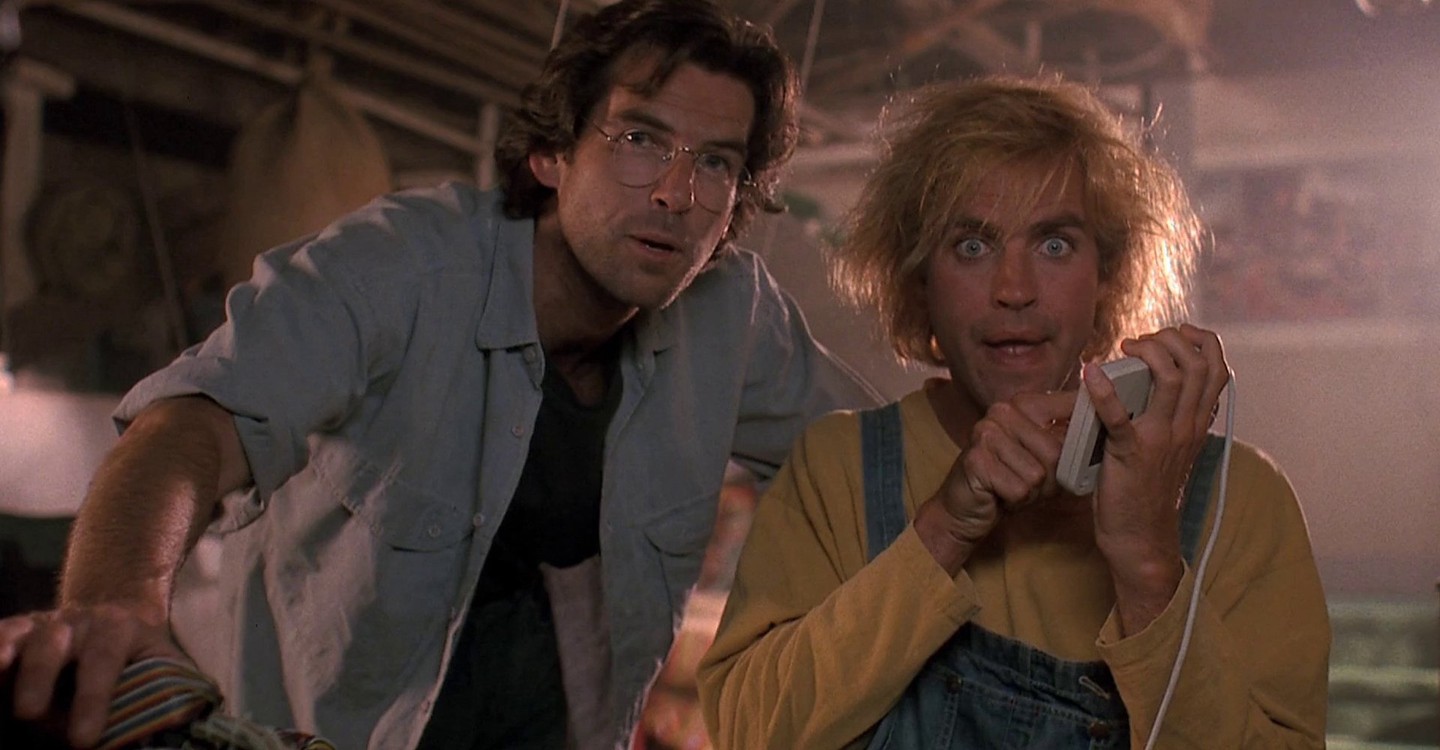
The film reads more like a cybernetic version of Charly (1968), the classic film about an intellectually handicapped man turned into a genius. The Lawnmower Man was one of the first films to jump on the new fascination with Virtual Reality that was just impacting on the public paradigm at the time. Yet, for the vast and far-reaching breakthrough in technology that the film purported to herald, its treatment of its subject matter is disappointingly heavy-handed and Luddhite.
In truth, The Lawnmower Man is a harbinger film. It is no different to films like Frankenstein (1931) or Demon Seed (1977) – it fears a coming wave of technological change and sounds a loud and clear warning in the most strident and luridly melodramatic ways possible. The film’s attitude towards Virtual Reality is never more clearly demonstrated than the opening explanation of what Virtual Reality is where it is cast into either being an opportunity for the evolution of the species or else for mind-control – a somewhat alarmist reaction that is no doubt of considerable surprise to most of the researchers in the Virtual Reality field. The film’s actual connection to Virtual Reality is also spurious – it was the first of an annoying string of films that portray Virtual Reality as an ontological as opposed to a representational environment.
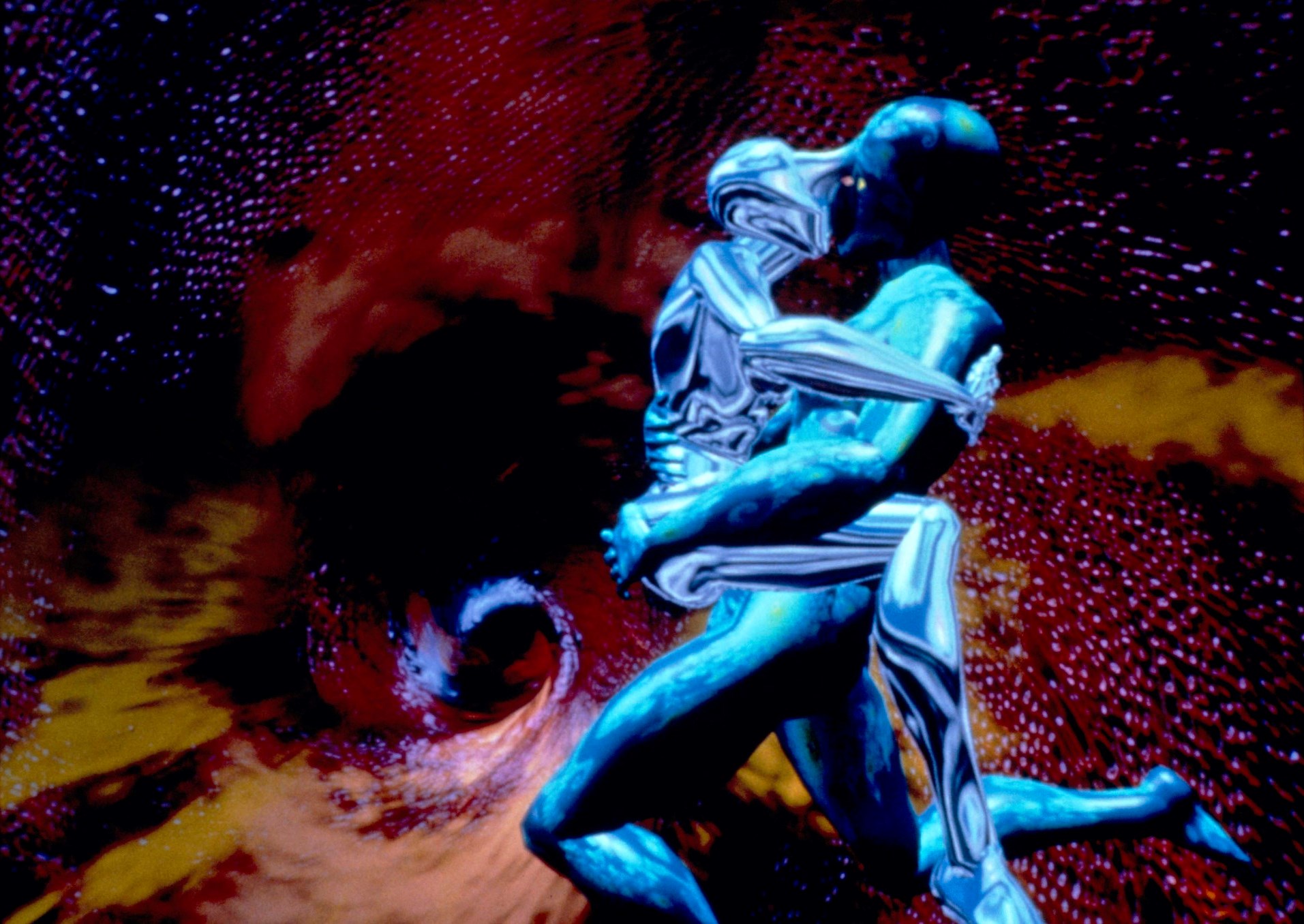
The great hypocrisy about The Lawnmower Man is that for such a Luddhite film it is dependent on the cutting edge of the very technology it fears in order to create its warning. The great irony of such an anti-computer film was that it heralded a major innovation in the use of CGI on film. Certainly, the CGI in The Lawnmower Man is highly impressive, all the more so for the relatively low budget the film was made on – only $17 million. The most striking of all is one sequence where two lovers become liquid metal, melding with one another and transforming into metallic insects flying across the computer-generated terrain.
Director Brett Leonard first appeared with the mad scientist/zombie film The Dead Pit (1989). Subsequent to this, he went on to try and carve a position for himself as a specialist in CGI cinema with CGI-driven vehicles such as Hideaway (1995) and Virtuosity (1995), as well as founding the short-lived CGI effects company L2 Communications. Unfortunately, the sheer fatuousness of Brett Leonard’s plots have always weighed heavily against him and his onscreen dexterity in CGI effects – The Lawnmower Man, for example, has that classic line of bad dialogue, “He learned Latin in two hours. It took me a whole year just to learn the alphabet.” Brett Leonard’s films regrettably never amount to anything more than eye-candy.
After the failure of Virtuosity, Leonard for some years found work in the one field that his all-eye candy, no-brain form of film seems ably suited for – the IMAX featurette. It then took ten years before Leonard returned to cinema screens again with the Marvel Comics adaptation Man-Thing (2005), the fascinatingly perverse Feed (2005) and the amazingly bad Highlander: The Source (2007).
The film was followed by an utterly laughable sequel Lawnmower Man II: Beyond Cyberspace/Lawnmower Man II: Jobe’s War (1996), where Jobe has become a mad messiah in cyberspace, although none of the personnel from this film were involved.
Other Stephen King genre adaptations include:- Carrie (1976), Salem’s Lot (1979), The Shining (1980), Christine (1983), Cujo (1983), The Dead Zone (1983), Children of the Corn (1984), Firestarter (1984), Cat’s Eye (1985), Silver Bullet (1985), The Running Man (1987), Pet Sematary (1989), Graveyard Shift (1990), It (tv mini-series, 1990), Misery (1990), a segment of Tales from the Darkside: The Movie (1990), Sometimes They Come Back (1991), The Dark Half (1993), Needful Things (1993), The Tommyknockers (tv mini-series, 1993), The Stand (tv mini-series, 1994), The Langoliers (tv mini-series, 1995), The Mangler (1995), Thinner (1996), The Night Flier (1997), Quicksilver Highway (1997), The Shining (tv mini-series, 1997), Trucks (1997), Apt Pupil (1998), The Green Mile (1999), The Dead Zone (tv series, 2001-2), Hearts in Atlantis (2001), Carrie (tv mini-series, 2002), Dreamcatcher (2003), Riding the Bullet (2004), ‘Salem’s Lot (tv mini-series, 2004), Secret Window (2004), Desperation (tv mini-series, 2006), Nightmares & Dreamscapes: From the Stories of Stephen King (tv mini-series, 2006), 1408 (2007), The Mist (2007), Children of the Corn (2009), Everything’s Eventual (2009), the tv series Haven (2010-5), Bag of Bones (tv mini-series, 2011), Carrie (2013), Under the Dome (tv series, 2013-5), Big Driver (2014), A Good Marriage (2014), Mercy (2014), Cell (2016), 11.22.63 (tv mini-series, 2016), The Dark Tower (2017), Gerald’s Game (2017), It (2017), The Mist (tv series, 2017), Mr. Mercedes (tv series, 2017-9), 1922 (2017), Castle Rock (tv series, 2018-9), Doctor Sleep (2019), In the Tall Grass (2019), Pet Sematary (2019), The Outsider (tv series, 2020), The Stand (tv mini-series, 2020-1), Chapelwaite (tv series, 2021), Lisey’s Story (tv mini-series, 2021), Firestarter (2022), Mr Harrigan’s Phone (2022), The Boogeyman (2023), The Life of Chuck (2024), Salem’s Lot (2024), the tv series The Institute (2025- ), The Long Walk (2025), The Monkey (2025) and The Running Man (2025). Stephen King had also written a number of original screen works with Creepshow (1982), Golden Years (tv mini-series, 1991), Sleepwalkers (1992), Storm of the Century (tv mini-series, 1999), Rose Red (tv mini-series, 2002) and the tv series Kingdom Hospital (2004), as well as adapted his own works with the screenplays for Cat’s Eye, Silver Bullet, Pet Sematary, The Stand, The Shining, Desperation, Children of the Corn 2009, A Good Marriage, Cell and Lisey’s Story. King also directed one film with Maximum Overdrive (1986). Stephen King on Screen (2022) is a documentary about King film adaptations.
Trailer here