
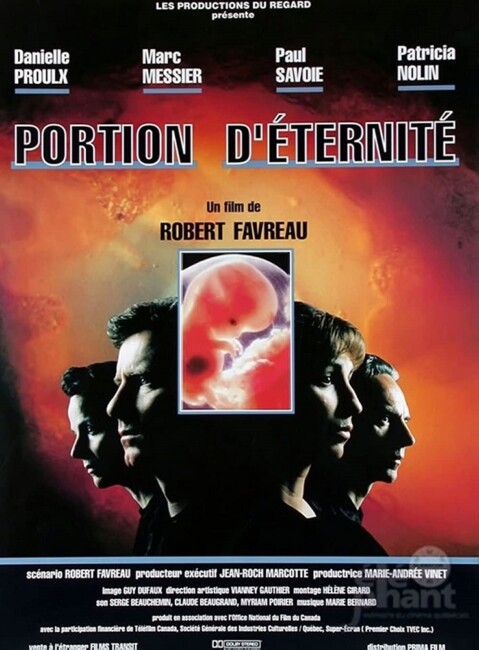
(Portion d’Eternite)
Crew
Director/Screenplay – Robert Favreau, Producer – Marie-Andree Vinet, Photography – Guy Dufaux, Music – Marie Bernard, Special Effects – Yvon Charbonneau & Jacques Godbout, Art Direction – Vianney Gauthier, Science Consultant – Jacques Testart, Medical Consultant – Dr Alain Campbell. Production Company – Les Productions du Regard Inc/The National Film Board of Canada.
Cast
Danielle Proulx (Marie Lemieux), Marc Messier (Pierre Lemieux), Patricia Nolin (Helene Duprez), Paul Savoie (Antoine), Gilles Pelletier (Mr Lemieux), Raymond Cloutier (Luc)
Plot
After Pierre and Marie Lemieux are killed in a car crash, Pierre’s father discovers they have left two human embryos behind at the Technogen fertility clinic. He enlists the help of government official Helene Duprez in an effort to have the embryos destroyed. In the course of her investigation, Helene discovers that Technogen, in an attempt to develop an immortality drug, are conducting illicit experiments by trying to create an artificial womb so they can breed embryos artificially and get around international bans on experimenting on embryos.
This French-language Canadian film is an intriguing debate on the ethics of contra-utero birthing, a subject that is as old as the German classic Alraune (1928). Longing for Eternity is a little more grounded in scientific fact then Alraune – even if at the end the case is still slanted towards decrying artificial birth as amoral.
While the talk of the possibilities that extra-utero birthing could open up is interesting, the way the film chooses to deliver them – as a dull series of position papers – is tedious and message heavy. It could have been an interesting film if it had developed as a thriller – but it fails to do so and all that one has is a film that is as about as dramatically exciting as an instruction tape on LeMarze birthing.
Trailer here
Portion d'éternité from elephantcinema.quebec on Vimeo.