
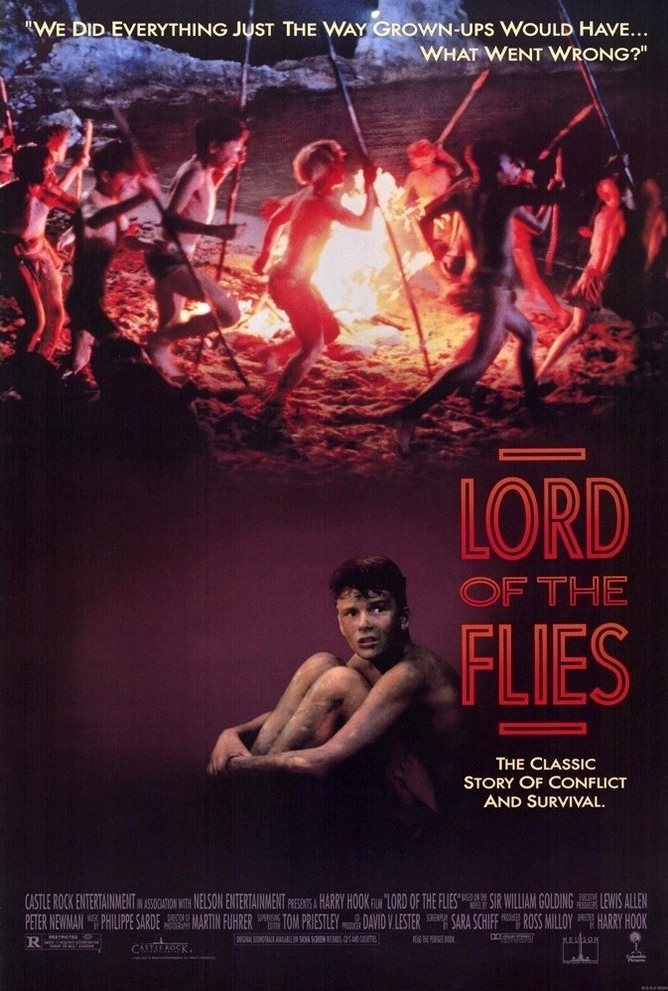
USA. 1990.
Crew
Director – Harry Hook, Screenplay – Sara Schiff [Jay Presson Allen], Based on the Novel by Sir William Golding, Producer – Ross Milloy, Photography – Martin Fuhrer, Music – Philippe Sarde, Optical Effects/Mattes – Peerless Camera, London, Makeup – Sarah Monzani, Production Design – Jamie Leonard. Production Company – Castle Rock/Nelson Entertainment/Jack’s Camp/Signal Hill.
Cast
Balthazar Getty (Ralph), Chris Furrh (Jack), Danuel Pipoly (Piggy), Andrew and Edward Tuft (The Twins), Badge Dale (Simon), Michael Green (Captain Benson), Gary Rule (Roger), Terry Wells (Andy), Braden MacDonald (Larry), Bob Peck (Marine Officer)
Plot
A plane carrying boys from a US military academy crashes over the ocean and the boys are washed up on an uninhabited tropical island. One of the older boys, Ralph, creates a nominal social order until they can be rescued and is elected leader by the others. However, a rival faction of hunters led by the charismatic Jack prove only too willing to forget about maintaining order and gleefully engage in savage hunting rites. This proves too exciting a temptation for most and Ralph’s society starts to fall apart as the boys increasingly defect to join Jack’s hunters. Tension grows between the two groups as Jack whips the boys’ fears up into a murderous frenzy.
William Golding’s book Lord of the Flies (1954) is a literary classic. It is an allegory for society standing on the borderlands between civilised order and the descent into barbarism dominated by primal rites and fear of the unknown. Lord of the Flies has become such a classic that it is taught in English Lit curricula in many high schools. The book was filmed once before this by British theatre director Peter Brook on a low-budget with a cast of unknowns as the excellent Lord of the Flies (1963). This was a heavily disappointing remake.
Lord of the Flies 1990 has been mounted by Rob Reiner’s Castle Rock Entertainment production company. This initially seemed to bode well as Castle Rock made a number of other respectable and above average productions during the 1980s/90s including tv’s Seinfeld (1990-8), various Stephen King adaptations, including the widely regarded The Shawshank Redemption (1994), and several Shakespeare adaptations.
Director Harry Hook was an unknown factor who had previously made The Kitchen Toto (1987) about the Mau Mau Rebellion. Hook is one of the few people involved in the production that is at least British, although he has subsequently gone onto a largely undistinguished career making period dramas mostly for tv. The script comes from a respectable source – writer Jay Presson Allen who also wrote works such as Alfred Hitchcock’s Marnie (1964), The Prime of Miss Jean Brodie (1969), Cabaret (1972), Funny Lady (1975) and Prince of the City (1981). Alas, Allen disowned the finished film and hid behind the pseudonym of Sara Schiff.
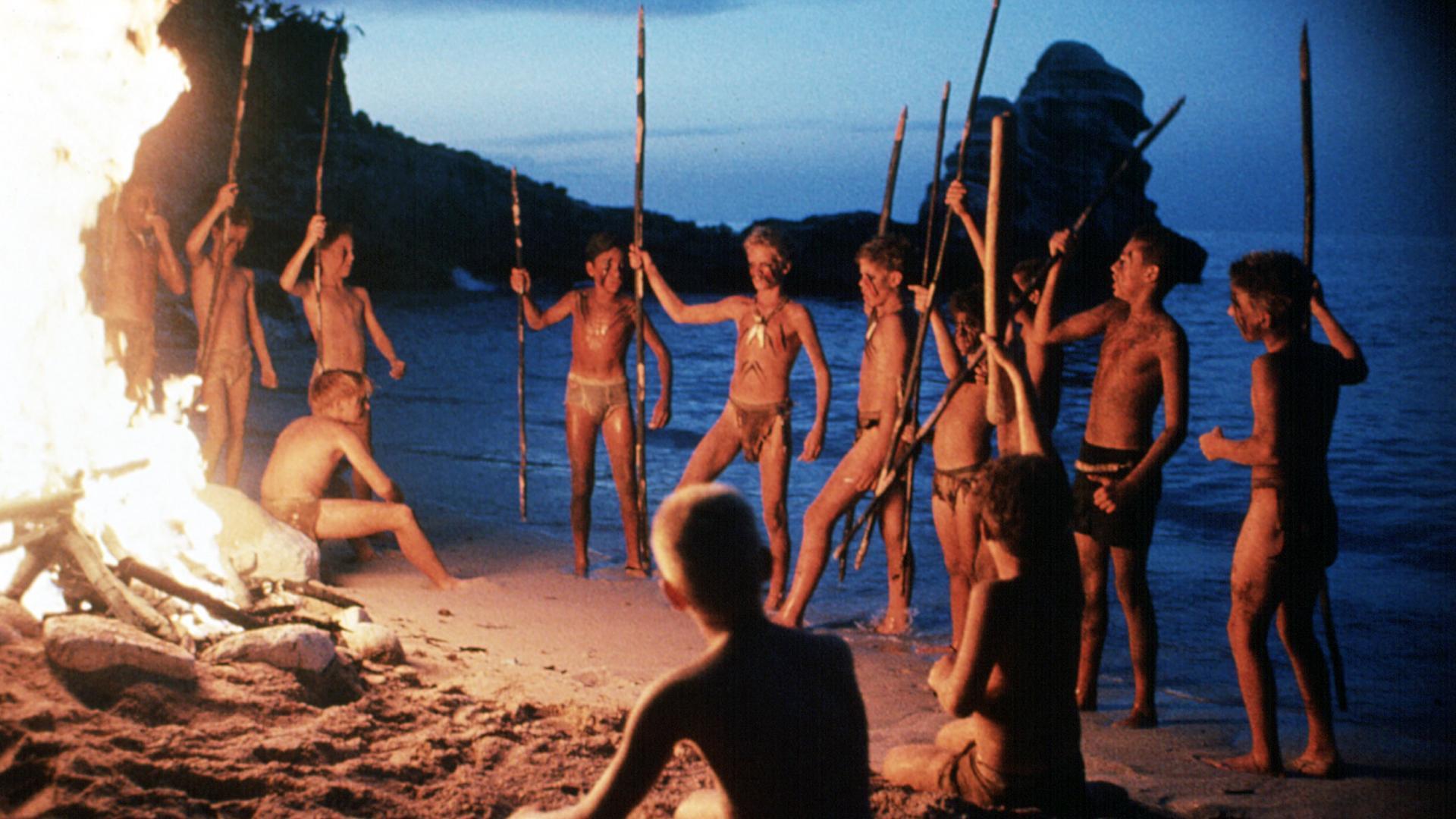
The biggest mistake that Lord of the Flies 1990 makes is to turn William Golding’s story into an American production. A good deal gets lost in the Transatlantic migration. For one, the boys no longer comes from a boarding school but are military academy brats who stand about calling each other ‘colonel’ – we even get the boys singing marching songs, while martial drums and pipes play on the soundtrack at appropriate points. Certainly, a military academy is perhaps the nearest an American production is able to get to simulating the environment of the book’s boy’s boarding school – but it still seemed far scarier in the book when the hunters turned out to be choirboys gone rogue.
The story has also been contemporised over William Golding’s post-War milieu. In one of the more grating scenes – something that has caused the film to date quickly – the boys sit around, getting maudlin as they wonder what time ALF (1986-90) is going to be on tv. Could they not have at least chosen a tv show that had a more substantial cultural afterlife than that? Even more dated is a scene where they worry about being captured by Russians, something that was obsolete only a matter of months after the film’s release. There are other additions such as having the pilot alive at the beginning of the story and the island being hit by a hurricane. Certainly, the remake has it over Peter Brook’s version in some beautiful natural location photography (in Hawaii and Jamaica) but this does no more than pointlessly widen a stage that was conducted with perfectly viable economy in both the book and the much more faithful 1963 film.
Mostly what the film lacks is any of the symbolic intensity of William Golding’s writing. It is a terrifying book where its classic status exists because of William Golding’s ability to let it rest in a series of dark, swimming symbols about socially repressed things emerging into the open. However, the film has scaled this down to no more than a literal melodramatic struggle. The drive to kill Simon and the fear of the pilot are devoid of symbolism and no different to the dramas that might occur in an episode of a regular tv series with its heroes stranded on this week’s tropical paradise. We get the pig’s head mounted on a stake but it is an image without any of the associated imagery – such that the title ‘Lord of the Flies’ no longer has any meaning that is explained in the film. The pilot remaining alive in perhaps the story’s most innovative change – in order not to have to invent the skeleton of a WWII pilot – but there is little about how this is turned into The Beast. The addition of dream sequences with the pilot telling them they are going to be rescued is incredibly lame.
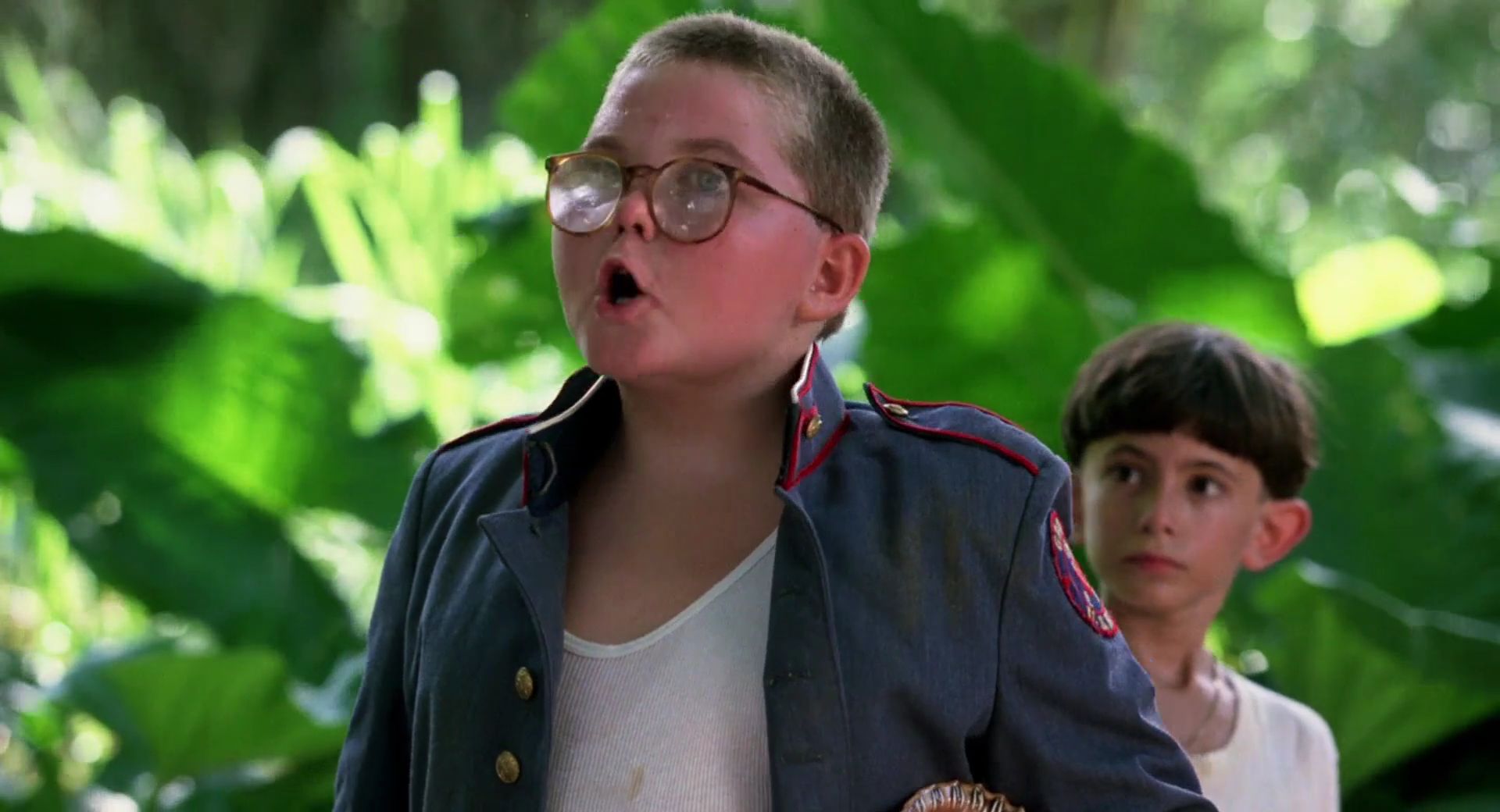
The other thing the film sorely lacks is William Golding’s subtlety of dialogue, of fears expressed from a child’s perspective, something that the Peter Brook film captured so well – these are just kids yelling “Eat shit and die.” The film also lacks the true descent into barbarism that existed in the book and the 1963 film. Too much of the film is taken up by the pretty tropical surroundings – it looks more like an episode of Survivor (2000– ) than it does a parable about the collapse of civilised order. The latter half of the film works the best because these sections mirror the events in the book reasonably closely and dig into the story’s darkness – there is still not the alarming barbarism of the 1963 version but Harry Hook generates some passable drama during scenes like the snatching of the glasses and Piggy’s murder.
The only one of the cast kids was ever heard from again was Balthazar Getty who went onto a modest adult career in films, including David Lynch’s Lost Highway (1997), Shadow Hours (2000) and Feast (2006), among others. (James Badge Dale has gone onto a minor career elsewhere). As Jack, Chris Furrh has bronzed, blonde good looks – you instantly hate him from the point you meet him and he brings an authentic venom once he becomes the leader of the rival tribe. As Piggy, Danuel Pipoly is a striking ringer for a younger version of Drew Carey. Nevertheless, Piggy is the one character in the film that stands out as written on the page by William Golding where Danuel Pipoly imbues the part with a plaintiveness that makes him the best developed character in the film.
There was purportedly also an uncredited Filipino adaptation of the story made in 1975. In the arena of bad ideas, a further Lord of the Flies remake was announced in 2017, which would be told as an all-girl version. This has yet to emerge however there was the SF film Voyagers (2021) that relocated the story on a spaceship.
Trailer here