
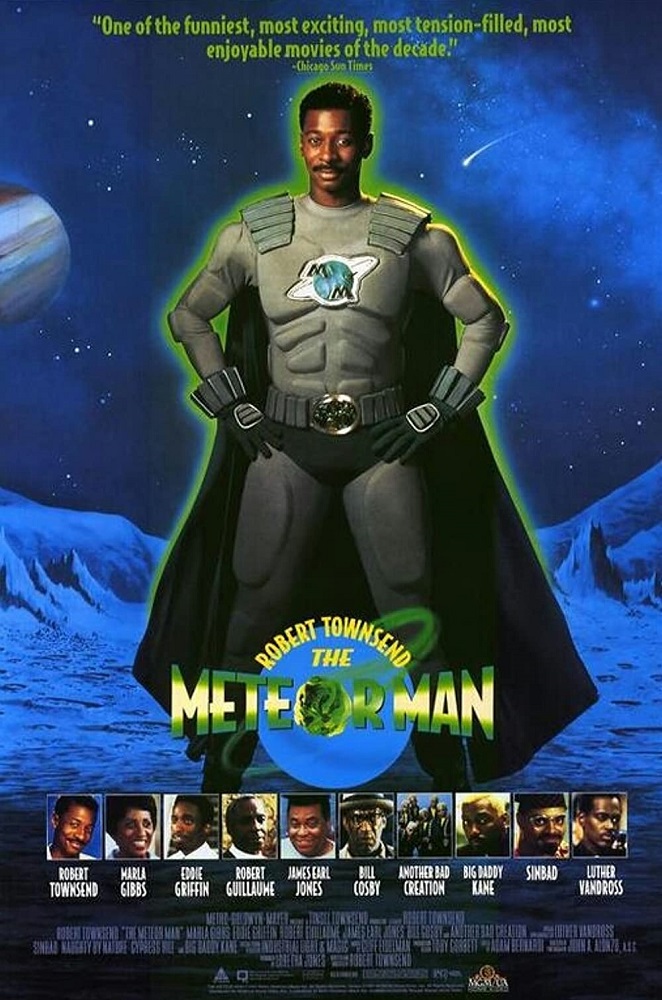
USA. 1993.
Crew
Director/Screenplay – Robert Townsend, Producer – Loretha C. Jones, Photography – John A. Alonzo, Music – Cliff Eidelman, Visual Effects – Industrial Light and Magic (Supervisor – Bruce Nicholson), Special Effects Supervisor – Al Disarro, Production Design – Toby Corbett. Production Company – Tinsel Townsend Productions.
Cast
Robert Townsend (Jefferson Reed), Roy Fegan (Simon), Eddie Griffin (Michael Anderson), Robert Guillaume (Mr Reed), Marla Gibbs (Maxine Reed), James Earl Jones (Ernest Moses), Frank Gorshin (Byers), Bill Cosby (Marvin), Wallace Shawn (Charlie Little)
Plot
African-American teacher Jefferson Reed is hit by a glowing green meteorite. Afterwards, he finds that he has extraordinary abilities, including x-ray vision, super-strength, is invulnerable to bullets, that he can absorb the contents of a book merely by touching it and can speak dog language. He stands up to and drives out the Golden Lords gang that terrorises his neighbourhood. However, this serves to bring reprisals from the gang and soon the neighbourhood are not certain if they want him protecting them or not.
This Black take on Superman comes from Robert Townsend who was best known up to that point as a stand-up comedian and several minor acting roles on film. Towensend had previously directed/written/starred in Hollywood Shuffle (1987) about the travails of a Black actor trying to break in to Hollywood, and The Five Heartbeats (1991) about a fictional Black musical quintet, although had had his greatest success as the director Eddie Murphy Raw (1987), a film of Murphy’s stand-up act. Townsend likewise directs, writes and stars here. He subsequently went onto make B.A.P.S. (1997) and In the Hive (2012), as well as direct a number of tv movie biopics and documentaries usually about other African-Americans.
Townsend has managed to reel in one of the most extraordinary African-American casts ever assembled since Roots (1977), including Bill Cosby, James Earl Jones, Robert Guillaume, wrestler Tiny Lister, comedian Sinbad, Lela Rochon, blues singer Luther Vandross, a then unknown Don Cheadle and Faizon Love and, from the looks of it, several real street gangs. However, while not trying to decry the nobility of Townsend’s efforts towards giving more screentime to African-American voices and faces, The Meteor Man is not a very good film. The huge cast is not well employed – the names never get much in the way of star turns and James Earl Jones, possibly the best Black actor in the world, is wasted as an aging Lothario ignominiously decked out in an horrendous punk wig.
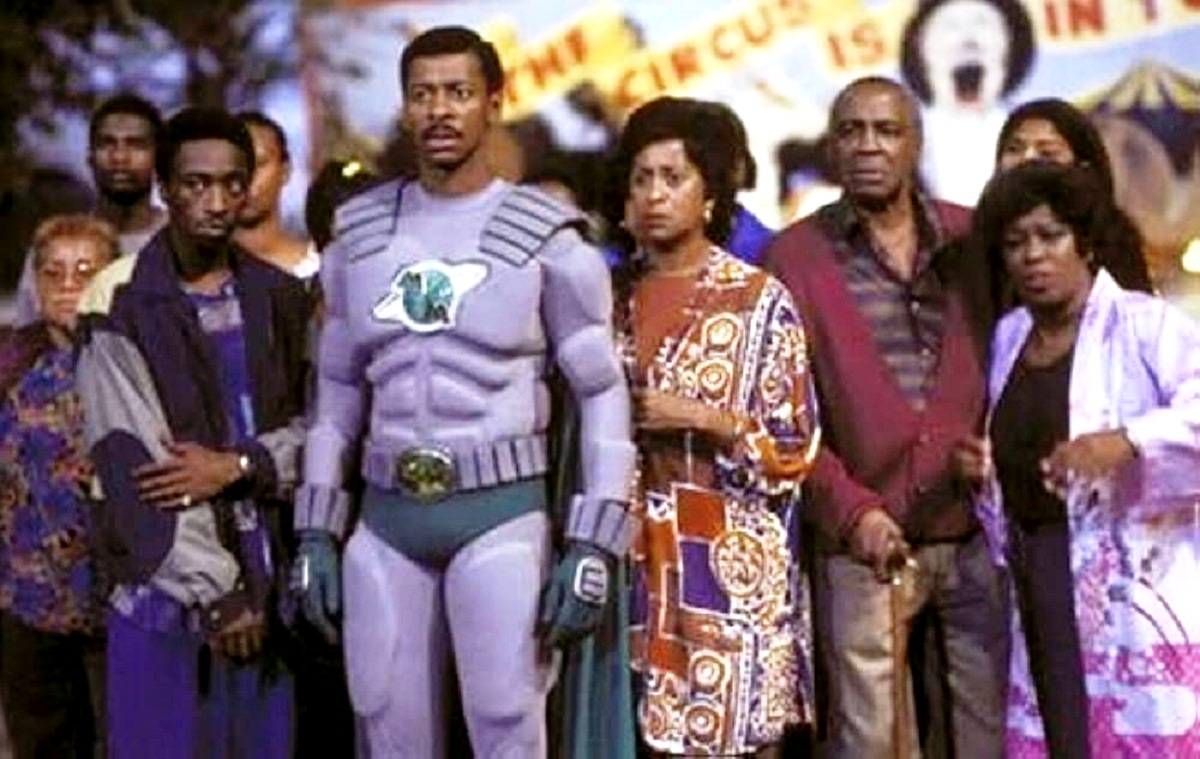
As director, Robert Townsend never seems too concerned about hurrying pacing along. The film is annoyingly simple-hearted – it has no depths, no levels to it, all it has is there on screen and spelt out. Meteor Man’s superpowers are virtually all copied from Superman’s but nevertheless seem vague and random, there because they suit a particular gag of the moment. The film seems full of elaborate effects gags that lead nowhere – like the scene where Townsend falls from the lamppost and creates an earthquake – it is over-elaborate and one is left wondering what point it serves.
Largely, the film appears to have been constructed not as a superhero film but as an empowerment fable for the ghettos, with Meteor Man standing in for what an ordinary man can do towards good. The film takes its sermonising position with a solemnity that verges on sanctimony. At the same time, the film cannot decide whether it wants to be a message film or a comedy – the worst moment is surely when Townsend interrupts the climactic battle to conduct bad Bruce Lee impersonations and take on the gang leader with mock catwalk poses.
Robert Townsend returned to superheroics directing and starring in the Disney tv movie Up, Up and Away! (2000), as well as directing episodes of the later DC Comics adapted Black superhero tv series Black Lightning (2018-21). Subsequent to The Meteor Man, there have been several other efforts venturing into the mini-genre of the comic Black superhero – Blankman (1994) and Pootie Tang in “Sine Your Pitty on the Runy Kine” (2001), as well as one serious effort – Steel (1997), and later characters within Marvel films such as Blade, Black Panther, Luke Cage, The Falcon and War Machine.
Trailer here