
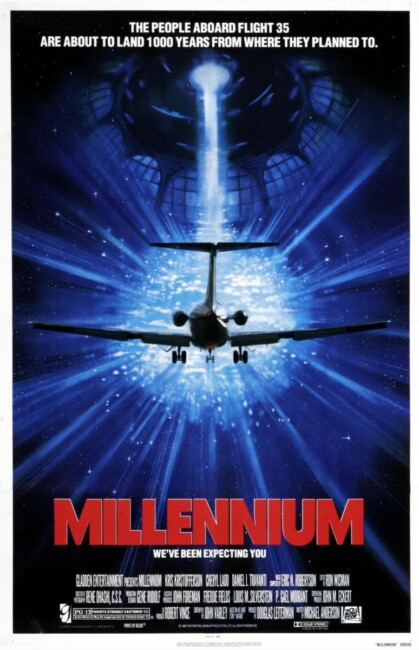
Crew
Director – Michael Anderson, Screenplay/Based on the Novel Millennium and Short Story Air Raid by John Varley, Producer – Douglas Leiterman, Photography – Rene Otashi, Music – Eric N. Robertson, Visual Effects – Syd Dutton, Light and Motion, Bill Taylor & Albert Whitlock, Makeup – Bob Laden, Production Design – Gene Rudolf. Production Company – Gladden Entertainment.
Cast
Kris Kristofferson (Bill Smith), Cheryl Ladd (Louise Baltimore), Daniel J. Travanti (Arnold Mayer), Robert Joy (Sherman), Leonard Chow (Beijing)
Plot
During the analysis of a crash site, air accident investigator Bill Smith discovers a number of anomalies – the black box recording has the crew reporting that the bodies were burnt and charred prior to the crash, all the electronic watches run backwards and a strange raygun is found among the wreckage. At the same time, Smith meets and falls in love with a strange stewardess Louise Baltimore. Gradually, Smith discovers that Louise is a time traveller. She has come from a badly polluted future where humanity has become sterile. She is part of an operation to repopulate the world by snatching people from the past about to die in accidents whose disappearances will not be noticed or affect time.
In this reviewer’s opinion, John Varley is the finest of all contemporary science-fiction writers. Varley blends intensely captivating characters with audacious conceptual hard science extrapolations. The beauty of the ideas, the playful wit and three-dimensional imagination that come in novels like The Ophuichi Hotline (1977), his Gaea trilogy, Titan (1979), Wizard (1980) and Demon (1984), or Steel Beach (1992), Slow Apocalypse (2012) and his compulsively readable short story collections The Persistence of Vision (1978), The Barbie Murders (1980) and Blue Champagne (1986) are way out beyond a frontier that few science-fiction writers ever cross.
Millennium is based on the John Varley short story Air Raid (1977). At the time, the short story was optioned as a project by effects man Douglas Trumbull, director of Silent Running (1972) and Brainstorm (1983), and was to have starred Paul Newman and Jane Fonda in the leads. Trumbull’s production fell through and it was later inherited by Randall Kleiser, the director of Grease (1978) and Richard Rush, the director of The Stunt Man (1980) and Color of Night (1994), without any success in it ever getting closer to the screen. John Varley eventually gave up and turned his screenplay into the novel Millennium (1983).
After several years dormancy, the production was eventually revived under director Michael Anderson. Anderson was not a particularly popular director in science-fiction circles, having mangled the likes of 1984 (1956), Doc Savage – The Man of Bronze (1975), Logan’s Run (1976), The Martian Chronicles (tv mini-series, 1980), as well as having made Second Time Lucky (1984), maybe one of the worst films ever made. (See below for Michael Anderson’s other genre films).
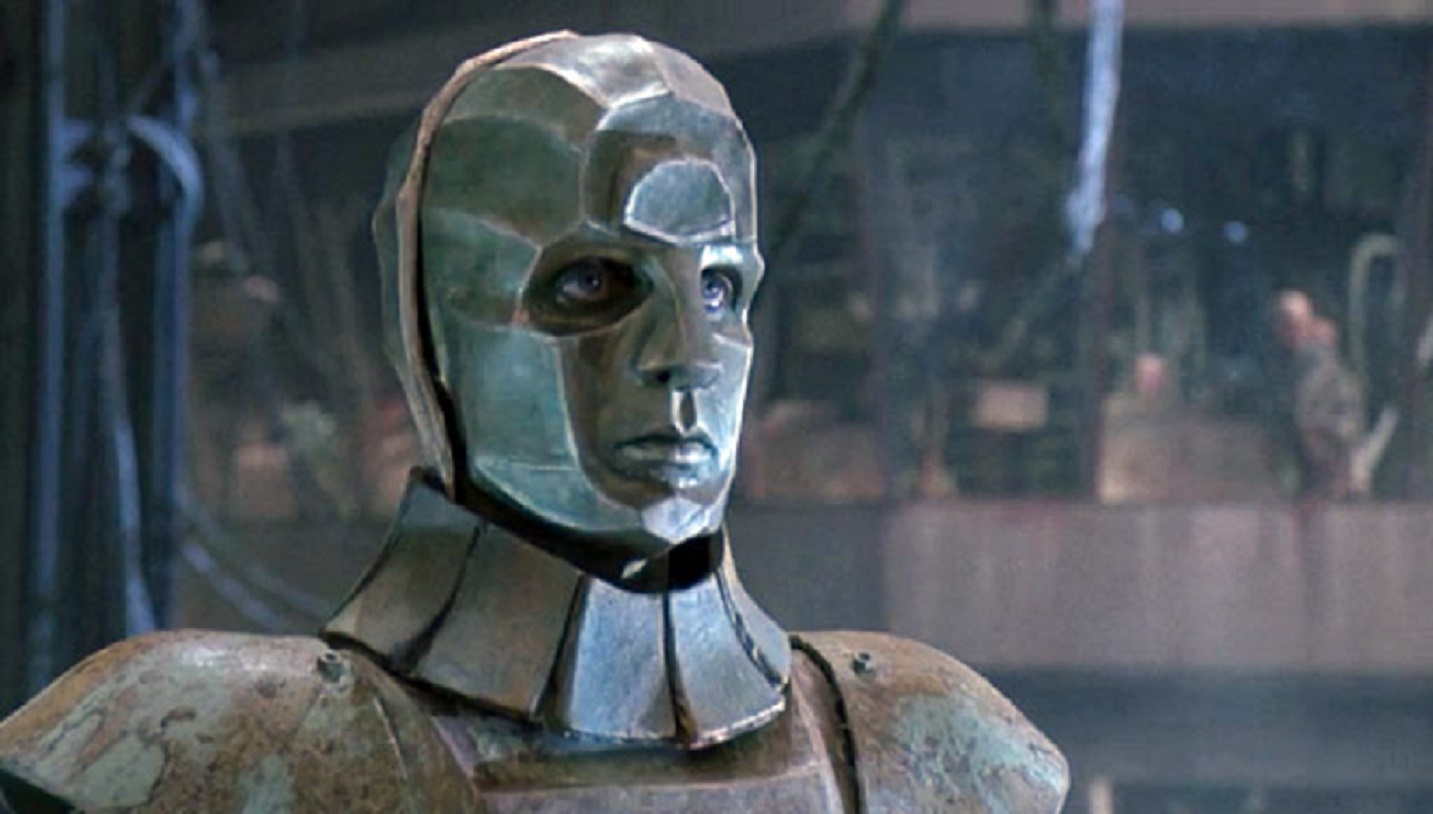
The relationship between Millennium the novel and Millennium the screenplay is cloudy – it is not sure whether the book could be called a novelization of a screenplay or the film an adaptation of the novel. Whichever way it is viewed, the film is a solid disappointment. It seems a bare bones reduction of the book’s sophisticated ideas – for instance, the sex robot Sherman, who in a mind-boggling last page throwaway is suggested as being God, becomes an art deco C3PO clone dropping smartass one-liners about its mother being a cash register; while fascinating ideas like the temporal Post Office have been ditched altogether and little is explained about the polluted future and the reasons for the operation.
What we have is a film that has the appearance of being made for people who do not believe its audience would understand difficult concepts like time travel – something that Back to the Future (1985) and sequels proved wrong – and writes them down to an incredibly simplistic level so they can be understood – like scenes where the highly trained members of the Snatch Team have to stand by and ask each other what temporal censorship is.
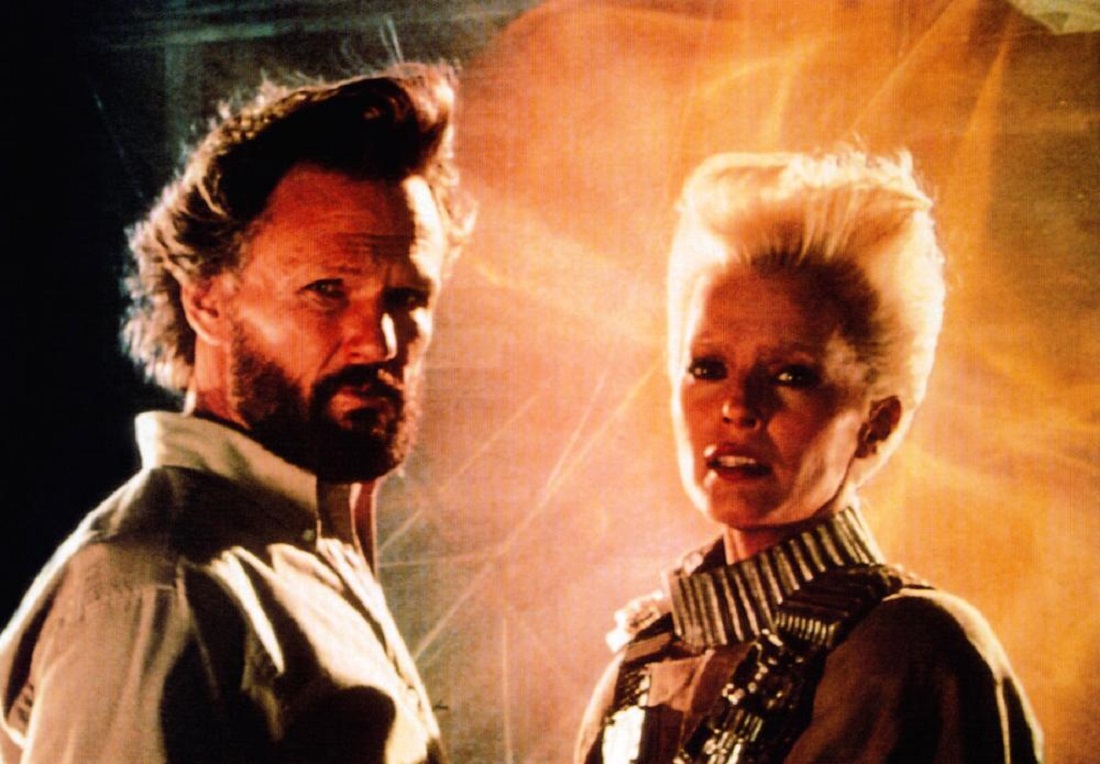
Despite its crudening, John Varley’s story is too good not to entirely fail. The double-plot where we see the mystery from contemporary man Kris Kristofferson’s point-of-view and then it doubles over and retells things from the point-of-view of time-traveler Cheryl Ladd as she appears at different points in time is cleverly worked and fascinating to watch unfold. Michael Anderson directs uncustomarily well and John Varley’s script does extremely well in its mapping out of people meeting at different points of time. Unfortunately, most of the potential for the film to work here is killed by the casting of wooden-carved Kris Kristofferson and the beautiful but bland Barbie Doll Cheryl Ladd. They create zero resonance together in the film’s central love story.
The only other John Varley work to have been adapted to the screen was Overdrawn at the Memory Bank (1985), based on Varley’s 1976 short story of the same name. The story, featuring a man trapped in a Casablanca (1942) simulation, was an early precursor of Virtual Reality themes. However, that film proved an even worse crudening of the original Varley story than Millennium did. It is high time someone brought more of Varley’s work to the screen – an adaptation of Gaea trilogy would be sensational.
Michael Anderson’s other genre films include an adaptation of George Orwell’s 1984 (1956); The Shoes of the Fisherman (1968), a political thriller concerning a near-future Pope; Doc Savage, The Man of Bronze (1975), based on the pulp hero; the dystopian sf film Logan’s Run (1976); the killer whale film Orca (1977); the psycho-thriller Dominique (1978); the tv mini-series adaptation of Ray Bradbury’s The Martian Chronicles (1980); the thriller Bells/Murder by Phone/The Calling (1981) about killer telephone calls; the excruciating Adam and Eve softcore comedy Second Time Lucky (1984); the tv movie remake of 20,000 Leagues Under the Sea (1997); and The New Adventures of Pinocchio (1999).
Trailer here