

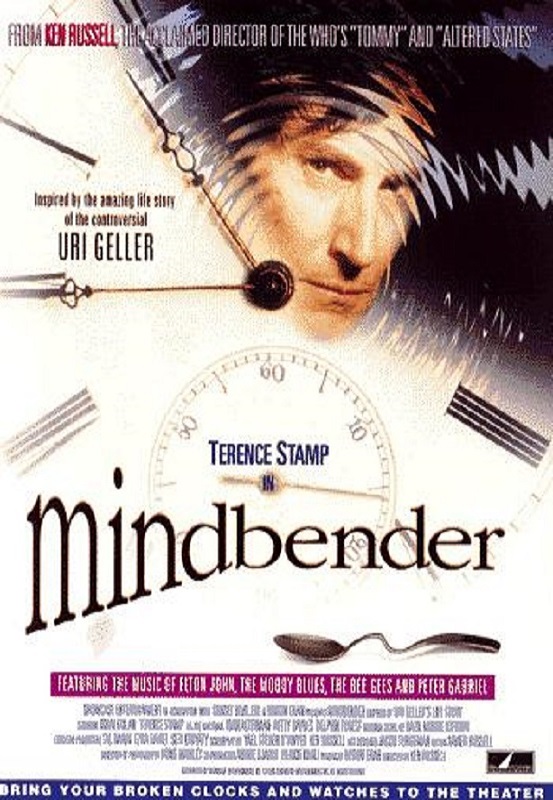
USA/Israel. 1996.
Crew
Director – Ken Russell, Screenplay – Ken Russell & Yael Stern, Producer – Doron Eran, Photography – Hong Mantley, Music – Bob Christianson, Special Effects Designer – Yoram Pollak, Art Designer – Jacob Turgeman. Production Company – Sunset Blvd Ltd/Doron Eran.
Cast
Ishai Golan (Uri Geller), Terence Stamp (Dr Joe Hartman), Idan Alterman (Shipi Strang), Hetty Baynes (Kitty Hartman), Delphin Forest (Sharon Geller), Rafi Tabor (Uri’s Father), Steven Greenstein (Don Drake), Rachel Einer (Hannah Strang), Aviva Yoel (Uri’s Mother), Yochanan Harrison (Dr Carl Zwemmer), Yael Horowitz (Lieutenant Bubbles Jones), Nitza Shaul (Teacher)
Plot
The true story of renowned psychic Uri Geller. Growing up in Tel Aviv, Geller struggled to make it as a stage act and soon started to amaze people with his ability to start stopped watches and read thoughts. Geller was spotted by parapsychological researcher Joe Hartman who took him to the US to conduct extensive tests into the scope of his abilities. Geller made a controversial appearance on a tv talkshow where he started watches and clocks across the country. He was then recruited by the US military who wanted him to take place in a series of sinister experiments into the weapons potential of his powers.
Uri Geller was one of the great phenomena of the 1970s, gaining distinction as the man who could bend spoons with the power of his mind. Geller obtained considerable celebrity after his famous appearance on the Weekend talkshow in 1974 – when people everywhere rang in claiming that he had made household utensils bend and watches start again after demonstrating such on the screen. Uri Geller’s celebrity on the 1970s talkshow circuit became such that he even released a disco record in which he showed people how to bend spoons themselves and was being studied by scientists.
Of course, many have questioned the actuality of Uri Geller’s powers – his spoon-bending abilities have been noticeably absent whenever cameras and measuring equipment are present. Former stage magician and noted sceptical debunker James Randi did his own tours and wrote a devastating book The Truth About Uri Geller (1982) in which he showed that all of Geller’s abilities could be duplicated with simple magical tricks. Geller responded to such accusations with a barrage of lawsuits, although his suit against Randi was eventually dismissed as frivolous.
Geller also makes extraordinary claims – to have been given his powers by UFOs, that UFOs appear whenever he goes on tv, that he can predict the future, to be a believer in lost Atlantean super-civilisation, to have designed a line of crockery that will spontaneously fly off shelves and to having been paid millions by oil companies to go dowsing for oil (even though Randi revealed that only one oil company had ever paid Geller and considerably less than Geller claimed). Geller even claimed on a radio station once to be able to make Big Ben stop by thinking about it – it never did. Geller’s own website (www.uri-geller.com) makes extraordinary claims such as: “His work with the FBI and the CIA has ranged from using MindPower to erase KGB computer files and track serial killers, to attend nuclear disarmament negotiations to bombard and influence delegates with positive thought waves so that they would sign the Nuclear Arms Reduction Treaty.” Clearly, many people believe in Uri Geller’s powers – in recent years, Geller emerged as Michael Jackson’s best friend. This author is not one of them – that any single one of Uri Geller’s claims might be true would involve an extraordinary reconceptualising of the way we look at the universe.
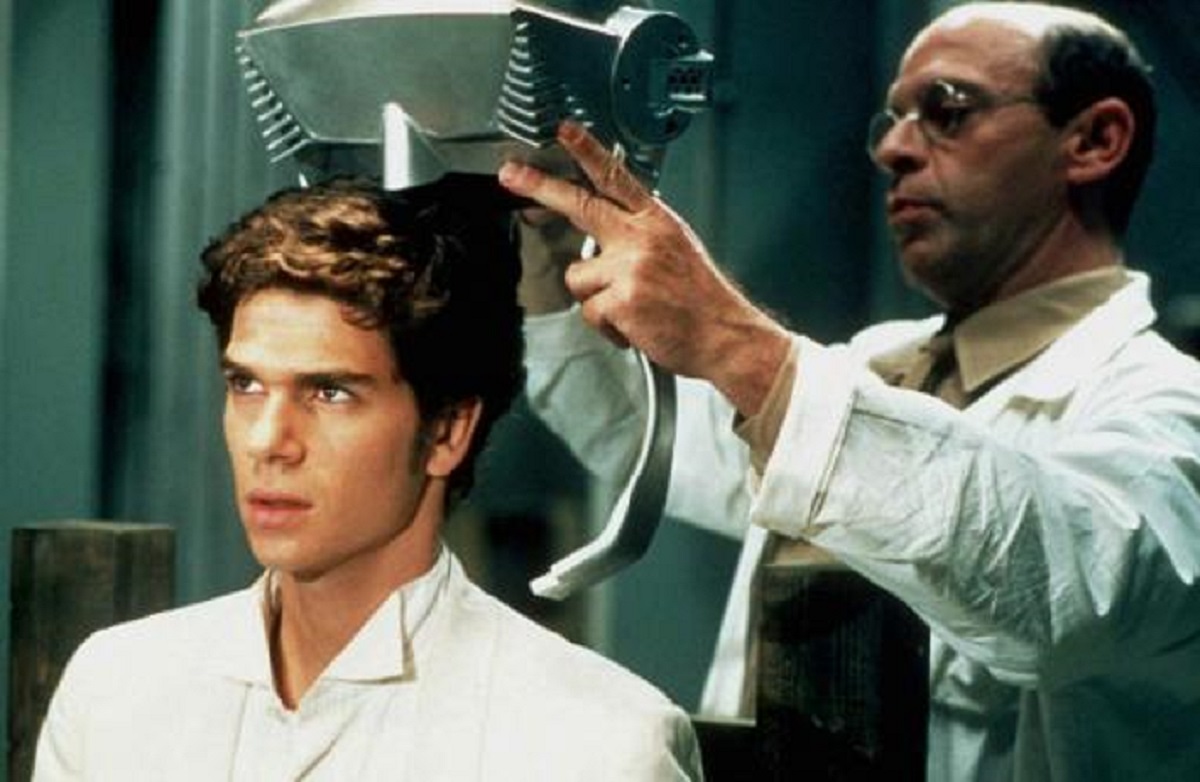
This Israeli-financed film was a biopic of Uri Geller’s life. Ken Russell was brought in to direct. Russell is a British director who courted outrage with films such as Women in Love (1970), The Devils (1971), Lisztomania (1974) and Tommy (1975) and was once one of the celebrated arthouse directors. (See below for Ken Russell’s other genre entries). In the 1980s and 90s, Ken Russell’s star has fallen considerably and he has struggled for the recognition he once held and was eventually forced to take on low-budget hackwork like this.
Mindbender appears to be taking itself deadly serious. As the credits tell us: “Uri is not a magician. He is using capabilities we all have and can develop. You will get a chance to practice with Uri at the end of the film.” On the other hand, the serious intent of the endeavour seems to be fighting with Ken Russell’s characteristic proclivities towards turning the film into a lunatically over-the-top madhouse. As the credits also ominously note “The following events are interpreted through the eyes of Ken Russell.” [my emphasis]. The nuttiness of Ken Russell’s ‘interpretation’ starts in from the moment the credits play – one is not sure what the biopic of a supposedly real psychic has to do with images of the Moon Landing and footage of Earth and the galaxy, all while Elton John’s Rocket Man (1972) plays on the soundtrack. It is clearly Ken Russell in a full flight of lunacy a la Tommy – the early scenes at an open-air school take place against a building, the different faces of which have been painted with a Dali melting clock; Uri’s father takes his belt off to give Uri a beating but contrarily rock music starts playing on the soundtrack; and there are randomly intercut images of crabs on a beach and toy UFOs.
Ken Russell’s films of the late 1980s became increasingly tongue-in-cheek. Here when it comes to the scenes at Terence Stamp’s house with Geller teleporting dogs and moving tennis balls and windup toys, you are not sure whether you are meant to be taking any of it seriously at all. There is an hysterically awful scene outside a casino (which looks suspiciously like a pool beside a mansion) where the door is blown off Geller’s limousine by a psychic storm, money he has just won at a gambling table blows everywhere and Geller starts twirling around in mid-air, all supposedly because he used his powers for personal gain.
Even funnier is the scene where Geller breaks out from military custody, which looks more like it belongs in a Scanners sequel rather than something that is attempting to be a serious biopic. Here Geller escapes the lab, using his powers to knock out soldiers and scientists, bending the guns aimed at him and the gates in his way, while at the same time as driving a car while wearing a sensory deprivation helmet that covers his eyes and navigating psychically, before finally teleporting into Terence Stamp’s living room, landing on the couch and nonchalantly asking “Am I late for lunch?” It is a scene that can be guaranteed prize status in any future collection of laughably bad screen moments.
The actor cast as Uri Geller, Ishai Golan, plays with an annoyingly arrogant manner. Moreover, he improbably looks about the age of fifteen throughout. The entire film, even the parts of the Americans, has been cast with Israelis who speak English through often thick accents.
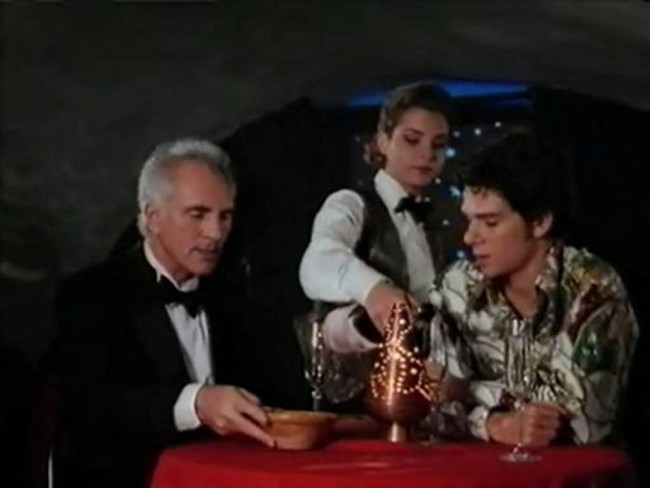
Mindbender sinks down to a level of true ineptitude. It is an entirely laughable film on almost every single count. In a few years, it is probably going to be revived and deemed worthy of Golden Turkey status. It is hard to believe that this laughable rubbish can come from the same director who made fine works such as The Devils and the underrated likes of Altered States (1980) and Crimes of Passion (1984).
What is also particularly noticeable is the film’s overwhelming endorsement of the actuality of Uri Geller’s powers. The film depicts a number of occasions when considerable doubt might have been placed on whether Geller was making it all up or not and then blithely ignores or dismisses any sceptical enquiry – like the time Geller is exposed for the fact that his volunteer chose his own wife as accomplice during the stage act. (Who is to say that this may not have been a genuine occasion when Uri Geller was exposed, when we have only his on-screen character’s claim that he did not know). Or when Geller’s photos of supposedly a UFO are revealed as identical to the lampshade in his house. Or where, after Geller’s famous tv performance during which he brought the microphone towards the clocks on the stage and revealed them all to be ticking, people later reported finding a tape recorder in his pocket. Or the very fact that the scientist (Terence Stamp) who supposedly brought Geller to America and measured his powers had all records of his experiments mysteriously erased and has himself gone off exploring in South America and cannot be traced ie. have Geller’s claims independently corroborated.
All of these, which would normally be strong reasons to doubt the authenticity of Geller’s claims, are raised by the film but dismissed without the blink of an eyelid. Mostly though, there is the plain lack of conviction to Uri Geller’s claims – if there was someone who had such frighteningly powerful superhuman abilities, including being able to teleport, kill people, levitate objects and bend metal, does it seem credible that he would waste his time putting them at the service of mere showmanship?
There is a funny ending that flashes forward into the future and supposedly gives us a telecast from the Sydney 2000 Olympic Games, which we are told now hosts spoon-bending events, while Ishai Golan, still looking fifteen (the real Geller was 55 at the time), turns up and asks everybody to touch their hands to the screen and concentrate on disarming nuclear weapons. Finally, the credits roll and then stop in mid-flow, whereupon the real Uri Geller appears. As the opening credits promise, he does show people how to harness their psychic powers – he demonstrates how to make a watch work by holding it in his hands and then asks viewers to touch their hands to the screen and concentrate on uniting the whole world in positivity. The cod showmanship of it all is hysterical. At least the real Uri Geller has a polished showman’s charm that Ishai Golan in playing him on-screen utterly fails to project.
Ken Russell’s other films of genre interest are:– the spy film Billion Dollar Brain (1967); the historical witch persecution film The Devils (1971); the quite deranged surrealist adaptation of The Who’s rock opera Tommy (1975); the sf film Altered States (1980); the psycho-sexual thriller Crimes of Passion (1984); Gothic (1986), centred around the events leading up to the inspiration for Mary Shelley’s writing Frankenstein (1818); the spoofily over the top adaptation of Bram Stoker’s The Lair of the White Worm (1988); The Fall of the Louse of Usher (2002), Russell’s demented home movie take on Edgar Allan Poe; and an episode of the horror anthology Trapped Ashes (2006).
(Winner for Worst Film in this site’s Top 10 Films of 1996 list).
Full film available here