

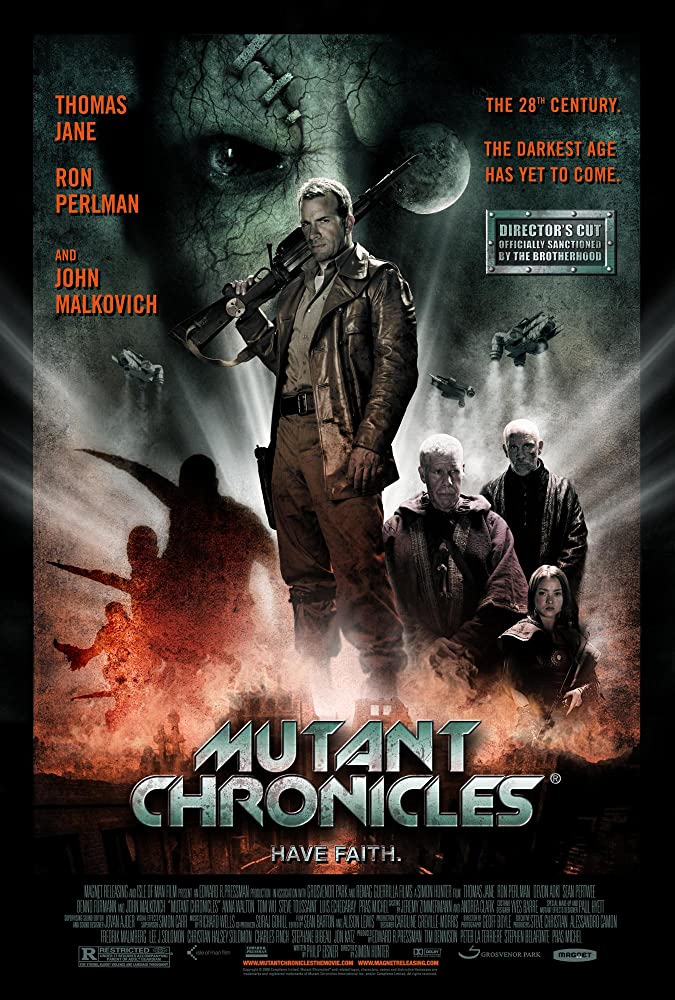
Crew
Director – Simon Hunter, Screenplay – Philip Eisner, Based on the Mutant Chronicles Role-Playing Game by Target Games, Producers – Stephen Belafonte, Tim Dennison, Peter La Terriere, Pras Michel & Edward R. Pressman, Photography – Geoff Boyle, Music – Richard Wells, Visual Effects Supervisor – Simon Carr, Visual Effects – Baseblack, Dinamo Productions (Supervisor – Llyr Williams), Lipsync Post (Supervisor – Glen Pratt), Men From Mars (Supervisor – Phil Attfield), Miniature Effects Supervisor – Leigh Took, Miniatures – Mattes & Miniatures Ltd, Special Effects Supervisor – Graham Longhurst, Makeup Effects Designer – Paul Hyett, Production Design – Caroline Greville-Morris. Production Company – Isle of Man Film/Edward R. Pressman Productions/Grosvenor Park/Remag Guerrilla Films/Campfame Ltd.
Cast
Thomas Jane (Major Mitch Hunter), Ron Perlman (Brother Samuel), Devon Aoki (Corporal Valerie Duval), Benno Fürmann (Maximilian von Steiner), Sean Pertwee (Captain Nathan Rooker), Anna Walton (Severian), Tom Wu (Corporal Juba Kim Wu), Steve Toussaint (Captain John Maguire), Luis Echegaray (Captain Jesus de Barrera), John Malkovich (Constantine), Roger Ashton-Griffiths (Science Monk), Shauna MacDonald (Adelaide Rooker)
Plot
It is the year 2707 where civilisation has collapsed and the world is now dominated by four powerful corporations, which are at war with one another. Across the war zone, there suddenly emerge hordes of mutants that have been birthed by a Machine that fell from the stars and was locked away beneath the Earth thousands of years ago. The mutants slaughter everything in their path. As the onslaught reaches the cities, the corporations plan to evacuate their elite to other planets and abandon Earth to the mutants. Brother Samuel belongs to an order of monks that have tended the sacred scriptures in wait for the preordained coming of those that will defeat The Machine. He begs Constantine, the CEO of Capitol Corporation, for the chance to take an army down beneath the Earth to destroy The Machine and fulfil the prophecy. Brother Samuel is given a handful of offworld passes as bribe and recruits a ragtag team of soldiers to enter the caverns. Led by Major Mitch Hunter, the group soon find themselves engaged in a to-the-death battle against the hordes of mutants.
Mutant Chronicles was originally a role-playing game that was created in 1993 by the Swedish company Target Games. The gamebook created an elaborate future history involving a post-apocalyptic Earth where humanity had spread out among the planets and everything was ruled by five corporations. The exploration of the outer planets had accidentally opened the gateway to another dimension and unleashed the Dark Legion, a horde of mutants and other assorted nasties. Players could adopt the roles of soldiers, clerics and corporate executives as they fight various menaces. A Mutant Chronicles film had been announced since the 1990s with various names including Stephen Norrington and John Carpenter being listed as director.
For a project that gained some high-profile durability and passed through various hands for several years, Mutant Chronicles emerges as surprisingly trivial in the end result. It feels like little more than one of the Resident Evil sequels, which it has many similarities to in both style and plotting. Despite a number of impressive names in the cast line-up – Thomas Jane, Ron Perlman, John Malkovich, Sean Pertwee, the great and underrated Devon Aoki, German star Benno Fürmann – the film only had a limited release on two screens in the US before being dumped straight to dvd/cable, for instance.
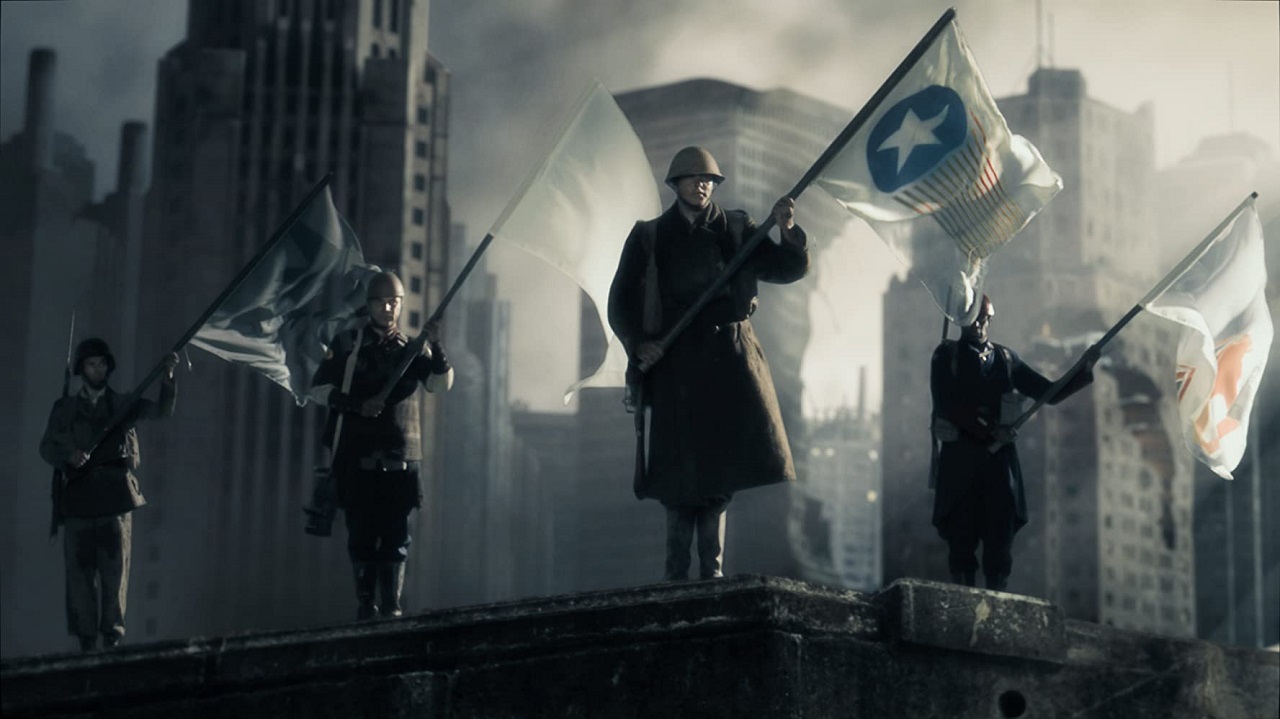
The early scenes plunge us into a bewildering world (although one that is very different to the background of the role-playing game). The film has created its future by shooting digital backlot (where the actors play out in front of a green screen and the backgrounds are later inserted digitally) a la a number of recent other genre works such as Immortal (ad vitam) (2004), Sky Captain and the World of Tomorrow (2004), Casshern (2005) and Sin City (2005). This allows the creation of a fascinatingly atemporal retro-future filled with digital cityscapes, battlefields, a mining complex and so on.
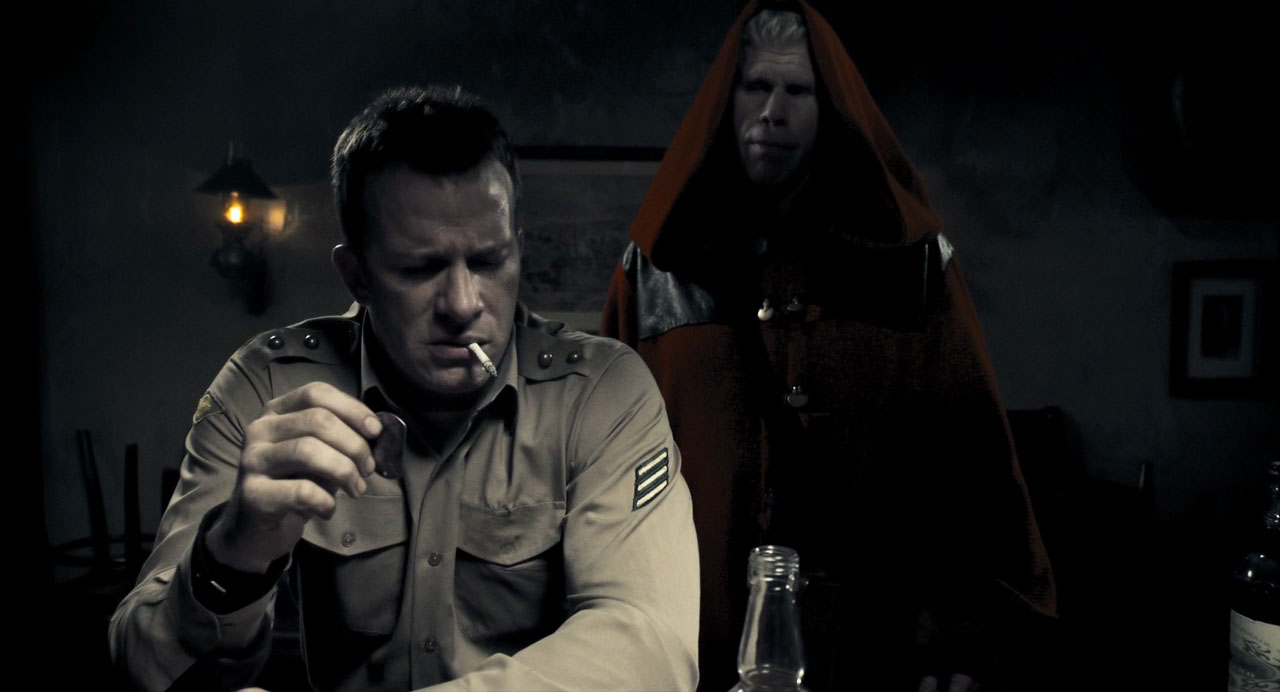
You are fascinated during the initial scenes trying to get a hold on the film’s scenario – the first few minutes, for instance, seem to be taking place in a World War I trench setting, albeit a trench warfare film crossbred with something like 28 Days Later (2002). Elsewhere people seem to be dressed as though they were in a World War II era film.
At the same time, all of this quickly emerges as the most trivial, most perfunctorily designed digital future we have seen on screen so far. (Although, I must say I did like the vision of a coal-powered armoured personnel flyer). Visually, everything has been muted to a dull dun brown, which causes the digital backgrounds to look exactly like one is watching a low-resolution computer game.
The larger problem with this is that Mutant Chronicles creates a world – a look that is clearly the future yet where everything is designed like the past; a complex background where humanity has spread out among the planets and corporations have replaced nations; a backstory involving a series of religious prophecies about The Machine that fell to Earth, was banished to the underground and has now created an army of mutants; a predestined hero come to defeat The Machine – but does almost nothing on either a writing, design and texture level to make any of it seem like a real world. We keep wanting to know more about the prophecies, what The Machine is, why the future looks like the past and so on, but the film offers nothing in terms of explanations. (Either that or the producers were hoping for a series of sequels in which these things might be elaborated).
The film creates a great line-up of characters with an interracial Dirty Dozen of sorts and sets them on a to-the-death suicide mission to save the entire world. This is something that holds great potential. However, the great pitfall that Mutant Chronicles then stumbles into is that it does absolutely nothing to make any of these characters interesting in any way. The distinctive mark of these Dirty Dozen films is creating a team of tough, acerbic individuals, each of which comes with their own unique distinguishing quirks and each of whom has been chosen for their own area of expertise. On the other hand, here the differences between the characters amounts to no more than their differing ethnicities and dress sense, sometimes the weapons they wield – such that we could not care less when they start dying.
Simon Hunter was a Scottish-born director who had previously made the hard-edged thriller Lighthouse (1999). After Mutant Chronicles flopped (only $2.1 .illion worldwide against a $25 million budget), it was nearly a decade before Hunter made another film with Edie (2017), a film that seems at opposite extremes to this in which a woman in her eighties climbs a mountain, although has made nothing since then.
Hunter creates some big flashy effects and action sequences – the mid-air suicide attack on the warship, the descent down the lift shaft, the venture through the mutants lair – but these, while technically accomplished, amount to surprisingly little. This is a film that entirely exists in terms of a surface glitter that is of paper-thin substance.