
Crew
Director – Howard McCain, Screenplay – Dirk Blackman & Howard McCain, Producers – Chris Roberts & John Schimmel, Photography – Pierre Gill, Music – Geoff Zanelli, Visual Effects Supervisor – David Kuklish, Visual Effects – Digiscope (Supervisor – Brennan Prevatt), Fantasy II Film Effects (Supervisor – Gene Warren Jr), Spin (Senior Supervisor – Jeff Campbell), Special Effects Supervisor – Tony Kenny, Creature Effects – Tatopolous Studios (Designer – Patrick Tatopoulos), Makeup Effects/Prosthetics – Caligari Studio, Production Design – David Hackl. Production Company – Ascendant Pictures/The Weinstein Company/Virtual Films/VIP 4 Medienfonds/Rising Star.
Cast
Jim Caveizel (Kainan), Sophia Myles (Freya), Jack Huston (Wulfric), John Hurt (Rothgar), Cliff Saunders (Boromir), Bailey Maughan (Eric), Ron Perlman (Gunnar), Patrick Stevenson (Unforth), Adam Devine (Einar)
Plot
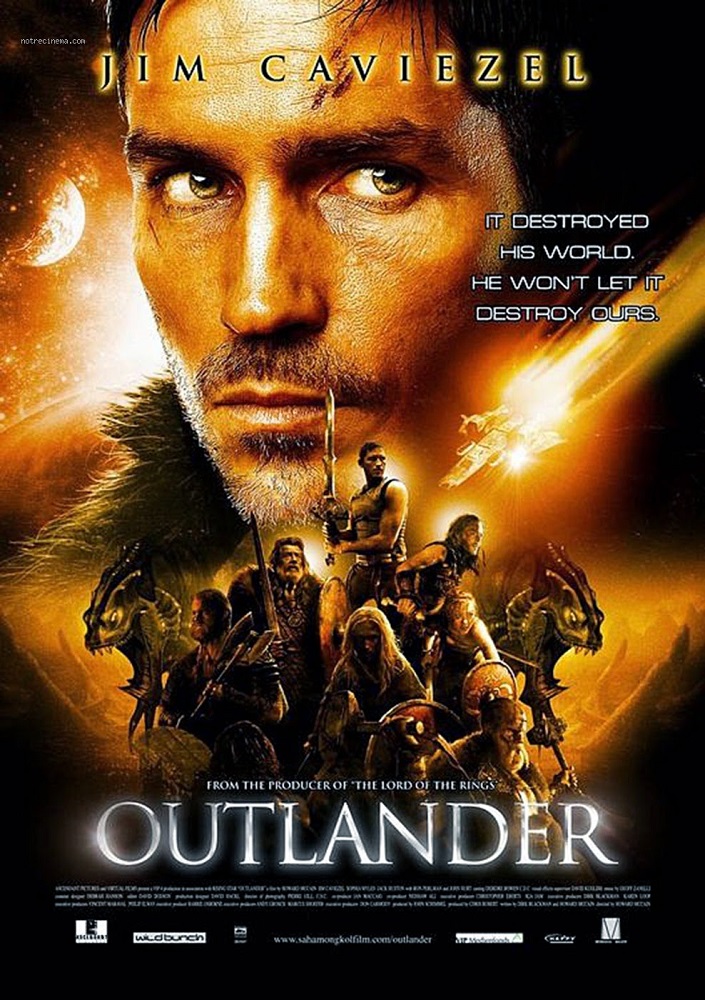
A spaceship crashlands in Norway 709 A.D. and a sole survivor Kainan emerges. Kainan absorbs local language and starts hunting after a creature that has been brought to Earth with him. However, he is captured and taken as prisoner by a village of Vikings. The village then comes under attack by the creature that slaughters everything it encounters and proves invulnerable to the Vikings’ attempts to defend against it. Kainan tells them that the creature is a Morwen, the native lifeform from a planet his people colonised and slaughtered its inhabitants. He has come hunting the single surviving Morwen after it killed his family. As the villagers realise what Kainan is saying is true, they must trust his methods in order to trap and destroy the Morwen.
Outlander is an interesting film. (Despite a title that makes it sound like a sequel to the 1980s classic Outland (1981), it is unrelated). The project was originally conceived in the 1990s by Howard McCain who at the time had only directed the comedy No Dessert Dad Till You Mow the Lawn (1994) and a couple of cable thrillers The Unspeakable (1996) and Perfect Prey (1998). McCain’s directorial career dried up after that point – subsequently, he has only written the screenplay for Underworld: Rise of the Lycans (2009) – nevertheless the Outlander project gained a prominence.
The script was at one point taken up as a directorial project for Renny Harlin and was to have been shot in New Zealand as designed by the Weta Workshop and starring Karl Urban. The script went through various development hiccups before Howard McCain eventually inherited the director’s chair, Jim Caviezel the lead and the production was shot in Newfoundland and Nova Scotia on a stripped-down budget. The finished film received exceedingly disappointingly box-office returns, being indifferently distributed is the US without any publicity and grossing a mere $160,000 despite a $50 million budget.
Howard McCain always intended Outlander as a version of the epic poem Beowulf translated into Viking culture. Co-writer Dirk Blackman later added a science-fictional interpretation. More interestingly, when Howard McCain conceived Outlander in the 1990s, there were no previous screen adaptations of Beowulf. However, by the time Outlander was eventually released, it came out amid a host of competing versions of Beowulf. There had been the Michael Crichton adaptation The 13th Warrior (1999), which also attempted a science-fictional adaptation that dropped the story into Viking culture, and the cheap Beowulf (1999) that transplanted the story into a post-holocaust setting. Around the same time as this, there were a number of other more traditional versions of the story such as Beowulf & Grendel (2005) (which Outlander borrows some of the costumes from) that set the story in a pseudo-historical milieu; Grendel (2006), an adaptation for The Sci-Fi Channel; Robert Zemeckis’s high-profile animated Beowulf (2007); and the low-budget Beowulf: Prince of the Geats (2007).
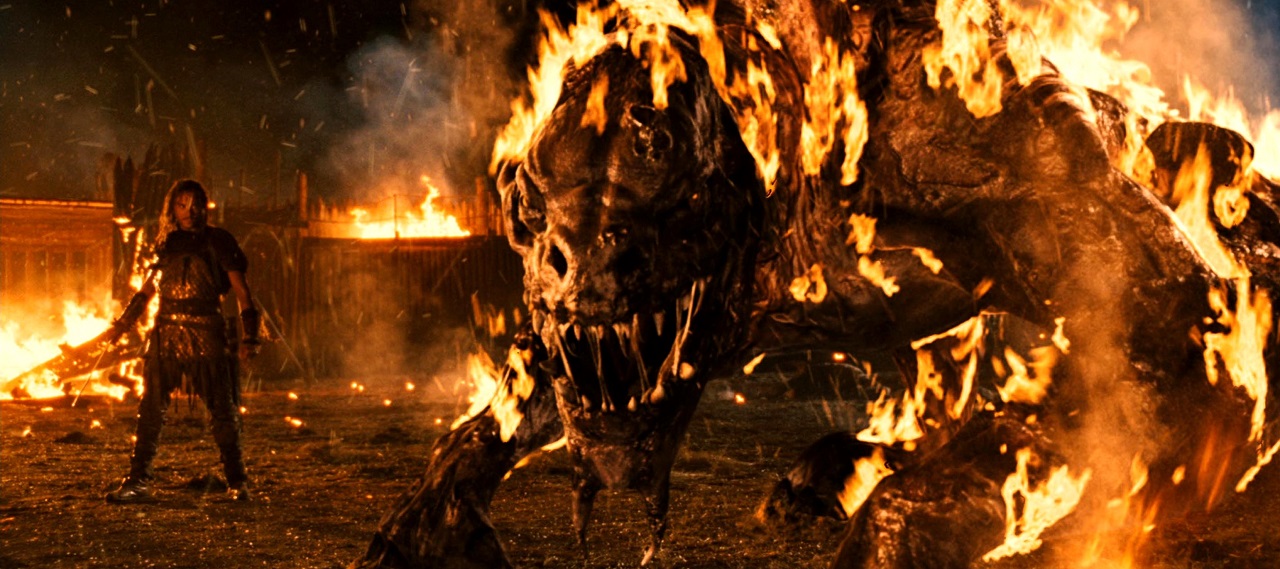
Visually, Howard McCain does well on the budget he has. The first ten minutes of the film are arresting, all fast, blurred action, epic flourishes of landscape and no dialogue in English (only Ancient Norse apparently) until we arrive at the Viking village. Thereafter Outlander works reasonably well in terms of the brutal, primal action scenes that this genre specialises in. Howard McCain makes a good stab at creating the historical milieu with verisimilitude and serves up the sword battle scenes with an admirable bloody brutality – where he has taken more than a few leaves from John McTiernan’s work in The 13th Warrior. The scenes pursuing the Morwen through the village and trying to trap it are well staged, even if the monster does look a little too much like a CGI effect.
It is interesting to look at the things that Outlander has done to the story of Beowulf. Beowulf, the warrior who arrives in Denmark from Geatland, is now cast as a humanoid alien who is stranded on Earth, while Grendel becomes an enraged alien monster that has been carried to Earth and slaughters all in the nearby vicinity. What we have now resembles less a version of Beowulf than it seems like The 13th Warrior mashed up with Alien (1979) or Predator (1987).
The monster’s appearance lit up from within by flashes of red just before it attacks people is original, if not entirely biologically convincing. Some of the best images are the visual effects scenes of the carpet-bombing of the Morwen homeworld, followed by the bulldozing of the Morwen bodies into mass graves. However, the problem with these scenes is that they create too much sympathy for the Morwen – it turns it from a ferocious monster into a sympathetic creature that is justly aggrieved about humanity’s treatment of it (as we see in most modern adaptations of Beowulf). However, this sits at odds with the portrayal of the Morwen creature everywhere, where it seems to be no more than a ravening monster in pure black-and-white terms without any sympathy or ambiguity.
Jim Caviezel plays the title role as serious, tight-lipped and grimly intent. As is frequently the dictum for these roles, the character’s dialogue has been stripped away to a minimum and Caviezel comes out with a moopy Jean-Claude Van Damme-like blankness. This works well enough for what the role initially seems but then about the 47-minute mark, the script requires Caviezel to suddenly open up and be accepted among the Vikings, join in the partying and romance Sophia Myles whereupon the effect is abruptly alienating because up to that point Caviezel has been such a primal blank as a character. The best member of the cast is John Hurt who radiates wisdom as the Viking king – unfortunately, the one thing that John Hurt does not have is physical stature and looks diminutive when cast as the role of a supposedly burly, fearsome Viking.