

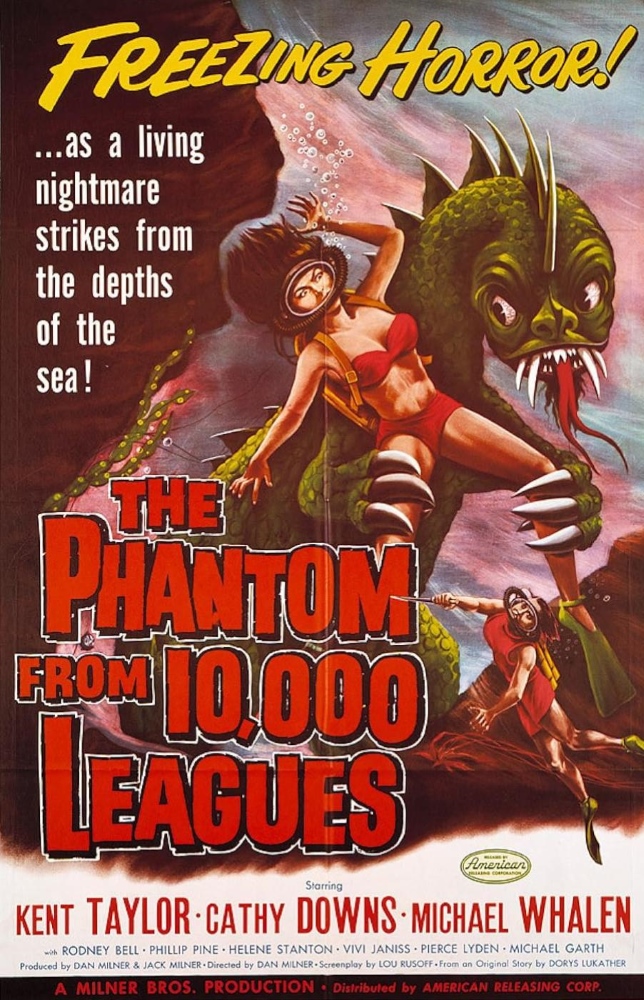
Crew
Director – Dan Milner, Screenplay – Lou Rusoff, Story – Dorys Lukather, Producer – Jack Milner, Photography (b&w) – Brydon Baker, Music – Ronald Stein. Production Company – Milner Brothers Productions.
Cast
Kent Taylor (Dr Ted Stevens), Kathy Downs (Lois King), Michael Whalen (Professor King), Rodney Bell (Bill Grant), Philip Pine (George Stevens), Vivi Janiss (Ethel Hall), Helene Stanton (Wanda)
Plot
Defense Department investigator Bill Grant and oceanographer Ted Stevens, the author of a controversial book on the effects of radiation on marine life, meet on a beach to investigate a dead body found there. Stevens finds a source of radiation on the seabed not far offshore and discovers that this has created a mutant monster that is now killing divers. Stevens goes to ask the help of Professor King, who runs a nearby oceanographic institute but King proves evasive. At the institute, both Grant and King’s duplicitous assistant try to get into the professor’s locked laboratory and discover the nature of the experiments he is conducting there.
Despite a misleading title – the word ‘phantom’ tends to suggest a supernatural horror film – this is actually an atomic monster movie. The Phantom from 10,000 Leagues is an independently made cheapie that was clearly rushed out to exploit the success of two then-recent films – The Beast from 20,000 Fathoms (1953) and The Creature from the Black Lagoon (1954). From the former it borrows the theme of an atomically-revived monster and from the latter the design of a bipedal reptilian monster. Plus the title is a more-than-passing attempt to catch some of the wake of the previous year’s Disney success 20,000 Leagues Under the Sea (1954).
Even as cheap 1950s monster movies go, The Phantom from 10,000 Leagues is dull. The direction is dreary and uninspired. The title monster rarely appears. During the occasionally times we do see the phantom, it proves to only be a cheap and unconvincing monster suit. Even then, it gets up to almost nothing. In fact, there is more threat posed by the sinister lab assistant (Philip Pine) lurking on the sand dunes with a speargun than there ever is by the monster. Indeed, with almost criminal dullness, the film is not even centred around the threat posed by the monster but the attempts of various parties to break into the professor’s lab and determine what experiments he is conducting behind locked doors. The film does at least occasionally venture underwater, although the diving scenes are slow and melodramatic.
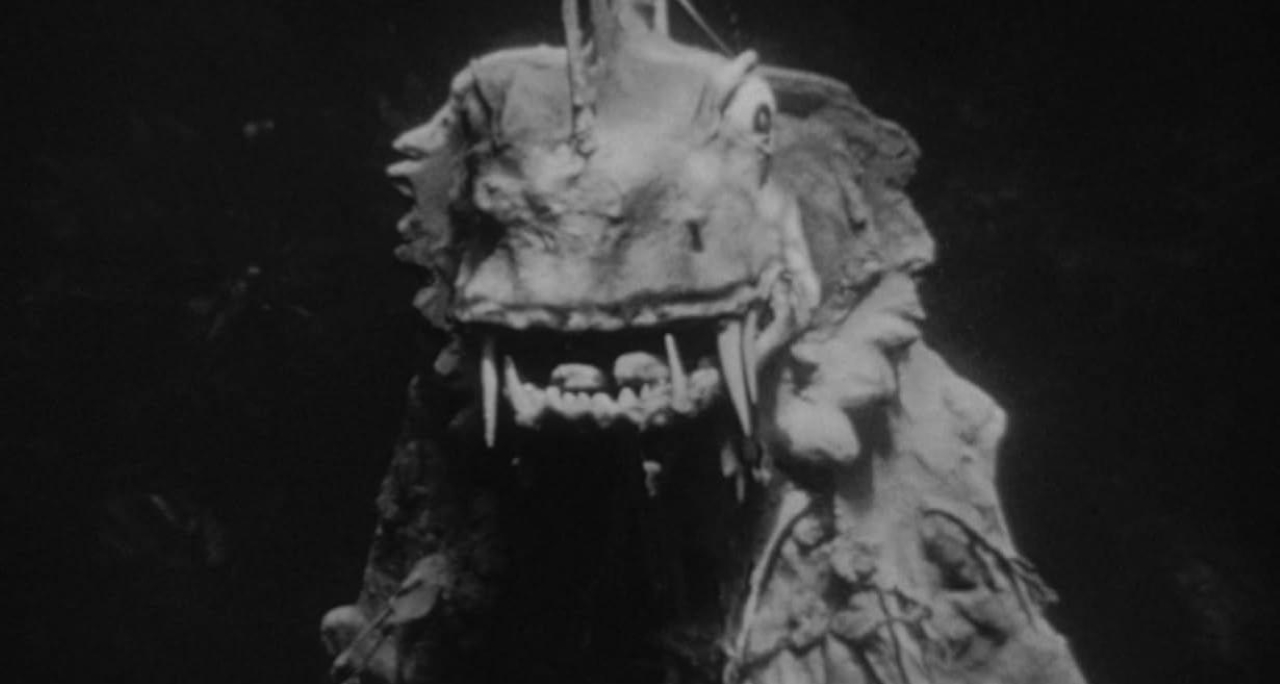
The film trots out all the lines about delving into forbidden science that were loved by mad scientist films of the previous decade. The professor reflects: “Science is a devouring mistress. She devours all who seek to fathom her mysteries and for every secret she reveals, she demands a price, a price that a scientist must be prepared to pay with his life and the life of those who stand in the way of his search.” As the film ends, it is reflected that: “Nature has many secrets that man mustn’t disturb and this was one of them.”
The Phantom from 10,000 Leagues was the first of three films made by director Dan Milner and his brother Jack. Milner later returned to atomic monster themes with the bad movie classic From Hell It Came (1957) about a possessed tree.
Full film available here:-