

Crew
Director/Screenplay/Producer/Music/Production Design – Shane Carruth, Photography – Shane Carruth & Anand Upadhyaya. Production Company – none listed.
Cast
Shane Carruth (Aaron), David Sullivan (Abram Terger), Carrie Crawford (Kara), Casey Gooden (Robert), Anand Upadhyaya (Phillip)
Plot
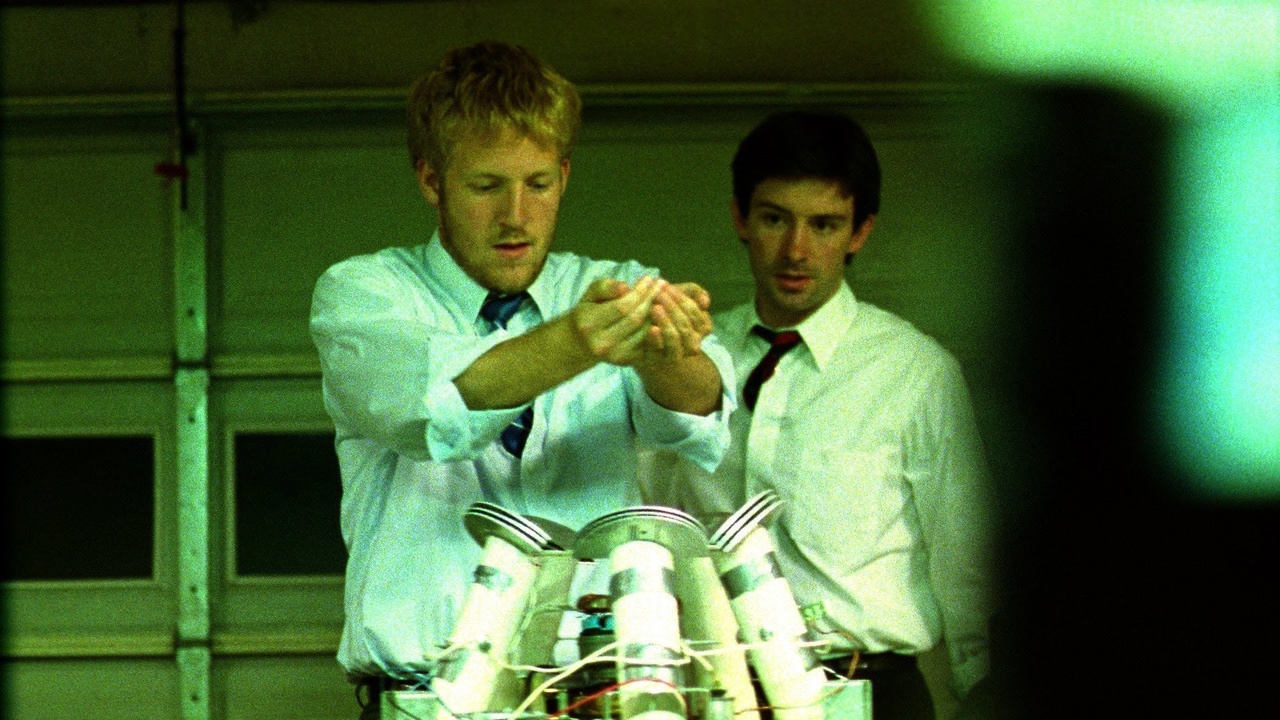
Aaron and Abe, two good friends living in Texas, come together to construct an engineering project. After building a working prototype of the machine, they discover that they have no idea what it does. It cultivates bacteria in rapidly accelerated time-periods and produces strange physical readings when objects are placed inside. They experiment with the idea of sending an object between the two poles in a way that interrupts and reverses its passage. After doing so, they are startled to see themselves emerge from a storage facility. They enter the locker to find a much more elaborate working version of the machine and realise they can use the reversal method to emerge further ahead or behind in time. They use this to obtain future stock results, all the while keeping their present selves out of the way in a hotel room in order to prevent causal corruption. However, as they try to correct mistakes, they find themselves trapped in a nightmare of compounding errors.
Primer arrives following a good deal of acclaim, having won the award for Best Drama at the 2004 Sundance Festival. It is a highly intelligent and strikingly original science-fiction film. In tone, it falls somewhere between Pi (1998) and Startup.com (2001), at least during its first half – of Pi‘s sense of an all-important scientific breakthrough that is going to bend reality, the nature of which is essentially withheld from the audience, and of Startup.com in the sense of a camera crew following two pioneers documentary-style through an important new tech development.
The film has been made on a minimalist budget and shot entirely on location on digital video. It is the work of newcomer director Shane Carruth, who conducts most of the major tasks behind the camera and also plays one of the two leads – he’s the dark-haired scientist. Expect to hear more from Shane Carruth soon.
Primer has certainly attracted some mixed responses. Audiences walked out of this film festival screening confused and puzzled about what was going on. It is certainly a film that insists that you work with it and pays no heed to anybody that cannot keep up. At times, it feels like several crucial incidents have been removed from the storyline or else the story condensed in some way. I came out at the very least wanting a number of points clarified and answered. Who set up the apparatus that the two characters find in the storage container? What is the significance of the person pursuing them? Why is someone unconscious in the guest bedroom? I also felt like I needed more illumination regarding the scene where someone starts shooting at a cocktail party and what significance it has to the causal mix-ups.
The trouble is that some important plot points are introduced so casually that we don’t understand their significance amid the density of information presented and are then left struggling to try and tie them together. If one dare suggest, this is a film where a more mainstream and commercial handling might have made something that was a good deal easier to understand.
Despite being difficult to follow, there is a compulsive fascination to the film. There is the sense of seeing two people rationally puzzling over a scientific phenomenon they do not understand. Shane Carruth has his camera sit and observe naturalistically, as though the film were a documentary, while the reactions of the characters are underplayed, which adds considerably to the effect. The dialogue is densely layered, with the two actors playing it as though they meant every word of it, and Carruth runs it all over the top of itself in such a way that it is the dialogue ends up driving the pace of the film.
The initial scenes with the two engineers piecing together the machine and puzzling over the increasingly stranger readings hold something intensely captivating. There is an even greater fascination when we get to them moving through and editing time, in seeing some of the reactions, and the increasing panic as everything starts going out of control. Even though one fails to understand why, the ending eventually arrived at becomes something disturbing.
Shane Carruth next went onto direct, write and star in Upstream Color (2013), a baffling film that appears to be a series of vignettes made without any connecting plot.