


Crew
Director – John Carpenter, Screenplay – Martin Quatermass [John Carpenter], Producer – Larry Franco, Photography – Gary B. Kibbe, Music – John Carpenter & Alan Howarth, Visual Effects Supervisor – Frank Grasmere, Special Effects – Kevin Quibell, Makeup Effects – Frank Carriosa, Production Design – Daniel Lomino. Production Company – Alive Films.
Cast
Donald Pleasence (Priest), Jameson Parker (Brian Marsh), Victor Wong (Professor Howard Birac), Lisa Blount (Catherine Danforth), Dennis Dun (Walter), Anne Howard (Susan Cavett), Ann Yen (Lisa), Susan Blanchard (Kelly), Ken Wright (Lomax), Dirk Blocker (Mullins)
Plot
While investigating the death of an aging colleague, a priest uncovers the existence of the Brotherhood of Sleep, a secret order within the Catholic Church. In the basement of the Brotherhood’s St Goddard’s priory in San Francisco, the priest finds a strange cylinder of glowing green liquid. He brings in Howard Birac, a physics professor friend, to investigate the cylinder. Birac brings several graduate students with him but the more they look, the more puzzling the cylinder becomes – the text surrounding it contains a set of ancient differential equations written in Latin and the canister itself is carbon-dated at being seven million years old and appears to locked so that it can only be opened from the inside. The canister then comes to life, the liquid entering the mouths and taking over several of the students and animating the derelicts outside the church. The team discover that they have woken what the texts call the ‘prince of darkness’, the Devil, which is part of an anti-universe that exists at a quantum level inside our own, waiting to take over and occlude this universe.
It is fashionable to slag the career of John Carpenter as a downward spiral since Halloween (1978), with only the odd hiccup like The Thing (1982) standing out. Certainly, since the mid-1980s, John Carpenter’s films have lacked a certain spark and he has failed since then to turn out any films on the order of The Thing or at least Escape from New York (1981). That said, the majority of John Carpenter’s films – barring occasional flops like Village of the Damned (1995) and Ghosts of Mars (2001) – remain consistently watchable. Prince of Darkness is usually dismissed as one of John Carpenter’s worst. I tend to argue otherwise, mostly for the very reasons that it is usually dismissed – Carpenter’s profusion of wild ideas. Prince of Darkness is perhaps the most difficult film in John Carpenter’s oeuvre to attempt to argue in favour of though.
John Carpenter is by his own confession a big fan of British writer Nigel Kneale, best known as the creator of the Quatermass tv shows and films. [See The Quatermass Xperiment/The Creeping Unknown (1955)]. Carpenter attempted to import Nigel Kneale to write his once-planned remake of The Creature from the Black Lagoon (1954) and employed him to write the script for the Carpenter-produced Halloween III: Season of the Witch (1982), which ended with unsatisfactory results on Kneale’s part. Prince of Darkness bears more than a few similarities to Nigel Kneale’s Quatermass and the Pit/Five Million Years to Earth (1967). In Quatermass and the Pit, Kneale had a construction team working on the London Underground unearthing an artifact (a rocketship) that contained alien bodies, which ended up triggering all manner of latent psychic phenomena. Kneale ingeniously used the idea to explain occult outbreaks and ghosts as buried psychic talents and the concept of The Devil as being a racial memory of horned aliens.
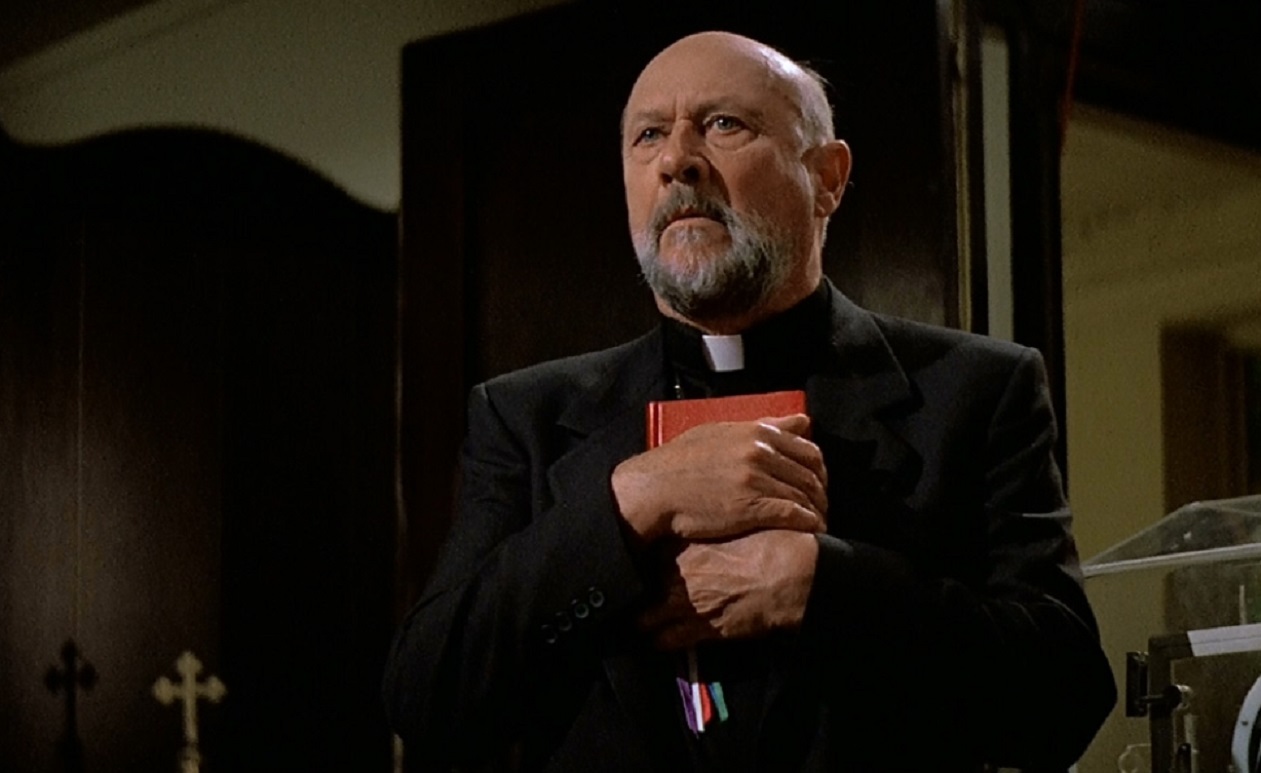
Prince of Darkness feels like John Carpenter has attempted to jump onto the same ingenious blend of rationalised myth and science-fictional explanations that Nigel Kneale engages in, albeit with slightly less conceptual coherence. Prince of Darkness could maybe be Quatermass and the Pit with a few dashes of Kneale’s tv play The Stone Tape (1972), which was about investigators probing ghostly phenomenon, thrown in. Carpenter cheerfully acknowledges his source material by taking the pseudonym ‘Martin Quatermass’ on the script. (Even more amusing is the press kit bio that came out with the film for ‘Quatermass’, which calls him the brother of the famous Bernard Quatermass, founder of the British Rocketry Group).
A good many people dismiss Prince of Darkness as pretentious nonsense. It is not hard to see why – anybody without a fair smattering of quantum physics is going to find it incoherent. But heck, if you do, why not be snobbish. Prince of Darkness may not make much sense but it is nice to be able to sit down and see something written by someone who speaks the same language that you do. It is an ingenious twist on classical occultism – one where The Devil is an anti-universe that exists at the level of quantum uncertainty waiting to occlude this one. It is as though John Carpenter has gone through a freshman year in physics and religious studies and put his wildest imaginings on paper in a conceptually mind-boggling series of meditations on tachyon particles, anti-matter theory and Schroedinger’s cat existentialism.
Not to say that John Carpenter doesn’t lose his hold occasionally. The conceptually mind-boggling ideas don’t always easily connect with the more visceral nonsense about possessed derelicts and students running around infecting one another with mouthfuls of green liquid. (The idea that Carpenter throws up – that The Devil is easily able to possess both insects and derelicts because they are lower forms of life – holds some not very nice implications about the socially dispossessed).
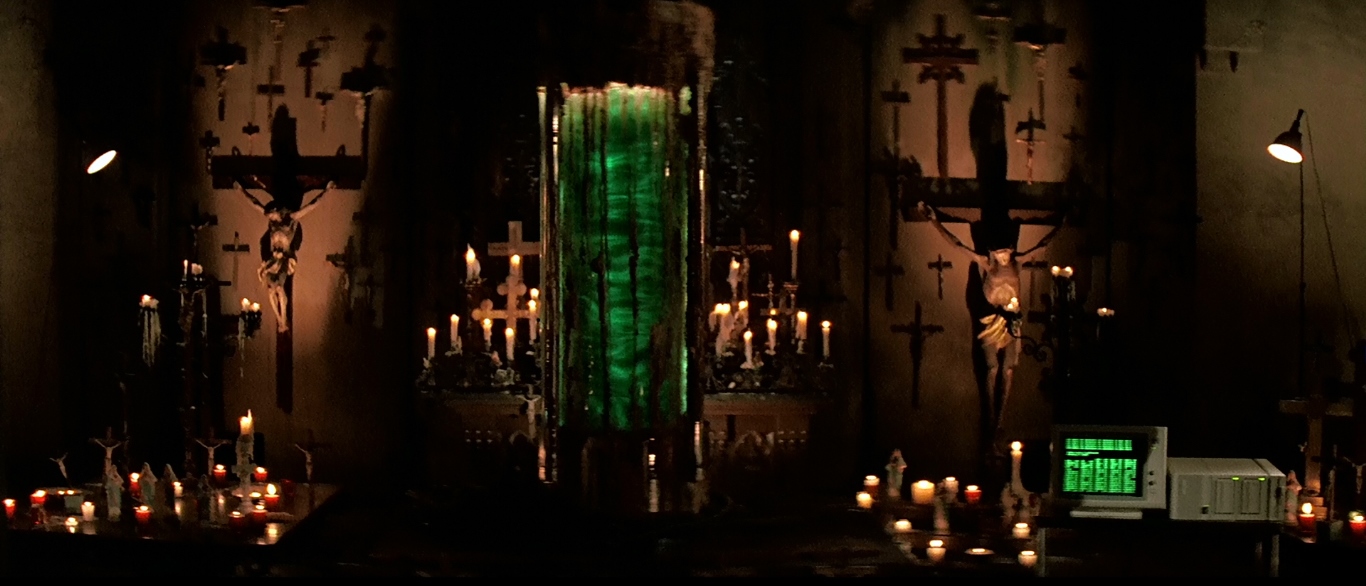
However, Carpenter is far too good a director to let the scare-show side of things down and some of the images – with characters becoming possessed by streams of green piddle, crawling their way up others’ slumbering bodies and the climactic tension with the possessed closing in on the remaining survivors – emerge as way-out. The twist ending tachyon dream is one that disturbs long after leaving the theatre even if one is not sure why. Certainly, there are also scenes that are silly – one student getting dispatched by bicycle impalement (from no less than a derelict played by Alice Cooper), while some of the makeup looks cheesy.
There is another good sinister and pulsing Carpenter electronic score. If there is anything to make a case for John Carpenter’s downwards slide it is in that he lets a fine cast, including Carpenter regulars Donald Pleasence and Victor Wong, slide through his hands in a series of unanimously flaccid performances. Leads Jameson Parker and Lisa Langlois are blank and forgettable, and it is only Dennis Dun, a returnee from Carpenter’s Big Trouble in Little China (1986), whose lively, jocular character in any way comes to life.
John Carpenter’s other genre films are:– Dark Star (1974); the urban siege film Assault on Precinct 13 (1976); Halloween (1978); the stalker psycho-thriller Someone’s Watching Me (tv movie, 1978); the ghost story The Fog (1980); the sf action film Escape from New York (1981); the remake of The Thing (1982); the Stephen King killer car adaptation Christine (1983); the alien visitor effort Starman (1984); the Hong Kong-styled martial arts fantasy Big Trouble in Little China (1986); the alien takeover film They Live (1988); Memoirs of an Invisible Man (1992); the horror anthology Body Bags (tv movie, 1993), which Carpenter also hosted; the H.P. Lovecraft homage In the Mouth of Madness (1995); the remake of Village of the Damned (1995); Escape from L.A. (1996); the vampire hunter film Vampires (1998); the sf film Ghosts of Mars (2001); and the haunted asylum film The Ward (2010). Carpenter has also written the screenplays for the psychic thriller Eyes of Laura Mars (1978), Halloween II (1981), the hi-tech thriller Black Moon Rising (1985) and the killer snake tv movie Silent Predators (1999), as well as produced Halloween II, Halloween III: Season of the Witch (1982), the time-travel film The Philadelphia Experiment (1984), Vampires: Los Muertos (2002), the remake of The Fog (2005) and the reboot of Halloween (2018).
Trailer here