


USA. 1968.
Crew
Director/Producer – William Castle, Screenplay – Edward Morris, Based on the Novel by Leslie P. Davies, Photography – Harold Stine, Music – Van Cleave, Photographic Effects – Paul K. Lerpae, Special Sequences – Hanna-Barbea Productions (Live-Action Director – Wally Burr, Producers – Joseph Barbera & William Hanna, Photography – Joseph Peach, Production Design – Alex Toth & Carl Urbano), Makeup Supervisor – Wally Westmore, Art Direction – Hal Pereira & Walter Tyler. Production Company – Paramount
Cast
Christopher George (Hagen Arnold), Greta Baldwin (Karen Summers), Henry Jones (Dr Crowther), Monte Markham (Gregory Gallea), Harold Gould (Colonel Holt), Phillip E. Pine (Dr Lee Craig), Lee Delano (Dr Tony Verity), Ivar Sonar (Colonel Cowen), Robert Cleaves (Dr George Tarvin), Sheila Bartold (Sybil Dennis), Keye Luke (Sen Chiu)
Plot
The 22nd Century. Genetic researcher Hagen Arnold returns from a top secret mission to Sino-Asia. The last thing he says before he lapses into a coma is that there are ten days left. The military want to find out what he means and go to a group of scientists who come up with an ambitious scheme to probe Arnold’s mind. First they revive Arnold using memory recordings and then create an elaborate scenario where they convince him that he is Alan Fraser, a 20th Century man hiding out at a farmhouse while on the run following a bank robbery. These conditions are set up so they can then probe Arnold’s mind with holograms while he sleeps and retrieve the memories of his mission to Sino-Asia. However, Gregory Gallea, an agent from Sino-Asia, who is supposed to be dead, infiltrates the set-up, trying to warn Arnold he is in danger.
Project X, which should not be confused with Project X (1987), the Matthew Broderick-Helen Hunt vehicle about trained Air Force monkeys, or the non-genre teen party film Project X (2012), was a venture into science-fiction from producer-director William Castle.
William Castle (1914-77) became famous in the late 1950s for films such as Macabre (1958), House on Haunted Hill (1959), The Tingler (1959), 13 Ghosts (1960) and Homicidal (1961), where he specialised in sensationalistic promotional gimmicks. By the time of Project X, Castle had abandoned such gimmicks and made this visit into the science-fiction genre – something he never did again, which, judging from the intriguing results, is a shame.
Project X has a way-out premise. There is an incredibly complex plot about involving – I am not sure if I entirely follow this – the attempt by 22nd Century scientists to probe a comatose man’s mind by creating a fake identity and placing him in a simulacrum of 20th Century Earth, all in order to try and create a situation that prompts him to dream of the information so they can retrieve it from his memory as they monitor him sleeping. There is considerable conceptual ambition to this – and about an equal degree of confusion. There are all manner of bizarre flips between reality and illusion, and a subplot akin to The Chairman (1969) involving a secret mission into China that are shot in trippy psychedelic visuals (courtesy of no less than Flintstones, Jetsons and Yogi Bear creators Hanna-Barbera).
It gets even more complicated when a saboteur starts trying to infiltrate the simulation and the person at the centre of it starts manifesting latent psychic powers a la Forbidden Planet (1956). If it is never particularly clear what is going on – the conceptual juggle of ideas that William Castle manages to keep spinning in the air all at once is mind-boggling. It should be noted that a similar plot was also used in the stunning Dark City (1998).
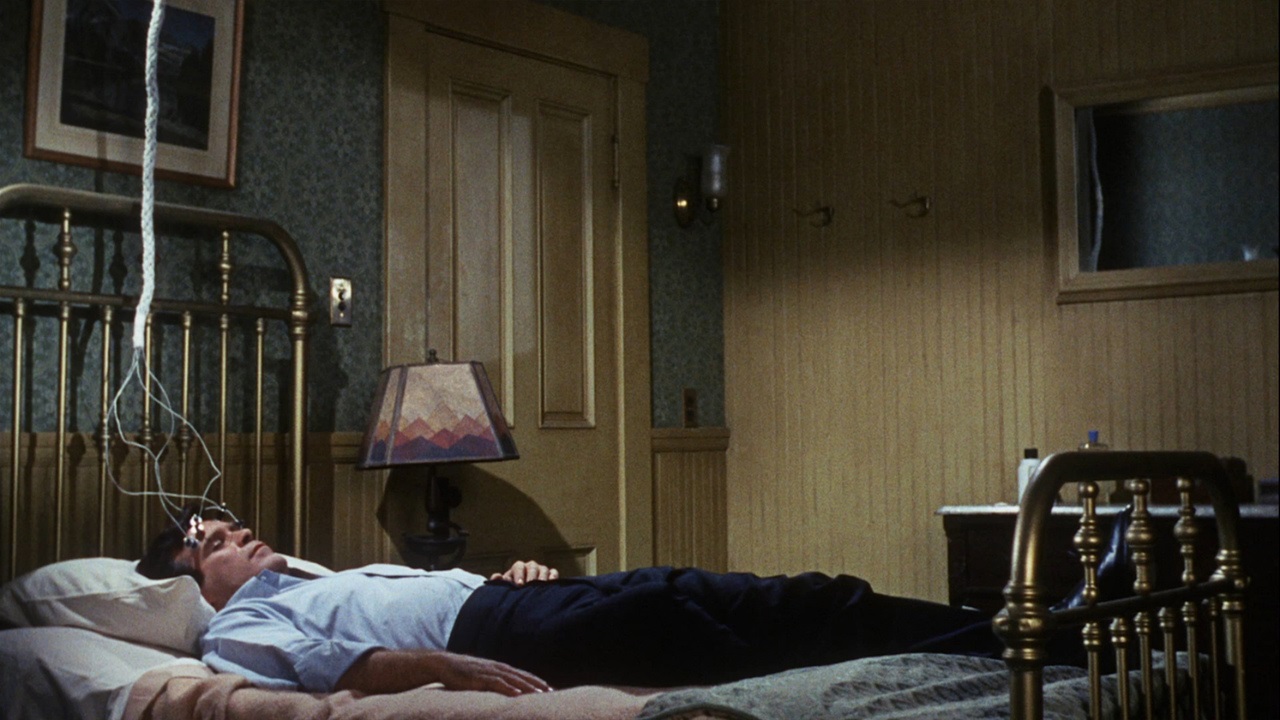
The supposedly futuristic technology does leave a number of amusements to us three decades later. There is no concept of closed-circuit monitoring systems, rather people have a wall-sized one-way mirror built right next to Christopher George’s bed; the electrodes attached to his skull come with huge trails of cables; and nobody seems able to do something as simple as trace a phone call made to the house.
William Castle’s other films of genre note as producer-director are:– as director of Crime Doctor’s Manhunt (1945), the sixth in a series of Columbia crime thrillers, of which Castle directed several, featuring a forensicologist against a split-personalitied killer; the psycho-thriller Macabre (1958); House on Haunted Hill (1959); the classic The Tingler (1959), probably Castle’s best film; the haunted house film 13 Ghosts (1960); the psycho-thriller Homicidal (1961); Mr. Sardonicus (1961) about a man with his face caught in a grotesque frozen smile; the juvenile comedy Zotz! (1962) about a magical coin; the remake of The Old Dark House (1963) for Hammer; the Grand Guignol psycho-thriller Strait-Jacket (1964) with Joan Crawford; The Night Walker (1965), a psycho-thriller about a dream lover; the prank phonecall psycho-thriller I Saw What You Did (1965); the psycho-thriller Let’s Kill Uncle (1965); the ghost comedy The Spirit is Willing (1967); as producer of the classic occult film Rosemary’s Baby (1968); as producer of the anthology series Ghost Story (1972-3); Shanks (1974) with Marcel Marceau as a puppeteer who can resurrect the dead; and as producer of the firestarting insect film Bug! (1975). Spine Tingler! The William Castle Story (2007) is a documentary about Castle.
Trailer here