
Crew
Director – Bob Wynn, Screenplay – Tom Rolf & Jay Simms, Producer – Bob Stabler, Photography – Bob Boatman, Music – Marlin Skiles, Art Direction – Herman Zimmerman. Production Company – Gold Key Entertainments/Vidtronics Co/Madison Productions/New Mexico Film Industry Commission
Cast
Leslie Nielsen (Harry Walsh), Bradford Dillman (Senator Clayton Zacahary Wheeler), Robert J. Wilke (Hugh Fielding), Angie Dickinson (Dr Diana Johnson), James Daly (Dr Redding), Jack Carter (Dwight Childs)
Plot
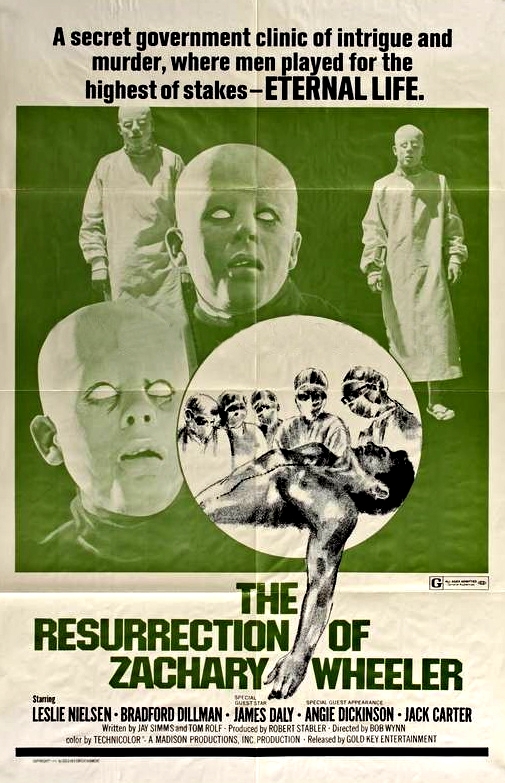
TV newsman Harry Walsh is present at a car crash scene and identifies the victim as Senator Clayton Zachary Wheeler. However, when Harry tries to pursue the story, he finds that Wheeler has vanished from the hospital he was taken to. He is then fired for refusing to retract the story. He persists with trying to follow the story but is pursued by sinister government agents. Meanwhile, Wheeler comes around in a secret laboratory in New Mexico run by a covert government-backed committee. They claim to have devised a means of protecting VIPs from harm. To Wheeler’s horror, he learns their scientists have discovered a means of creating synthetic copies of people, which they call somas – mindless but identical twins that can be harvested for organ transplants without fear of tissue rejection and are then killed afterwards.
The Resurrection of Zachary Wheeler is a low-budget production, originally shot on videotape and transferred to film for cinema release. The result is an intriguing thriller that prefigures many of the medical paranoia thrillers of the late 1970s – Coma (1978) and sundry Robin Cook adaptations, Parts: The Clonus Horror (1979), Extreme Measures (1996) and the like. Indeed, a substantial part of the premise of The Resurrection of Zachary Wheeler was later stolen as the basis of the big budget sf/action film The Island (2005). The Resurrection of Zachary Wheeler also has the distinction of being the first film to depict cloning (although the word clone is not mentioned and the clones are referred to as somas).
The script is structured well, building an intriguing mystery. (Although as the nature of the conspiracy starts to unfold, the subplot about Leslie Nielsen’s journalist being pursued by anonymous government agents is largely forgotten about). The central idea of the clone bodies is one that sits right on the fence between plausibility and hokiness, although one that has been given a new topicality in the 00’s with the controversy over the issue of stem cell research. Thankfully the film chooses to present it with sober conviction – the revelation of Bradford Dillman’s mindless twin is a good shock moment.
The low-budget is something that often works for the film – the graininess of the photography adds a raw documentary-like conviction. On the other hand, it does make it hard to build much in the way of edgy political paranoia out of the dull ordinary offices that the political machinations take place in or the nondescript panel vans that are supposed to be sinister government vehicles.
The most irritating aspect about the film is its anti-climactic non-ending wherein Bradford Dillman and Leslie Nielsen’s threat about going to the media seems to be dissipated by the announcement of the arrival of some VIP (whose significance is never made apparent) whereupon the film just stops dead.
Trailer here