

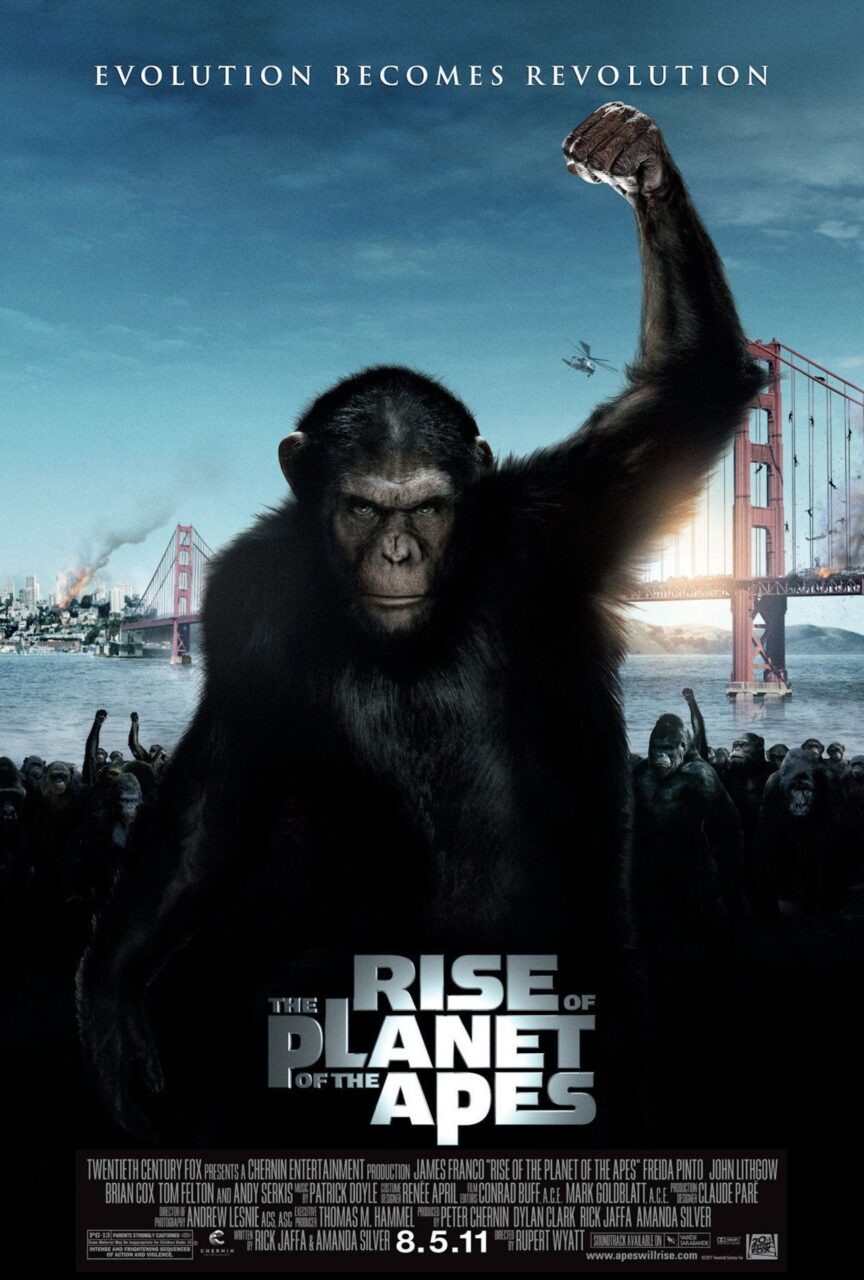
USA. 2011.
Crew
Director – Rupert Wyatt, Screenplay – Rick Jaffa & Amanda Silver, Producers – Peter Chermin, Dylan Clark, Rick Jaffa & Amanda Silver, Photography – Andrew Lesnie, Music – Patrick Doyle, Senior Visual Effects Supervisor – Joe Letteri, Visual Effects Supervisor – Dan Lemmon, Visual Effects – Weta Digital (Supervisors – R. Christopher White & Erik Winquist), Special Effects Supervisor – Tony Lazarowich, Makeup Effects – WCT Productions (Supervisor – Bill Terezakis), Production Design – Claude Paré. Production Company – 20th Century Fox/Dune Entertainment/Chermin Entertainment/Ingenious Media/Big Screen Productions.
Cast
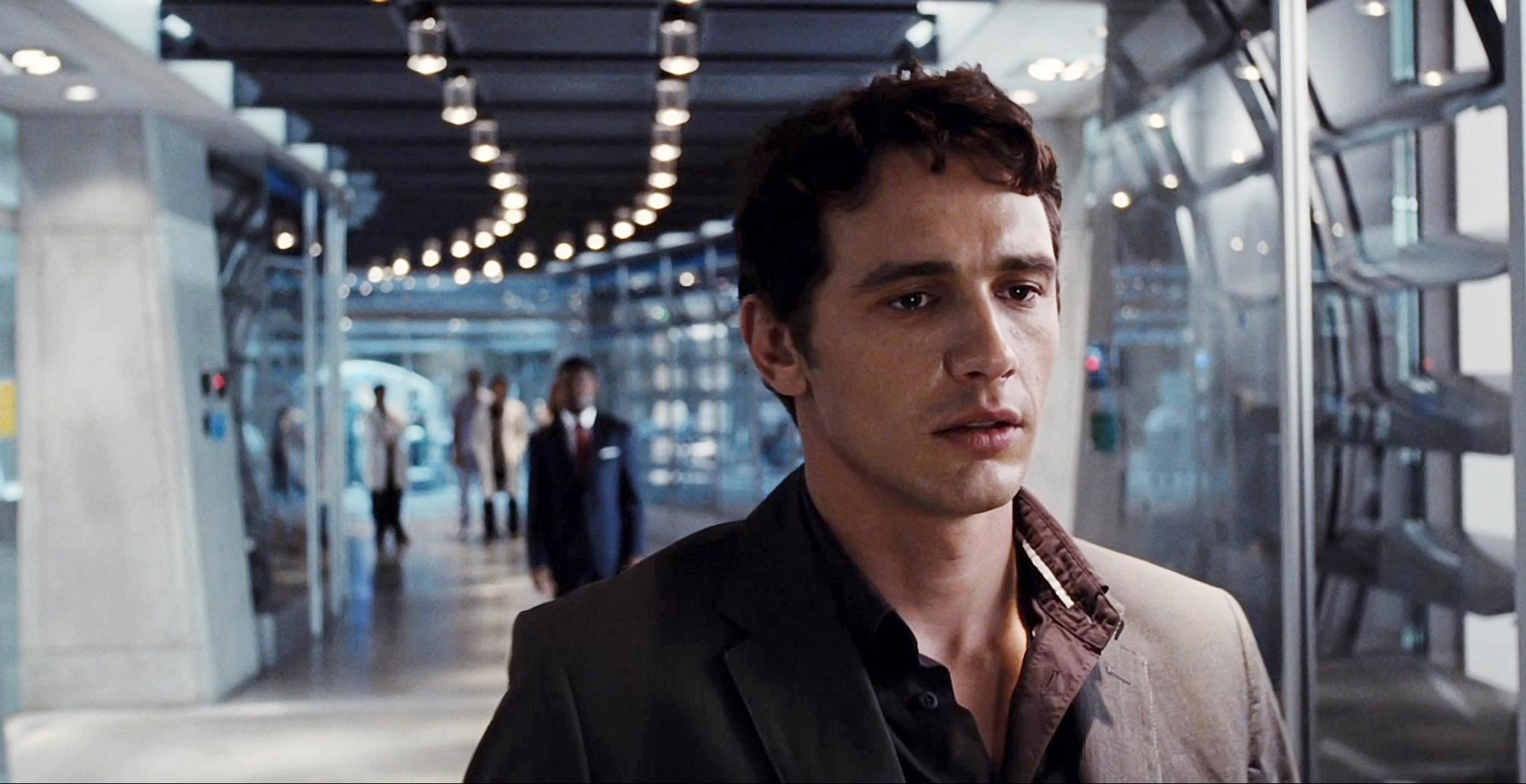
James Franco (Will Rodman), Frieda Pinto (Carolina Aranha), John Lithgow (Charles Rodman), Tom Felton (Dodge Landon), David Oyelowo (Steve Jacobs), Brian Cox (John Landon), Tyler Labine (Robert Franklin), David Hewlett (Hunsiker), Jamie Harris (Rodney), Ty Olsson (Chief John Hamill)
Ape Performers
Andy Serkis (Caesar), Karin Konoval (Maurice), Terry Notary (Rocket/Bright Eyes), Richard Ridings (Buck), Chris Gordon (Koba)
Plot
At Gensys laboratories in San Francisco, Will Rodman is experimenting on apes with an experimental drug ADZ-12, which he hopes will be able to affect a cure for Alzheimer’s. They find that the apes injected with it are experiencing remarkable leaps in intelligence. Just as Will is making his big pitch for funding, the most promising ape, the chimpanzee Bright Eyes, escapes its pen and rampages throughout the facility before breaking into the conference room and having to be shot, effectively ruining their chances of funding. All the apes are ordered put down. It is then discovered that Bright Eyes had a child and Will agrees to take it home and raise it himself rather than put it down. He discovers that Caesar, as the chimpanzee is named, has remarkable intelligence. He also begins illicit experiments with the ADZ-12 using his aging father as a subject and these have amazing results. However, when Caesar breaks out and attacks a neighbour, Animal Control is called and Caesar ordered placed in the local pen. There Caesar must adjust to dealing with other more aggressive and less intelligent apes, as well as sadistic human warders. However, Caesar has the intelligence to outwit all the others and succeeds in becoming the most dominant ape. He breaks out to steal supplies of the ADZ-12 from Will’s home so as to raise the intelligence of the other apes. From there, Caesar and the apes start plotting rebellion.
Planet of the Apes (1968) was one of the genuine science-fiction hits that emerged prior to the modern blockbuster era. It was science-fiction produced on a class instead of a B-budget, for once. The popularity of the film was such that it led to a series of sequels beginning with Beneath the Planet of the Apes (1970), which blew up the planet at Charlton Heston’s bequest; was then followed by Escape from the Planet of the Apes (1971), which had apes travelling back in time to the present-day; and Conquest of the Planet of the Apes (1972) about the rebellion against humanity; and Battle of the Planet of the Apes (1973) with the founding of the ape society. There was also the live-action tv series Planet of the Apes (1974) and the animated Return to the Planet of the Apes (1975), both of which stood outside the continuity established by the films.
Around twenty-five years later, the original was then remade with Tim Burton’s Planet of the Apes (2001), which had its moments but is generally considered a failure and one of the worst films in Burton’s canon. To great surprise, Rise of the Planet of the Apes made its way onto production schedules exactly ten years after the remake came out. The surprise about Rise of the Planet of the Apes is that it was made as a sequel (or at least a prequel) when the Tim Burton remake was so universally unpopular (although still successful enough when it came out to make it onto that year’s Box-Office Top 10 charts). From the basic set-up, Rise of the Planet of the Apes appears to be a loose remake of Conquest of the Planet of the Apes. While it could easily act as a prequel to the Tim Burton films, with the films success the scriptwriters/producers treated it as a reboot of the franchise, albeit following the internal chronological timeline of the series.
Rather than necessarily a remake of an original, Rise of the Planet of the Apes and Conquest of the Planet of the Apes should be considered films with occasional parallels. There is an ape named Caesar in both, although in Rise his origin is explained away as being due to an experimental drug and any mention of apes time travelling from the future has been eliminated; in both films, Caesar is raised in seclusion and is then captured and subject to human cruelty; in both films, he mounts a rebellion among the apes and they run amok through human civilisation. Conquest of the Planet of the Apes had the apes being domesticated as servants after pets were killed off by a virus brought back by a Mars probe; there is a Mars probe seen being launched on tv here at one point and a virus that is spread throughout the world, although neither appears to be connected to the rise in ape intelligence. Rise also eliminates the anthropologically dubious idea that the apes became intelligent and learned to talk simply because they were domesticated and replaces this with much more biologically credible idea of intelligence-enhancing genetic drugs.
Rise of the Planet of the Apes comes with one of the things that none of the other Planet of the Apes films ever had – and that is the advent of CGI effects. Okay, they were present in the Tim Burton remake but only to create things like the space stations and time warps, whereas the apes there were created the same way they were in the original films – via makeup, albeit more sophisticatedly.
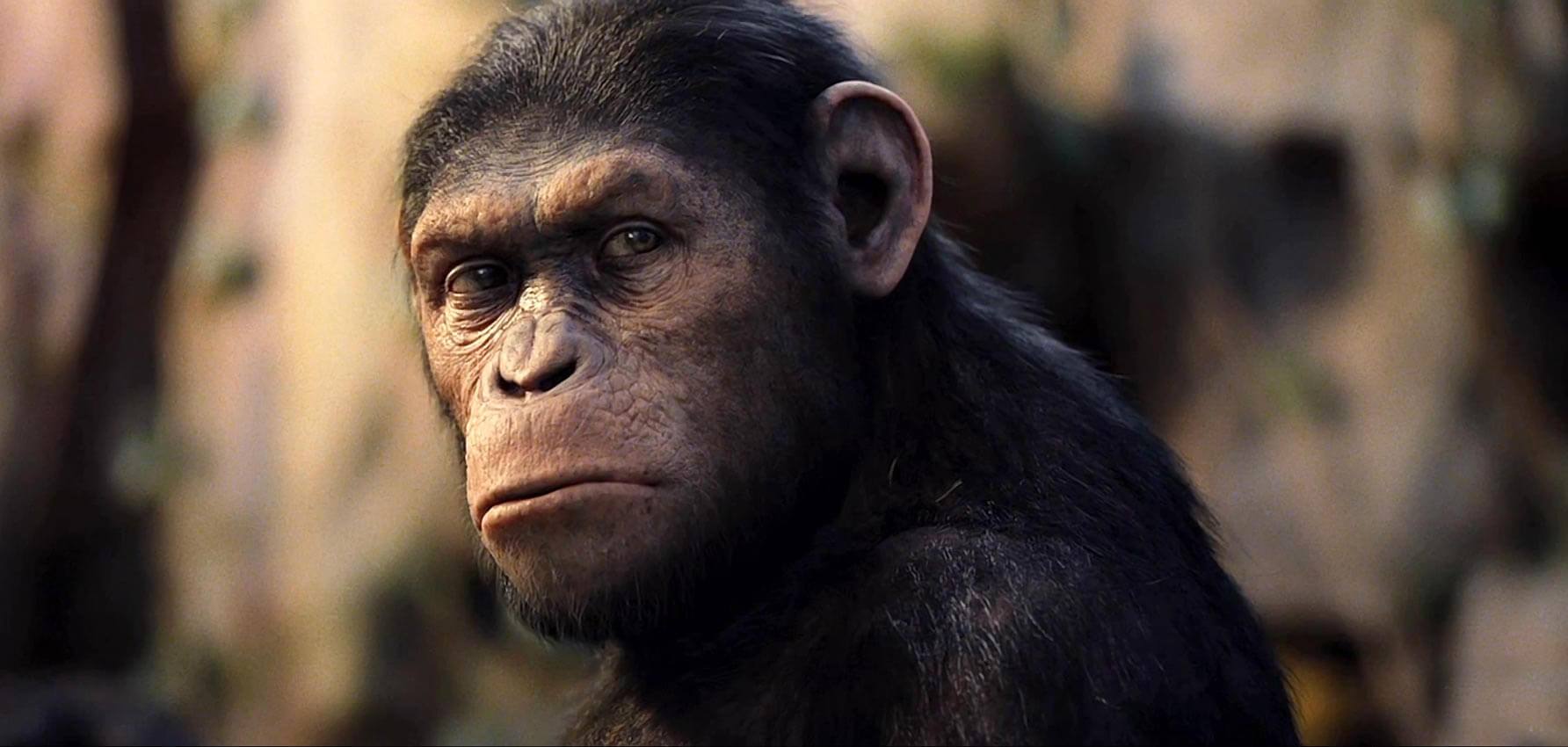
By the time of Rise of the Planet of the Apes, the effects revolution has risen to the point where the apes are now depicted by CGI and motion capture suits. Indeed, the producers of Rise of the Planet of the Apes have travelled Down Under to obtain the services of Peter Jackson’s Weta Digital, the company that first brought motion capture animation into prominent focus. Jackson himself did a sterling venture into cinematic apedom with his remake of King Kong (2005) and mindful of that, Rise of the Planet of the Apes has employed Andy Serkis, who played Kong (and before that Gollum), inside the motion capture suit as Caesar.
From the moment we first see Caesar flushing the toilet, swinging around the kitchen, jumping up to sneak cookies from the jar and replacing the lid before swinging up to pull down the stairs to the attic, the new ape effects prove dazzling. Weta Digital have conducted an extraordinary job in bringing the apes to life. It is amazing watching the range of expressions that manage to cross Caesar’s face throughout. The latter two-thirds of the film become almost entirely dominated by ape characters (all created digitally) as the film spends extended times dealing with the behavioural politics in the ape cage at the zoo and Caesar’s plot to raise the intelligence of the apes, followed by their breakout and rampage through San Francisco.
Director Rupert Wyatt fills the film with some glorious images – the apes riding atop a streetcar through the streets of San Francisco, Caesar on horseback, the apes running en masse across the Golden Gate Bridge, the little displays of dominance and aggression that go on as Cesar establishes his leadership. Indeed, the apes become so distinctive as characters in their own right that from about the point that the film gets to the animal shelter, the humans drop off and become supporting scenery – certainly, among the cast James Franco never gets to do much, while Frieda Pinto is so much part of the window dressing that I don’t believe that we even get to hear the name of her character once throughout. The apes do indeed rule and Rise of the Planet of the Apes is a strong and worthwhile return to the franchise.
The film is also stuck with conducting cute little pieces of fanservice. There are characters named after various key figures in the various original Planet of the Apes works – Tom Felton plays a character named Dodge Landon after the two other astronauts that accompanied Charlton Heston in Planet of the Apes; there is a character named after original film director Franklin J. Schaffner, series producer Arthur P. Jacobs and an ape named after Maurice Evans; while the Mars probe is called the Icarus probe after Charlton Heston’s original spaceship. Over cutely, Tom Felton also gets to quote Charlton Heston’s famous line “Take your stinking paws off me, you damned dirty ape” at one point, while the first line that Caesar speaks is “no”, the word said to be the first said by an ape according to the Planet of the Apes films.
This was followed by Dawn of the Planet of the Apes (2014), War of the Planet of the Apes (2017) and Kingdom of the Planet of the Apes (2024). Rise of the Planet of the Apes is parodied in Scary MoVie (2013).
British director Rupert Wyatt had previously made The Escapist (2008), a modest prison escape film with a deathdream ending, and subsequently produced the tv remake of The Exorcist (2016-8) and directed the alien invasion film Captive State (2019).
The script comes from husband and wife duo of Rick Jaffa and Amanda Silver. Their other works include the other two films in the Planet of the Apes reboot trilogy, plus Eye for an Eye (1996), the monster movie The Relic (1997), Jurassic World (2015), In the Heart of the Sea (2015), Mulan (2020) and Avatar: The Way of Water (2022). Silver on her own wrote The Hand That Rocks the Cradle (1992).
(Nominee for Best Special Effects at this site’s Best of 2011 Awards).
Trailer here