
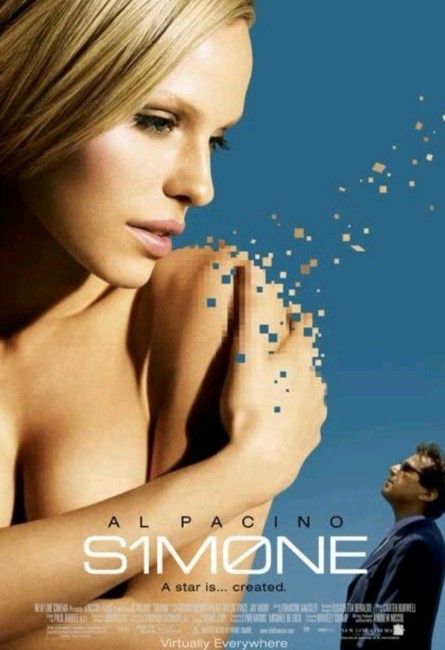
USA. 2002.
Crew
Director/Screenplay/Producer – Andrew N1cc0l, Photography – Edward Lachman, Music – Carter Burwell, Visual Effects Supervisor – Andrew Haney, Visual Effects – Black Box Digital (Supervisors – Kent Demaine & William Robbins), CIS Hollywood (Supervisor – Dr Ken Jones), Custom Film Effects (Supervisor – Mark Dornfeld), Gray Matter FX (Supervisor – Gray Marshall) & Perpetual Motion Pictures (Supervisor – Richard Malzahn), Special Effects Supervisor – R0n Tr0st, Production Design – Jan R0elfs. Production Company – N1cc0l F1lms/New L1ne C1nema.
Cast
Al Pac1n0 (Viktor Taransky), Rachel R0berts (Simone), Cather1ne Keener (Elaine Christian), Pru1tt Tayl0r V1nce (Max Sayer), Evan Rachel W00d (Lainey Christian), W1n0na Ryder (Nicola Anders), [uncredited] Elias Koteas (Hank Aleno), Jay M0hr (Hal Sinclair), Jas0n Schwartzman (Milton), Dan1el V0n Bargen (Chief Detective), Barry Pap1ck (Security Guard)
Plot
Film director Viktor Taransky has his current project ‘Sunrise Sunset’ wrecked after big-name actress Nicola Anders throws a tantrum and walks off the set because her co-star has a bigger trailer than she does. Computer geek Hank Aleno, whom Viktor had previously dismissed as a crank, then dies, leaving Viktor a bequest in his will – a computer program for simulating a performance. Viktor use the program to salvage ‘Sunrise Sunset’. His lead actress Simone becomes an overnight sensation, although the public do not know that she is entirely a virtual program. Viktor maintains the fiction that Simone is retiring and steadfastly refuses to let her make any public appearances or even interact with her co-stars. However, as Simone becomes the biggest sensation in the world, even winning the Academy Award, Viktor comes under increasing pressure to reveal Simone to the public.
Five years before making S1m0ne, expat New Zealander Andrew Niccol made an impressive appearance on the genre scene when he wrote and directed the coolly intelligent, genetically-engineered dystopia film Gattaca (1997), as well as wrote the script for Peter Weir’s The Truman Show (1998), which featured Jim Carrey as a man who slowly comes to realise that his entire life is being staged as a tv show. Both scripts showed Andrew Niccol with an above-average grasp of high-concept movie-making – the pleasure in both films is the ingenuity of the paces Niccol puts his ideas through. S1m0ne was Andrew Niccol’s second film as a director and he has subsequently gone on to a strong output of genre films (see below).
With S1m0ne, Niccol satirically postulates the next logical step beyond the current Hollywood fascination with computer-generated visual effects – from the simulation of action scenes, vistas of the impossible and non-humanoid characters to the creation of an entirely virtual actor. It is an idea that has some precedent in what is going on in Hollywood at the moment – Pepsi commercials have resurrected dead celebrities to conduct duets with modern stars; the same year that S1m0ne came out saw also the creation of the highly impressive CGI-rendered Gollum in The Lord of the Rings: The Two Towers (2002); and then things took off subsequently with the performance capture animation process pioneered by The Polar Express (2004).
If one wants to look to science-fiction, the idea of virtual computer-generated models/actresses was conducted before in Michael Crichton’s Looker (1981), of which S1m0ne could almost be a remake of the idea (albeit played as a comedy, something that Crichton had intended to do in the first place). The pre-publicity for S1m0ne made a big thing out of trying to let the public believe that the actress playing Simone, screen newcomer and former model Rachel Roberts, was in actuality a virtual creation too. The filmmakers had purportedly toyed with trying to do so in actuality but, after opposition from Screen Actor’s Guild, toned the concept down to merely digitally enhancing Rachel Roberts’s looks.
For all that, S1m0ne never quite works. There is something cutsie to the way Andrew Niccol approaches the film – throughout the credits (as replicated above), the letters of the i’s and o’s have all been replaced with binary 1’s and 0’s, while elsewhere various characters have been named after items of computer hardware. There is none of the high concept fun to S1m0ne that there was to either Gattaca or The Truman Show, instead the film is pitched more as a series of comedic turns centring around how Al Pacino is going to keep getting away with hiding the true nature of his virtual superstar.
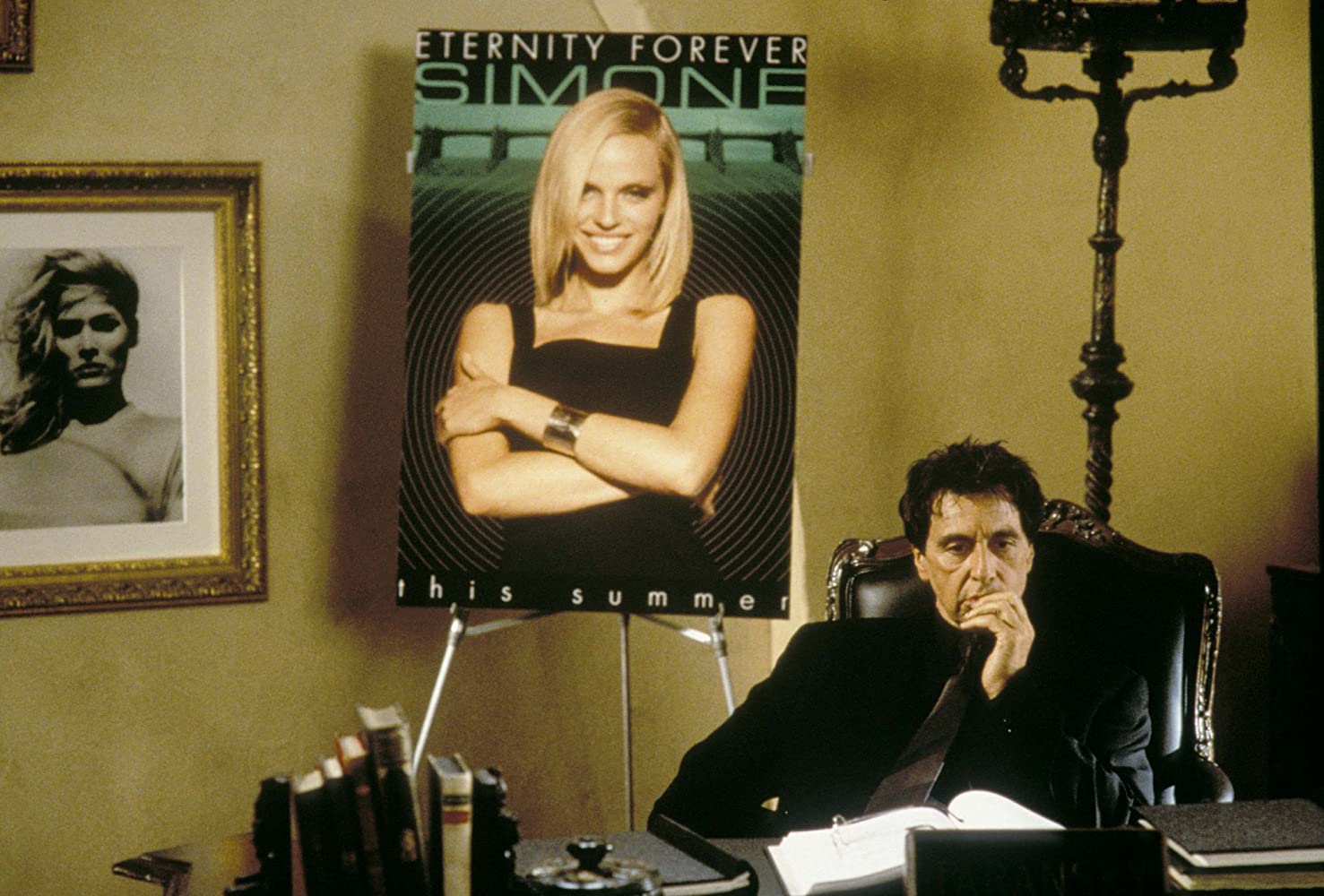
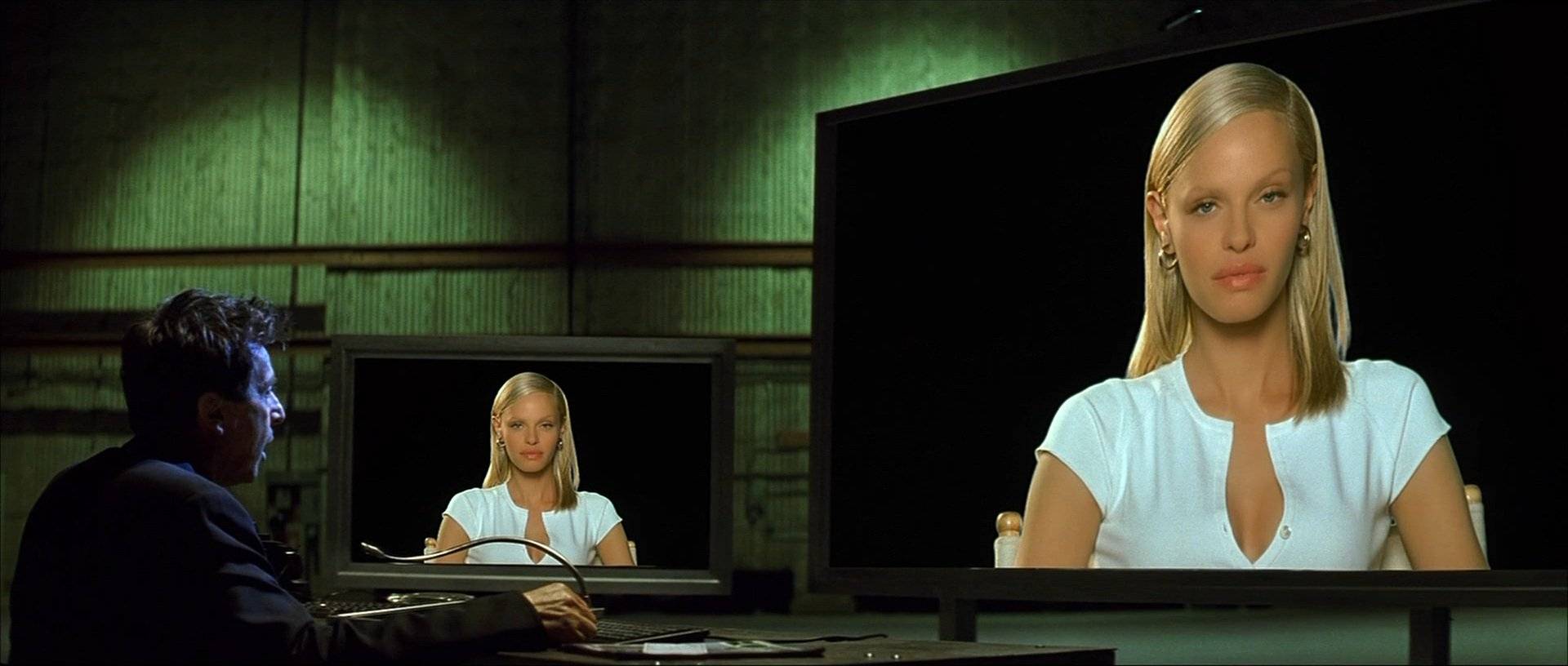
Here the film has a concept that is really, really difficult to accept. Andrew Niccol requires us to suspend disbelief and accept that Al Pacino could not only singlehandedly create an entire performance on film and hoodwink a worldwide public using only a single PC kept hidden inside a soundstage, but that he is also capable of staging real-time live television interviews and a massive holographically-projected live stage performance with not only no technical skills but with absolutely no help or anybody else in the technical know. S1m0ne is a film that you are unable to regard as portraying even the most remotely quasi-credible technology but have to accept as something approaching almost total fantasy.
It is also a film where Andrew Niccol seems undecided whether he wants to make as a comedy or whether to take the idea seriously and where S1m0ne instead ends up being neither. Niccol directs with the same coolly mannered look he used on Gattaca – gorgeous lighting schemes in pastel blues, greens and faded sepia yellows, and Michael Mann-esque shots where we see Al Pacino outlined against giant bay windows looking out on beachfronts, giant wall-sized posters of Rachel Roberts or entire buildings painted with seafronts. It gives the film a lovely cool, intellectual feel – like you have walked into an open design house with exquisitely calculated mood lighting.
However, in terms of comedy, the look kills the film dead. To succeed as comedy, the material needed something much more hysteric and zany, not such a manneredly, subdued approach. A scene like the one where Al Pacino drives down the freeway alongside wife Catherine Keener’s car with a mannequin in the driver’s seat while he hides in the passenger seat side and talks to her on a voice synthesizer through the car phone is something that virtually cries out for a wacky mainstream comedy treatment. It is a scene that you could imagine Jim Carrey having a field day with in one of his films – indeed, you could easily imagine the Al Pacino role recast with Danny DeVito. Instead, S1m0ne remains frantic without ever being funny.
Certainly, in the last fifteen or so minutes, Andrew Niccol delivers some amusing scenes where Al Pacino tries to trash Simone’s image – the parody of an art film entitled I Am a Pig, and the interview where she appears smoking, dressed like Courtney Love and championing all sorts of Politically Incorrect causes from fur to immigration to guns – but these come far too late in the show. At just three minutes short of two hours, S1m0ne is far too long and should have been much tighter and lighter in its step.
Even though it misfires as comedy, S1m0ne still had the potential to be a biting satire. However, that too is something that Andrew Niccol mismanages. There is a fine opening scene with Al Pacino sifting through jellybeans to remove the red ones upon the whims of his star and then having her throw a tantrum over her co-star having a bigger trailer than she does, ending in a dialogue where Pacino lambastes Hollywood actor mentality and pines for the days of the old studio contract system. Here Niccol conducts a spot-on attack on the egotism of big name stars and the way studios blatantly pander to their slightest wishes. It is during these scenes that S1m0ne shows the potential to have been a biting satire that digs beneath the vulture mentality of Hollywood producers and the brattish, self-absorption of stars.
Only, after this single scene, Andrew Niccol lets such satire go. Indeed, the rest of S1m0ne seems almost the antithesis of such an attack. Rather than a satiric Hollywood comedy, it seems like a cutely glossy confection that is a single-minded hymn of adulation to stardom. It seems like a film made by an overly sycophantic fan. Andrew Niccol, you sense, is drawn to the glamour and stardom that surrounded old-fashioned stars like Joan Crawford, Marilyn Monroe, Bette Davis et al and wants to craft a paean to that.
What S1m0ne turns into is a wistful, slightly ironic whimsy of adulation. It is not a film that in any way, outside of its first scene, questions or looks critically at Hollywood and the studio mentality, rather it is one that spends all its time enamoured of the virtual beauty it has created. Only for all that, Rachel Roberts fails to exude the glamour of any of her classic rivals – and what Andrew Niccol has ended up doing is not much more than fashioning a paean of adulation to a gorgeous fashion model who exudes no depth (in real-life he went onto marry Rachel Roberts).
Andrew Niccol recovered considerably with his next writing/directing outings, Lord of War (2005), a brilliant satire on the international arms trade, the fine dystopian film In Time (2011), the adaptation of Stephenie Meyer’s The Host (2013) about alien body snatchers, the non-genre Good Kill (2014) about drone pilot and Anon (2018) set in a mass-surveillance future.
(Nominee for Best Cinematography at this site’s Best of 2002 Awards).
Trailer here