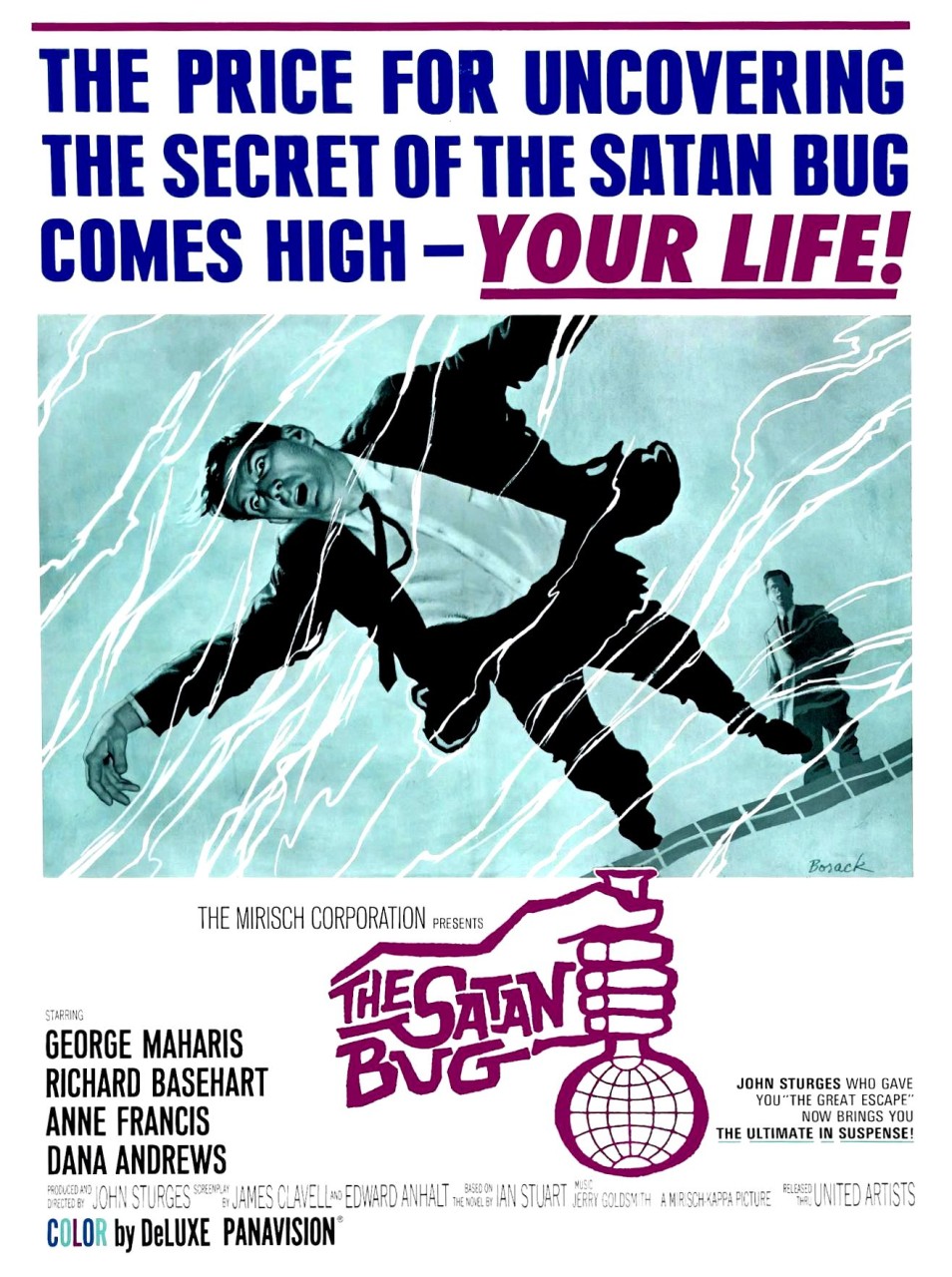
USA. 1965.
Crew
Director/Producer – John Sturges, Screenplay – Edward Anhalt & James Clavell, Based on the Novel by Ian Stuart [Alistair MacLean], Photography – Robert Surtees, Music – Jerry Goldsmith, Special Effects – Paul Pollard, Art Direction – Herman Blumenthal. Production Company – Mirisch/Kappa.
Cast
George Maharis (Lee Barrett), Anne Francis (Anne Barrett), Richard Basehart (Dr Gregor Hoffman), Dana Andrews (The General), Edward Asner (Veretti), Frank Sutton (Donald), Richard Bull (Eric Cavanaugh)
Plot
Lawyer Lee Barrett is recruited back to duty in his former job as the security head of Station 3, a top-secret germ warfare laboratory in the California desert. Station 3 has been broken into and a flask that contains The Satan Bug, a virus so potent it could destroy all life on Earth, stolen. Barrett realizes that the theft had to be an inside job. Investigating, he discovers that the person behind the scheme is a mad millionaire who has been posing as one of the scientists. Now the millionaire is threatening to release the Satan Bug in Los Angeles if Station 3 is not dismantled.
The Satan Bug was based on a thriller by Scottish writer Alistair MacLean, best known for popular adventure and war stories such as The Guns of Navarone (1957), Ice Station Zebra (1963), When Eight Bells Toll (1966) and Where Eagles Dare (1967). At one point, Alistair MacLean was considered the most popular thriller writer in the world. The Satan Bug (1962) was one of two novels that MacLean published under the name Ian Stuart as an experiment to prove that his works were popular due to their content, not merely his name above them.
This film adaptation was made by John Sturges, then a director of Westerns such as Bad Day at Black Rock (1955), Gunfight at the OK Corral (1957) and The Magnificent Seven (1960). Into the 1960s, as the Western began to taper off in popularity, John Sturges’ films began to venture into the same territory as Alistair MacLean’s no-nonsense masculine thrillers. Sturges made one other MacLean adaptation Ice Station Zebra (1968), and other works like the war film The Great Escape (1963), the Space Mission techno-thriller Marooned (1969) and the very MacLean-esque The Eagle Has Landed (1976).
The book was adapted by James Clavell, then a Hollywood screenwriter with films such as The Fly (1958), Sturges’ The Great Escape and To Sir with Love (1967), but later to become a popular novelist with Oriental-themed works such as Tai-Pan (1966), Shogun (1975) and Noble House (1981). In Clavell’s adaptation, Alistair MacLean’s tight thriller has undergone considerable change. Most notable is the uprooting of the story’s setting from England to the US. The hero also gets a name change, presumably because MacLean’s original choice, Pierre Cavell, sounded too French.
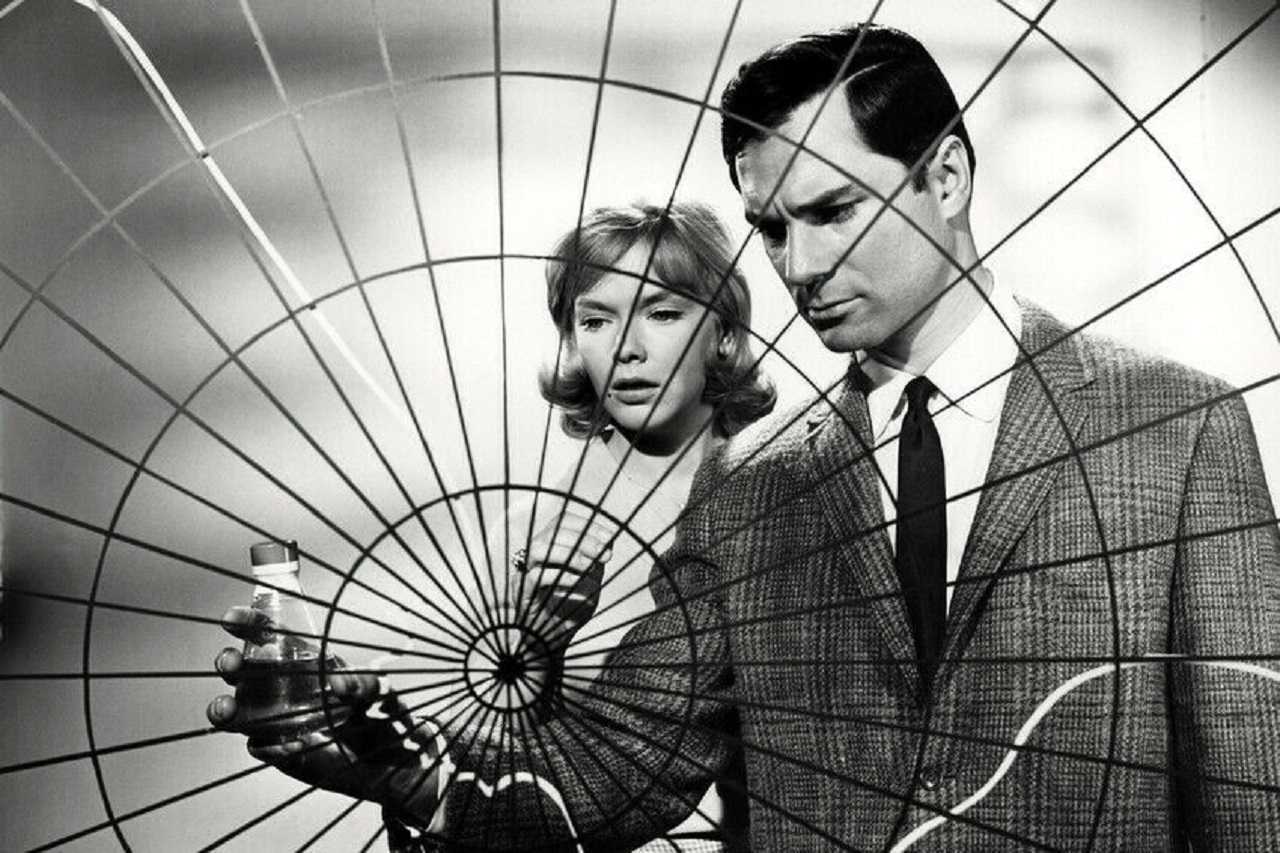
Much of MacLean’s densely wound whodunnit plot has been disposed of for merely a few conspirators and an early-tipped villain in order to provide a greater action rather than thriller emphasis. Odd pieces from the book still remain – like the investigation of the break-in, the helicopter climax, the impersonation of the missing scientist, and the introduction of Barrett and the scene with the fake World Peace Council. Although some of the lingering remnants do not make sense, such as the reason why Barrett is chosen for the job – if Cavanaugh is the Station 3 security head why is it not he that heads the investigation?
The results are an efficient, if occasionally uneven, thriller. The only piece that seems superfluous is the Station 3 opening – it adds a pointless fifteen minutes to the film where the scenes would have worked far better if the lab and procedure could have been introduced through Barrett’s eyes later. The film is lifted through the rougher patches by a driving score and by Sturges who plays a number of scenes for effective tension – particularly one with George Maharis and two agents trying to survive after a spilt flask of botulinis is thrown into a barn, and a climactic mid-air fight in and around a careening helicopter. John Sturges’s work is more known for its efficiency than its artistry but there is a great opening shot that cuts from the animated credits of a body being infected to a road with a car travelling down it that looks just like an artery.
George Maharis has a wooden efficiency as the stock hero. However, there is pleasure in the casting of bright, animated Anne Francis of Forbidden Planet (1956) fame, who proves wonderfully spry as the wife. Particularly good is Richard Basehart as the villain, where Basehart’s dignity and torturedness of spirit thoroughly convinces of the otherwise transparent madman’s scheme.
Trailer here