
Crew
Director – Lance Mungia, Screenplay – Lance Mungia & Jeffrey Falcon, Producers – Michael Burns & Leanna Creel, Photography – Kristian Bernier, Music – Brian Tyler, Songs – The Red Elvises, Visual Effects – Jason Dunn, Production Design – Jeffrey Falcon. Production Company – HSX Films.
Cast
Jeffrey Falcon (Buddy), Justin McGuire (The Kid), Stephane Gauger (Death), Lex Lang (Voice of Death), John Sakisian (Russian General)
Plot
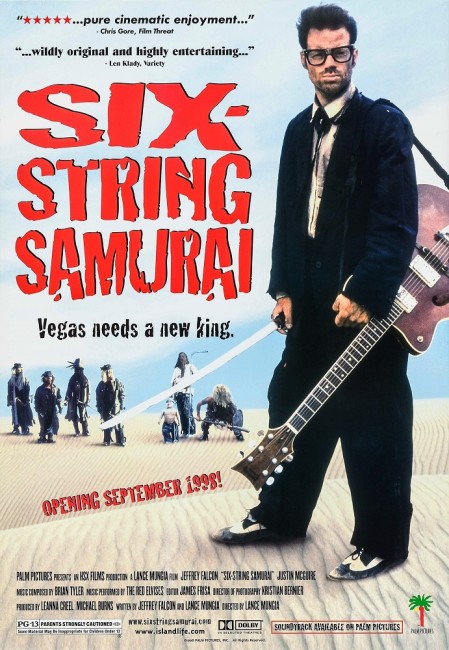
The USA was devastated by a Russian nuclear strike in 1957. In Lost Vegas, Elvis was proclaimed the king. Now, with the death of Elvis, the guitar and samurai-sword wielding Buddy seeks to become the new king. Reluctantly accompanied by an orphan child that he saves, Buddy makes his way across the post-apocalyptic Nevada Desert, fighting off crazies, and all the while pursued by Death who wants to usurp rock’n’roll with heavy metal.
It is not long into Six-String Samurai when you wonder what on Earth it is you have sat down to watch. The opening moments feature a samurai sword-waving Buddy Holly lookalike (in the midst of what the opening credits tell us is a post-apocalyptic alternate world) despatching Neanderthal mutants and a trio of bowlers who hide blades inside their bowling pins, while a group of mariachi Elvis impersonators play from the sideline. Subsequent encounters include brushes with a strange cannibal family, Communists and a Spinach Monster, which, in what appears to be an attempt to parody bad science-fiction movies, is represented by an eye on a corrugated pipe. The rock’n’roll samurai hero is also pursued throughout by a heavy metal-playing Death.
It rapidly becomes apparent that Six-String Samurai is a gonzo indie experiment in cinematic textural meldings, where the creators have thrown everything into the soup – rock’n’roll mythology is crossbred with Japanese samurai films, a parody of the Mad Max 2 (1981) post-holocaust genre and a deliberate attempt to be a bad science-fiction movie. It all gets fairly silly – the scenes with the moronic mutants conducting a Mad Max style chase at about five miles-per-hour is inane.
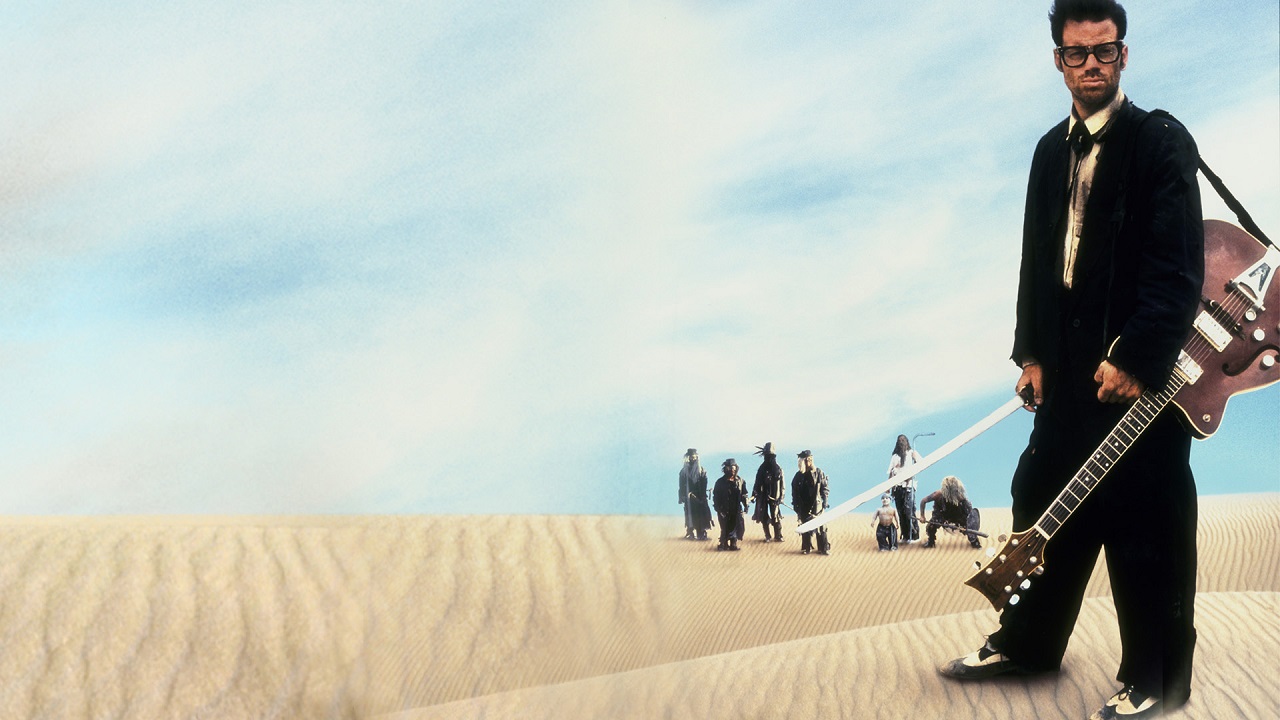
Oddly enough though, all the silliness eventually develops a certain panache. Director Lance Mungia manages the action poses with a reasonable degree of style – the film and its low-budget chutzpah ends up reminding one to some extent of Robert Rodriguez and his debut with El Mariachi (1993).
Mungia’s stroke of fortune is his lead actor (also his co-writer and production designer) Jeffrey Falcon. Besides bearing an uncanny resemblance to the real Buddy Holly, Falcon pulls off the potentially absurd image of a bespectacled, bedraggled sword-wielding Buddy Holly with thorough conviction. Falcon delivers the cod rock’n’roll dialogue with a wonderfully thin-lipped mealy pout and proves surprisingly lithe when it comes to all the fight poses. Ultimately, the film proves an oddity that leaves one scratching their head in puzzlement but not an unenjoyable one.
Subsequently, Lance Mungia went onto direct the fourth instalment of the Crow franchise with the disastrous The Crow: Wicked Prayer (2005).