
Crew
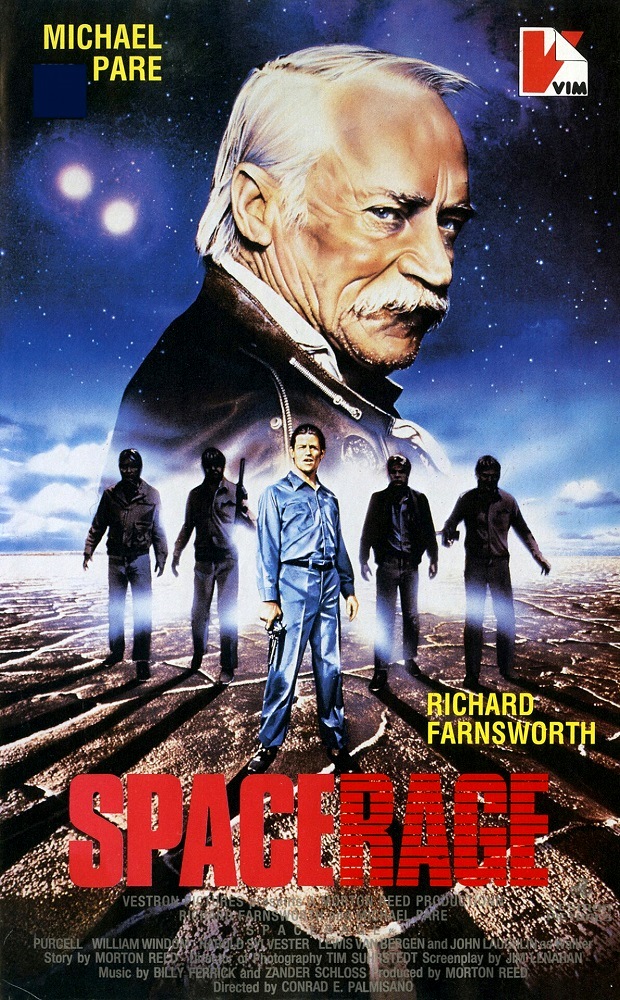
Director – Conrad E. Palmisano, Additional Scenes Directed by Peter McCarthy, Screenplay – Jim Lenahan, Story/Producer – Morton Reed, Additional Scenes Produced by Eric Barrett, Photography – Tim Suhrstedt, Additional Scenes Photographed by Tom Richmond, Music – Billy Ferrick & Zander Schloss, Performed by Yorface, Special Effects – Frank De Marco & Roger George, Art Direction – Cliff Cunningham & William Pomeroy, Art Direction for Additional Scenes – Richard Rollison. Production Company – Vestron Entertainment.
Cast
Michael Paré (Grange), Richard Farnsworth (Colonel), John Laughlin (Walker), Lewis Van Bergen (Drago), Frank Doubleday (Brain Surgeon), William Windom (Governor Tovah), Dennis Redfield (Quinn), Lee Purcell (Maggie)
Plot
Grange is apprehended after robbing the Bank of Luna and sentenced to life at the New Botany Bay prison on the planet Proxima Centauri. Upon arriving, Grange learns that New Botany Bay is a prison that has no walls – with the planet’s only shuttle landing port heavily guarded, there is no need to keep prisoners behind lock and key as there is nowhere for them to escape to. Grange is determined to prove the prison governor wrong and organises the prisoners into an armed breakout to capture the shuttle port.
Spacerage: Breakout on Prison Planet is a dreary effort from the early days of the direct-to-video release. It has been almost completely forgotten since then – which is fitting as there is nothing of any distinguishing note about Spacerage as a film. Spacerage was made by Conrad E. Palmisano who is better known as a stuntman and stunt coordinator and has been working in the industry since the 1970s with a number of high-profile film credits to his name. Palmisano only went on to direct one other film – the equally forgotten martial arts entry Busted Up (1986).
Spacerage: Breakout on Prison Planet almost certainly drew its inspiration from the then-recent hit of John Carpenter’s Escape from New York (1981), which popularised the idea of a futuristic prison. Since Escape from New York, the future prison concept has become surprisingly prevalent in science-fiction with the likes of Turkey Shoot (1983), Dead-End Drive-In (1986), Moon 44 (1990), Story of Ricky (1991), Wedlock/Deadlock (1991), Fortress (1993), New Eden (1994), No Escape/Escape from Absolom (1994) and Death Race (2008). Most of these were pseudo science-fiction films that did little more than transplant the prison movie genre cliches into a science-fictional venue. (For a more detailed listing see Prisons).
This generic transplantation is particularly evident in Spacerage. Indeed, if there should be some type of award for the science-fiction film with the least actual science-fiction content, then Spacerage could be in for a clear win. When you boil the scanty science-fiction elements away, Spacerage is really a Western. The desert locations could be those of any Western and there are stock Western characters like the determined pursuing lawman, while it takes little to imagine horses in lieu of the dune buggies that everybody drives.
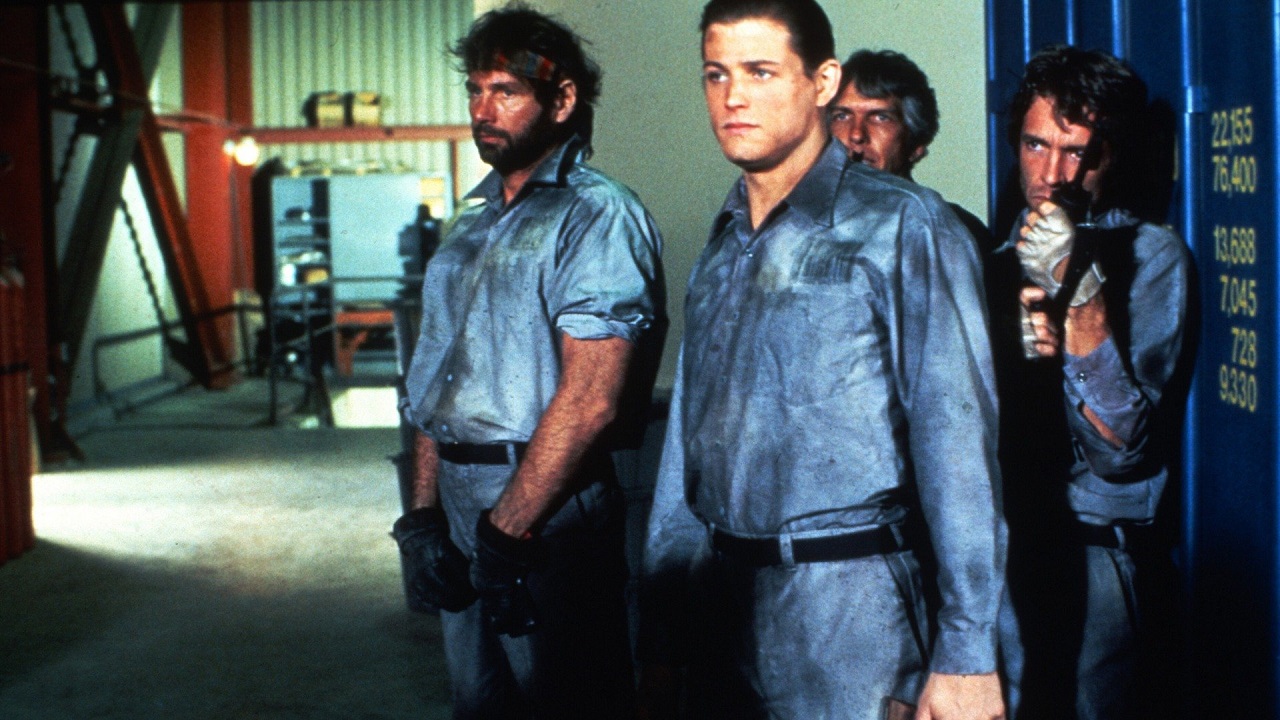
Indeed, the only science-fiction content in the whole of Spacerage comes in a sum total of three (admittedly quite professional) effects shots – a planetary matte-scape and the landing of a spaceship. There are not even any laser guns, everybody instead wields shotguns – the science-fiction content is so cursory that even these stock emblems are not deemed necessary (or perhaps more to the point, the film’s budget was too skimpy to flex any more imagination that that). Without these details there would be nothing that would in any way separate Spacerage from being a contemporary action film about escaped prisoners fleeing through the desert.
Most of the film has been shot on the cheap. For someone who comes from a stuntman and stunt coordinator background, the action that Conrad E. Palmisano directs is surprisingly dull and dreary. Most of this consists of macho posturing and stuntmen pretending to be shot and taking dives. The film also gives the appearance of having been hacked about after principal photography with substantial credits for reshooting. Even so, the finished film only runs to a slim 77 minutes.
Michael Paré gives another of his wooden leading man performances. Richard Farnsworth, himself a player in numerous Western roles during the 1950s and 60s and later a Best Actor Oscar-nominee in David Lynch’s The Straight Story (1999), looks bored but provides a dependable solidity as the determinedly pursuing lawman.