
Crew
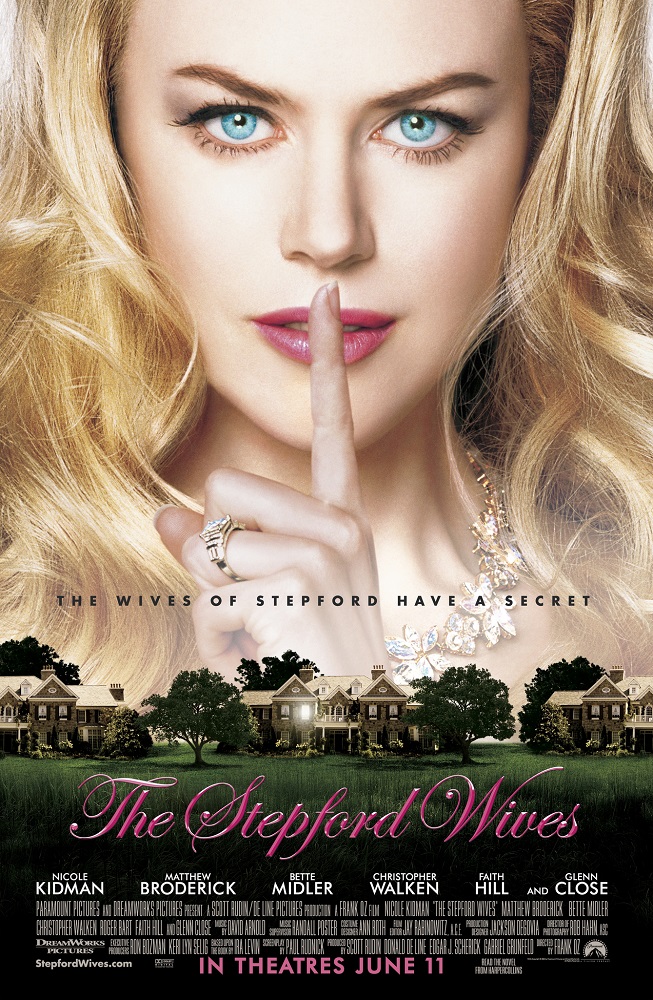
Director – Frank Oz, Screenplay – Paul Rudnick, Based on the Novel The Stepford Wives by Ira Levin, Producers – Donald De Line, Gabriel Grunfeld, Scott Rudin & Edgar J. Sherick, Photography – Rob Hahn, Music – David Arnold, Music Supervisor – Randall Poster, Visual Effects Supervisor – Scott Souter, Visual Effects/Animation – Tippet Studio (Supervisor – Frank Petzold), Visual Effects – &Company & Whodoo FX Inc (Supervisor – Helena Packer), Is Stepford Right For You? Animation Sequence – Asterix, Special Effects Supervisor – Steve Kirshoff, Production Design – Jackson De Govia. Production Company – Dreamworks SKG/Paramount/Scott Rudin/De Line Pictures.
Cast
Nicole Kidman (Joanna Eberhard), Matthew Broderick (Walter Kresby), Bette Midler (Bobbie Markowitz), Glenn Close (Claire Wellington), Christopher Walken (Mike Wellington), Roger Bart (Roger Bannister), Jon Lovitz (Dave Markowitz), David Marshall Grant (Jerry Harmon), Faith Hill (Sarah Saunderson), Mike White (Hank)
Plot
Joanna Eberhard is a high-flying executive with the EBS tv network. After one of her reality tv shows goes wrong and a disgruntled contestant starts shooting people, she is fired and subsequently has a nervous breakdown. Her husband Walter quits his own job with the network and makes the decision to move to the gated town of Stepford in Connecticut. Once there, Joanna becomes increasingly concerned with the seemingly perfect life in the community where all the women are sex goddesses and like nothing better than making house and waiting on their husbands. As Joanna and her friend Bobbie, the one other less-than-perfect housewife in the town, penetrate the secrets of the Men’s Association, they discover that the Stepford husbands are replacing their career-obsessed wives with androids designed to be perfectly servile. Moreover, they realize that the two of them are next in line for replacement.
The Stepford Wives is a remake of The Stepford Wives (1975), which was in turn based on a 1972 novel by Ira Levin of Rosemary’s Baby (1967) and The Boys from Brazil (1976) fame. In some ways, it is a surprise to see The Stepford Wives being remade as the original was never particularly successful when it was released, although it did gain a cult during tv screenings in later years and spawned three dreary tv movie sequels Revenge of the Stepford Wives (1980), The Stepford Children (1987) and The Stepford Husbands (1996). I must admit to never being much of a fan of the original film. It seemed uneasily caught between being a paranoia thriller and a satire on the sex wars, and failed to establish its premise with credibility.
This remake comes from the hand of Frank Oz. Frank Oz was of course one of the central talents on The Muppet Show (1997-81) and will probably always be remembered as the voice of Miss Piggy. Oz branched out as director with two films under the Jim Henson umbrella – co-directing the sublime fantasy film The Dark Crystal (1982) with Henson and then going on to solo direct The Muppets Take Manhattan (1984). Frank Oz’s solo directing career took off when he was given the helm of the remake of Little Shop of Horrors (1986). Oz subsequently branded himself as a director of mainstream comedies with the generally amiable likes of Dirty Rotten Scoundrels (1988), What About Bob? (1991), HouseSitter (1992), Bowfinger (1999), The Score (2001) and Death at a Funeral (2007). He made one other venture into fantasy with the excellent and underrated children’s film The Indian in the Cupboard (1995).
The Stepford Wives remake was scripted by Paul Rudnick, a New York-based scriptwriter who usually writes gay-themed films – Jeffrey (1995), In & Out (1997) (also directed by Frank Oz) and to some extent Marci X (2003), as well as the Jacqueline Susann biography Isn’t She Great (2000), which also starred Bette Midler.
Oz and Rudnick have reworked The Stepford Wives as a comedy. (Screenwriter William Goldman claimed to have conceived the first film as a satire, only to have seen it watered down by director Bryan Forbes). The original Stepford Wives came out amid the growing tide of the 1970s Women’s Lib movement. Of course, by 2004, when the Women’s Lib movement is well and truly integrated into society, such satire seems outdated – as this film acknowledges in the opening scene, we now have women corporate CEOs. This does place the film in the awkward position of trying to satirize the war of the sexes when the sexes have achieved a relative degree of equality.
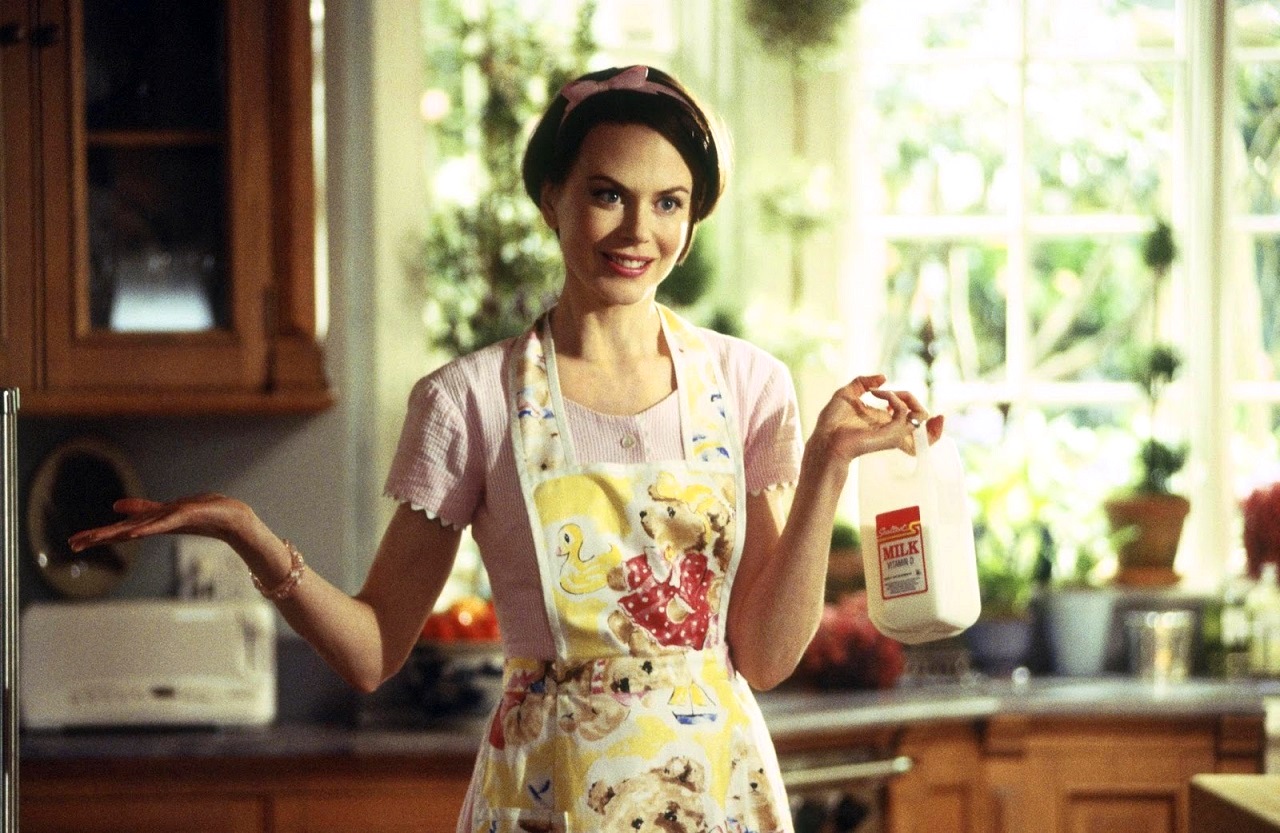
However, what the film is now about is not so much men being afraid of women gaining independence but about men (who are all portrayed as ineffectual nerds) feeling that they have been rendered useless and impotent by women’s assumption of power in the corporate environment and are trying to regain some idea of traditional control. One feels a little dubious about such satire – after all, women’s places in the corporate echelons has by no means even tipped the 30% mark. Moreover, Nicole Kidman’s Joanna ends up being caricatured. The 1974 film was clearly by implication on the side of Joanna and her desire for liberation; this version shows that Joanna is deeply unhappy about being liberated.
Nicole Kidman stalks through the film, her tall angular frame in a severe black power-dress, looking for all the world like The Wicked Witch of the West. At one point, she is diagnosed as a “neurotic, castrating, man-hating career bitch,” which she is happy to agree with and we are told (indeed, told to the point of it being overstressed) that she is miserable being so ambitious and successful. I must admit to not being too much of a fan of Nicole Kidman. That she is an extremely competent actress is in no doubt – but she also comes across as an aloof ice queen. She is not exactly sympathetic in the central role here. She is not, for example, someone that one can feel empathy with over her fears about being replaced by an android.
The one who does radiate far more likeability here is actually Bette Midler. One cannot help but sneakingly think that the film might have worked a good deal more sympathetically if Bette Midler had been given the Joanna role and allowed to play it with the exact same character she had been given here and that Nicole Kidman had instead been cast as the friend who gets transformed. Alas, amid various gossip column reports of on-set diva rivalry between the two stars, Bette Midler is sidelined and entirely overshadowed by Nicole Kidman; in fact, literally so – when the two appear together Midler appears to be more than a foot shorter than Kidman.
The film is more successful when Frank Oz and Paul Rudnick indulge in a satire of the social milieu of the original, welcomely jabbing a pin up into the conservative American concept of Family Values and the Martha Stewart-styled deification of the art of homemaking – indeed, after being transformed, one of the androids even becomes a Republican politician. Stepford now becomes a gated community and there is pointed commentary made about the lack of ethnic diversity to be found there. The remake is even PC enough to add a gay couple to the community, where one of the men replaces his male partner with an android duplicate. On the opposite side of the coin, the film champions the right to be messy, unhappy and flamboyantly camp, seeming to say that the reverse of conservative conformity is an undeniably colourful diversity where people are just as they are. The film concludes upon a fair point of deciding that people should be allowed to work things through in their own way, imperfect and unhappy as they might be.

[SPOILERS ALERT]. This version also throws in a pointless happy ending. However, this is something that, in the addition of a revelation that everything was being conducted by a demented Glenn Close as a means of dealing with a traumatic incident, waters the original concept down. An equally pointless addition is a scene where Matthew Broderick repents of his chauvinist ways and restores the wives to normal. This latter scene also reveals one of the other annoying things about the film – its fundamental confusion about the nature of the wives. Certainly, compared to the 1974 film, this version is much freer to be a science-fiction film. In the 1974 version, the mechanics of the android replacement took place off-screen. By the time of this version, the language of science-fiction has seeped into everyday parlance with much greater ease and the film is freer to show androids and so forth.
However, the climax of the film shows that Paul Rudnick has a fundamental confusion about what is going on. During the animated commercial and the scene where Matthew Broderick undoes the conditioning, we see that the housewives have only been programmed with computer chips in the brain – when Broderick deletes these, the housewives return to being their normal flesh and blood selves. However, with complete contradiction, they elsewhere seem to be androids – Faith Hill’s wife spins out of control and sparks; the others are able to increase her breast size when they pick up her remote control; the Bette Midler replacement is unhurt when she accidentally places her hand into a gas flame; and where the Christopher Walken replacement gets his head knocked off during the climax, it is shown to be filled with wires. It is impossible to imagine any of these happening if the respective wives had only been given mind control chips. One suspects the sad reason is simply another unfortunate case of the film having selected a writer who knows nothing about science-fiction.
Other Ira Levin film adaptations of genre note are:- Roman Polanski’s classic Satanic impregnation film Rosemary’s Baby (1968), The Boys from Brazil (1978) about a Nazi cloning conspiracy, the whodunnit parody Deathtrap (1982), the psycho-sexual thriller Sliver (1993) and the tv mini-series remake of Rosemary’s Baby (2014).