
Crew
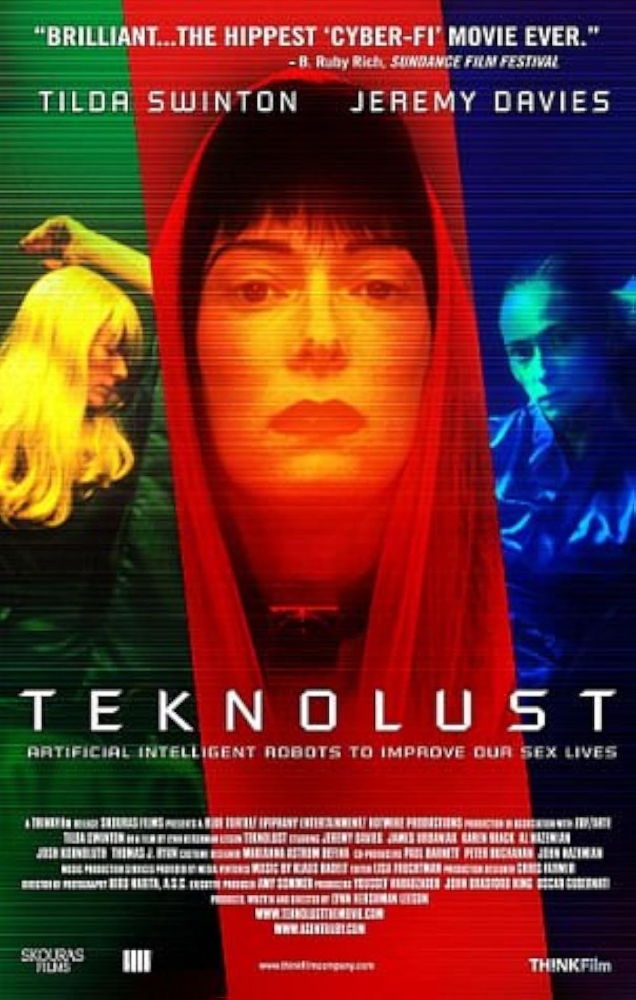
Director/Screenplay – Lynn Hershman Leeson, Producers – Lynn Hershman Leeson, John Bradford King, Oscar Gubernati & Youssef Vahabzadeh, Photography – Hiro Narita, Music – Klaus Badelt, Production Design – Chris Farmer. Production Company – Blue Turtle/Epiphany Entertainment/Hotwire Productions/ZDF/Technolust LLC.
Cast
Tilda Swinton (Dr Rosetta Stone/Ruby/Marinne/Olive), Jeremy Davies (Sandy), James Urbaniak (Agent Edweard B. Hopper), John O’Keefe (Professor Crick), Karen Black (Dirty Dick), Josh Kornbluth (Tim), Abigail Van Alyn (Sandy’s Mom), Al Nazemian (Dr Bea), Diana Demar (Dana), Thomas Jay Ryan (Preacher), Howard Swain (Alex), S.U. Violet (Dr Aye)
Plot
Dr Rosetta Stone has illicitly created three SRAs (Self Replicating Automatons) – androids grown out of her own DNA. However, the SRAs need a constant replenishment of male sperm in order to stay alive. One of the SRAs, Ruby, regularly sneaks out from the lab where Rosetta keeps them confined and goes into the San Francisco streets where she propositions men and collects their semen to distribute among the other SRAs. This is having an unforeseen side effect that is causing all the men to come down with a strange infection imprinted in a barcode on their foreheads. As the authorities quarantine the men, Rosetta is called in to give advice. When she realises what is happening, she tries to hide her involvement. At the same time, the other two SRAs, Marinne and Olive, are starting to desire knowledge of the outside world, while Ruby is drawn to a lonely young printer’s assistant Sandy.
Teknolust was the second film of San Francisco-based writer-director Lynn Hershman Leeson. Leeson previously made Conceiving Ada (1997), which also starred Tilda Swinton. Conceiving Ada was a science-fiction film that vanished in a welter of pretensions and indeed seemed unsure whether it was trying to be a science-fiction film or an historical biography. Leeson has polished her filmmaking abilities somewhat since Conceiving Ada, although Teknolust is no less confusing a film.
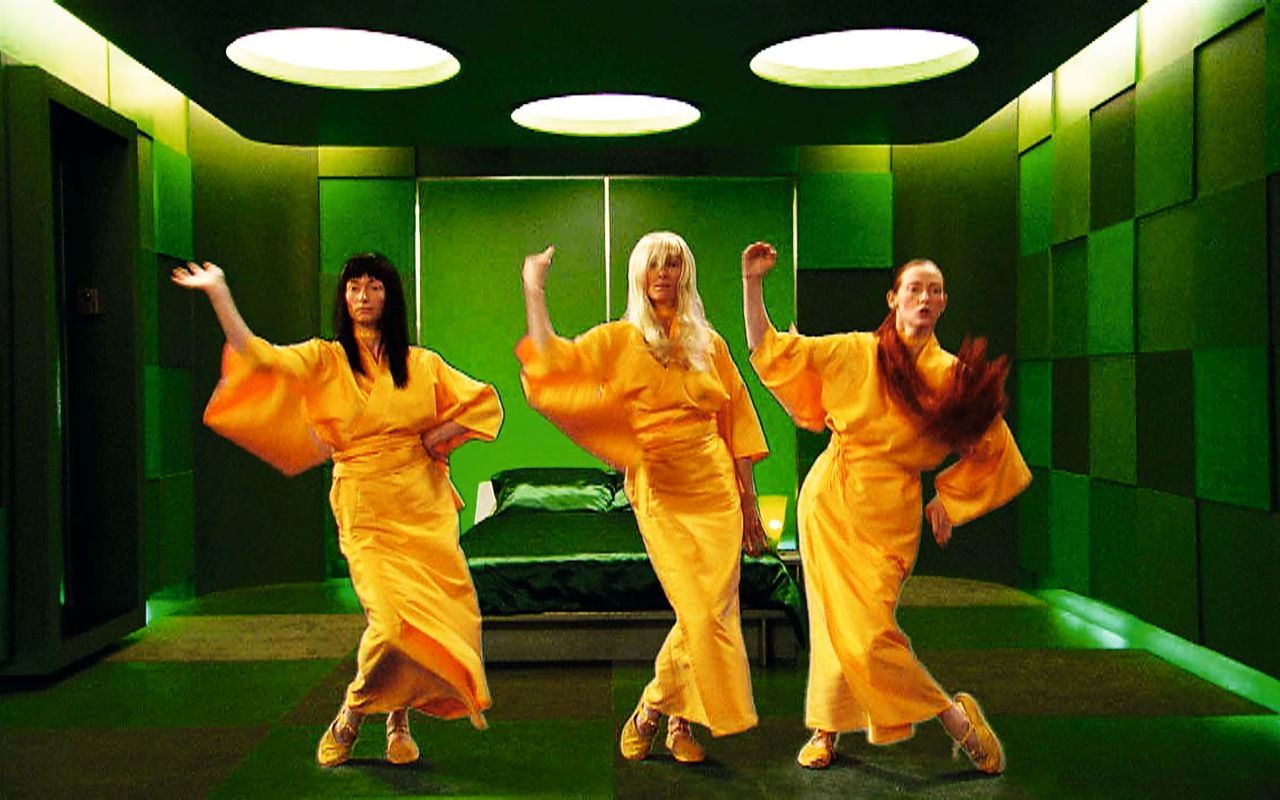
Teknolust certainly has an appealing opening that promises much – a red-wigged Tilda Swinton seduces a man in a bathroom and then pops the condom off and puts it in her handbag, asks if she can have a cuddle and then tells him he cannot see her again as three time is her quota for each man, before returning home, boiling the condom and serving it up as a cup of tea to two other copies of herself. The colour schemes that Leeson outfits the sets and the costumes of the three different Tilda’s that we meet in these scenes are bold and striking. Despite this, the film quickly becomes buried under Leeson’s familiar pretensions. Take a sample piece of dialogue – advice given to Tilda Swinton’s scientist: “Just make sure you don’t download yourself into your work.”
There is a potentially worthwhile idea to the film – of a scientist creating three copies of herself, which then proceed to go out of control in their search for independence. It is almost like a feminist version of Multiplicity (1996). However, Teknolust sounds a much more interesting film in synopsis than it emerges up on screen. Leeson clearly wants to make science-fiction films – and the idea of science-fiction as a genre for the woman’s film is one that had yet to be explored at this point – but she displays incredibly little interest in the genre – the film here has the ludicrous notion of computer viruses somehow being able to infect humans, for one. Nor does Leeson ever make it clear whether the SRAs are clones or androids.
Leeson further has little interest in the dramatic or comic potentials of the idea and the film circles around its premise without ever going anywhere. While Leeson has good ideas in her films, it feels like what she needs is a co-writer to come on board and clarify what she is trying to say. Her direction of actors also feels forced – the romance between Tilda Swinton and the incredibly annoying Jeremy Davies is without any type of conviction, the least of which is something like a twenty-year age gap between the two of them.
Perhaps the most interesting aspect of Teknolust is its real-life echoes. Between 1974 and 1978, Leeson created an alter ego for herself as Roberta Breitmore, managed to obtain legal documentation and maintained the identity in numerous ways, including going on dates in character. Leeson then hired three performers to play the part of Roberta and enact her life. Subsequently, Leeson created a number of other identities, including the interactive online identities and programs known as Lorna and Agent Ruby. These and their interactions later became the basis of her art installations.