

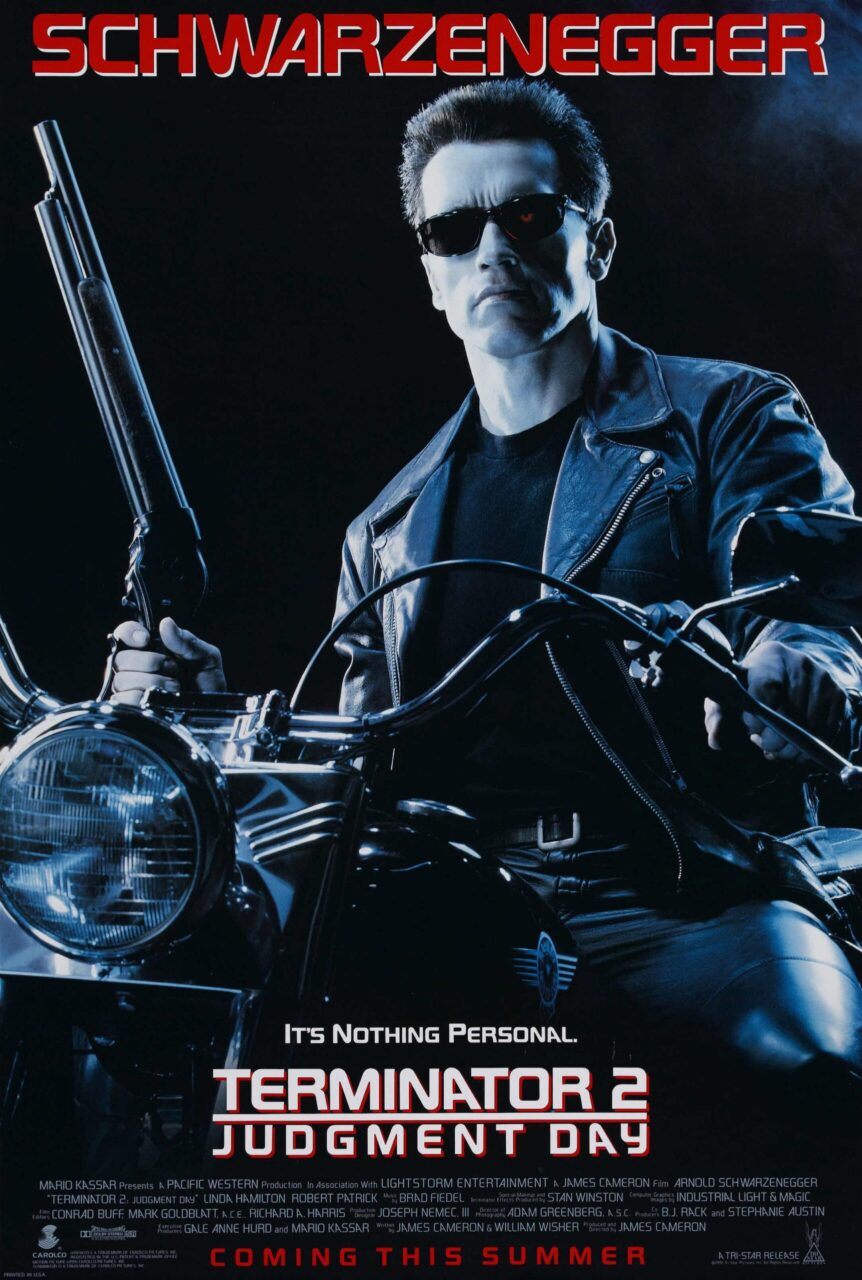
USA. 1991.
Crew
Director/Producer – James Cameron, Screenplay – James Cameron & William Wisher, Photography – Adam Greenberg, Music – Brad Fiedel, Visual Effects – Fantasy II Film Effects (Supervisor – Gene Warren Jr) & Industrial Light and Magic (Supervisor – Dennis Muren), Miniatures/Mechanical Effects – 4-Ward Productions (Supervisors – Dennis & Robert Skotak), Special Effects Supervisor – Thomas L. Fisher, Makeup Effects – Stan Winston, Production Design – Joseph C. Nemec III. Production Company – Pacific Western/Lightstorm Entertainment.
Cast
Arnold Schwarzenegger (The Terminator), Edward Furlong (John Connor), Linda Hamilton (Sarah Connor), Robert Patrick (The T-1000), Joe Morton (Miles Dyson), Earl Boen (Dr Silberman)
Plot
A second Terminator android arrives in L.A., several years after Sarah Connor faced the previous one. She has been committed to a psychiatric institution after conducting acts of terrorism against computer installations, driven by the terrifying knowledge of the coming nuclear holocaust on August 29, 1997. Upon arriving, The Terminator tracks down her now adolescent son John Connor who has been fostered out. However, when a cop attempts to kill John, The Terminator steps in to protect him. The Terminator explains to John that it has been reprogrammed and sent back by his older self to protect he and his mother from the T-1000, a more advanced Terminator unit built of liquid metal that is capable of molding itself into any form. Pursued by the relentless and invincible T-1000, John and the Terminator rescue Sarah from the asylum and set about trying to stop the events that lead to the machines triggering a nuclear holocaust that will kill three billion people.
Nobody expected that James Cameron, Arnold Schwarzenegger and Linda Hamilton would have returned in Terminator 2: Judgment Day with a Roman numeral and enough military hardware in tow to fuel several Central American juntas with the intention of offering audiences anything other than more of the same. Nevertheless, James Cameron has the ability in what he does to make films that have a great deal of intelligence, which leaves Terminator 2: Judgment Day with much greater promise than any standard sequel would hold. James Cameron’s Aliens (1986), after all, is considered by many to be a superior sequel to the original Alien (1979). The Terminator (1984) was only a B movie with a slightly bigger budget. However, in the period between the two Terminator films, James Cameron springboarded to the forefront of genre filmmaking with the impressive big-budget likes of Aliens and The Abyss (1989). By the time of Terminator 2, Cameron was able to return with a whopping $98 million budget, nearly fifteen times that of the first Terminator (although part of this was Carolco giving Schwarzenegger the $12 million gift of a Gulfstream plane). This made Terminator 2: Judgment Day the then most expensive film ever made – only to then be successively outdone by Cameron’s next three films True Lies (1994), Titanic (1997) and Avatar (2009).
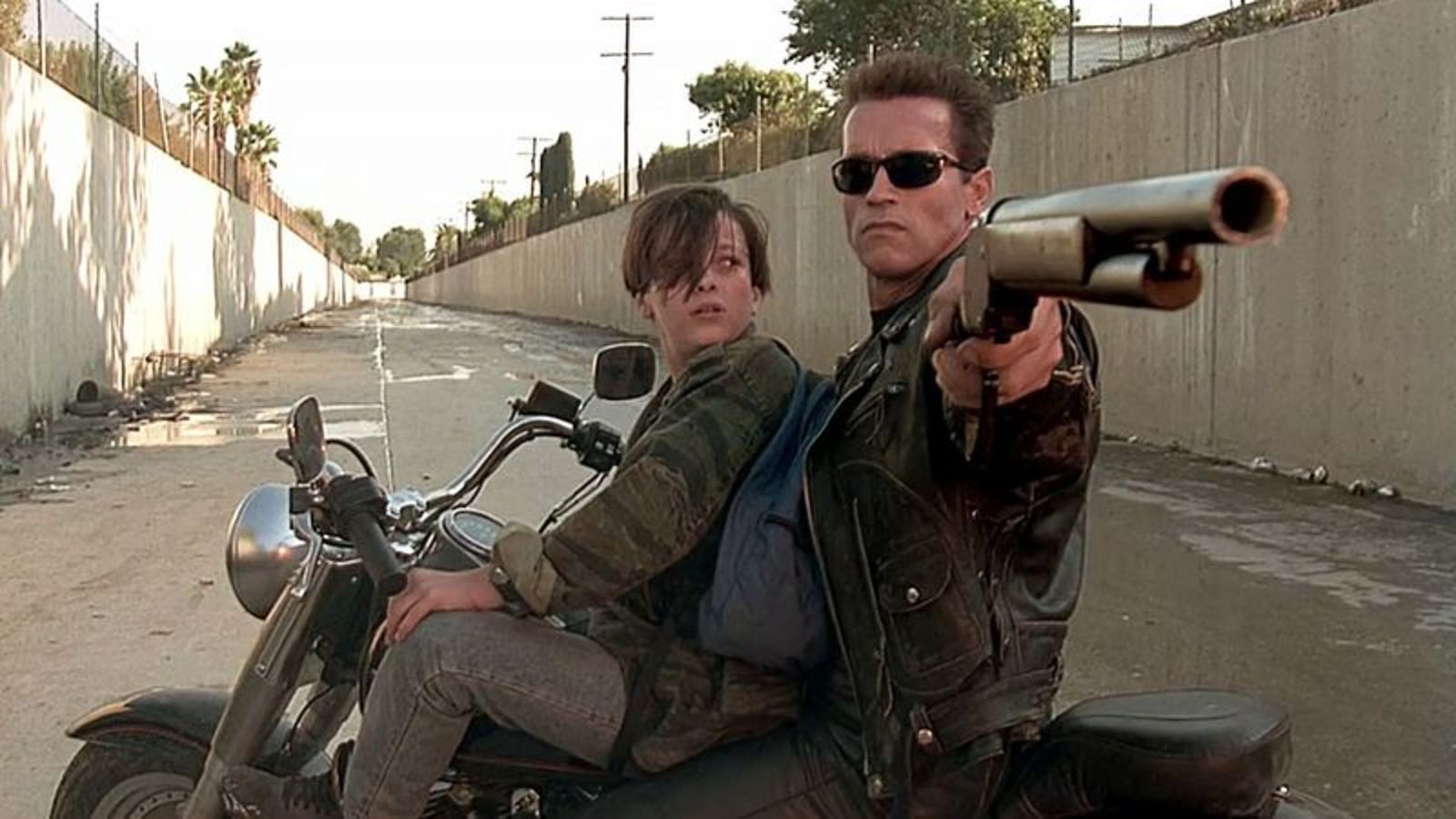
Not unexpectedly, everything shows up on screen with spectacular results. The plot nominally charts the same course as the original film – one Terminator and one defender both return through time to eliminate/defend Sarah Connor and the son that will become the leader of the future resistance, there is a break-in to an institution where Sarah is being held and a long extended chase sequence against invincible odds that culminates in a factory. However, the big budget has allowed Ja,es Cameron to up everything by a quantum factor. The film bristles with spectacularly exciting action sequences – the T-1000 barrelling down a storm culvert in a semi-trailer pursuing John Connor on a motorcycle; an armed siege at the laboratory with the Terminator single-handedly attacking SWAT teams with rocket launchers and tear gas canisters; and an amazing highway chase sequence involving a police van, an exploding helicopter, an antiquated pickup and a tanker truck skidding on its side.
Most amazing of all is the T-1000, which comes designed with the then new computer-assisted process known as ‘morphing’, which consisted of digitally mapping the points between two distinct and different live-action objects onto one another, allowing them blur together. This results in some stunning effects set-pieces – with the T-1000 managing to disguise itself as a wafer thin section of checkered tile floor, transforming its arms into meter-long steel spikes to impale victims through the head, its successive blowings apart leaving gaping football size holes of metal in its head and it split to the midriff like some gleaming android version of The Thing (1982). The most amazing and talked-about set-piece was the one where it is frozen and shattered by a toppled tanker of liquid nitrogen, only to then be melted by a spill of molten metal and collect its splattered blobs of metal back together.
Within a year of Terminator 2, morphing effects were being copied by every commercial, music video and other science-fiction/fantasy film out there. What Terminator 2 served to create was the modern 1990s and 2000s CGI and action spectacular. The next couple of years would see the creation of CGI cyberspace landscapes with The Lawnmower Man (1992) and then the CGI creature/disaster spectacular with Jurassic Park (1993). Moreover, while the action movie had previously existed as a series of car chases and fight sequences, James Cameron upped the bar and added the element of the insistently spectacular, both in terms of visual effects and epic-sized action set-pieces. It is from here that films like Speed (1994), Armageddon (1998), The Mummy (1999), Schwarzenegger’s End of Days (1999) and Pearl Harbor (2001) to name but a handful of the most empty-headed guilty offenders began to develop.
While these reduce the spectacular to routine meaninglessness in their insistent need to keep piling action and CGI effects on top of the other, Terminator 2 still holds its own as one of the most amazing. (In one’s personal dream of what Hollywood should be like, directors should be given a competency hearing by CGI houses before they sign onto films – those that cannot use effects without engendering a sense of genuine amazement should be forced to make a Dogme 95 film instead). There are certainly few filmmakers other than James Cameron who managed to ever convincingly use morphing effects. In a rapid space of time, we saw morphing replace traditional air-bladder transformation effects – thus we had morphing werewolves in Bad Moon (1996) and vampires in From Dusk Till Dawn (1996), but both having almost nothing in the way of the amazement that the air-bladder transformations had when films like The Howling (1981) and An American Werewolf in London (1981) came out. The truth is that organic forms do not transform with the smooth fluidity that morphing offers and upon almost every occasion it was used the effect looks fake.
The major change over The Terminator is that Arnold Schwarzenegger is the good guy this time. Some people dislike the humanising of Schwarzenegger’s ruthless tough killing machine from the original, although should be aware that Schwarzenegger had originally signed onto the first film to play the hero Reese. Certainly, the humanising of the Terminator is well written upon James Cameron’s part, if ultimately one that falls into humanocentric notions of androids learning emotions – Cameron cannot quite resist the notion of going out on the Terminator’s self-sacrifice and he commenting “I know now why you cry.” However, the relationship between The Terminator and Edward Furlong and the striking image of it becoming the perfect father figure is well written. As with the first film, Cameron loves putting Arnold Schwarzenegger in cool macho poses – dressing him in black leather and dark glasses throughout, as well as outfitting him with a Harley Davidson and all manner of slow-motion poses twirling guns into camera and the like. Although when Schwarzenegger walks up to a biker during the opening moments and only takes a pair of shades instead of killing him and then drives off to the accompaniment of Bad to the Bone on the soundtrack, it is a macho pose that is starting to seem a little cod.

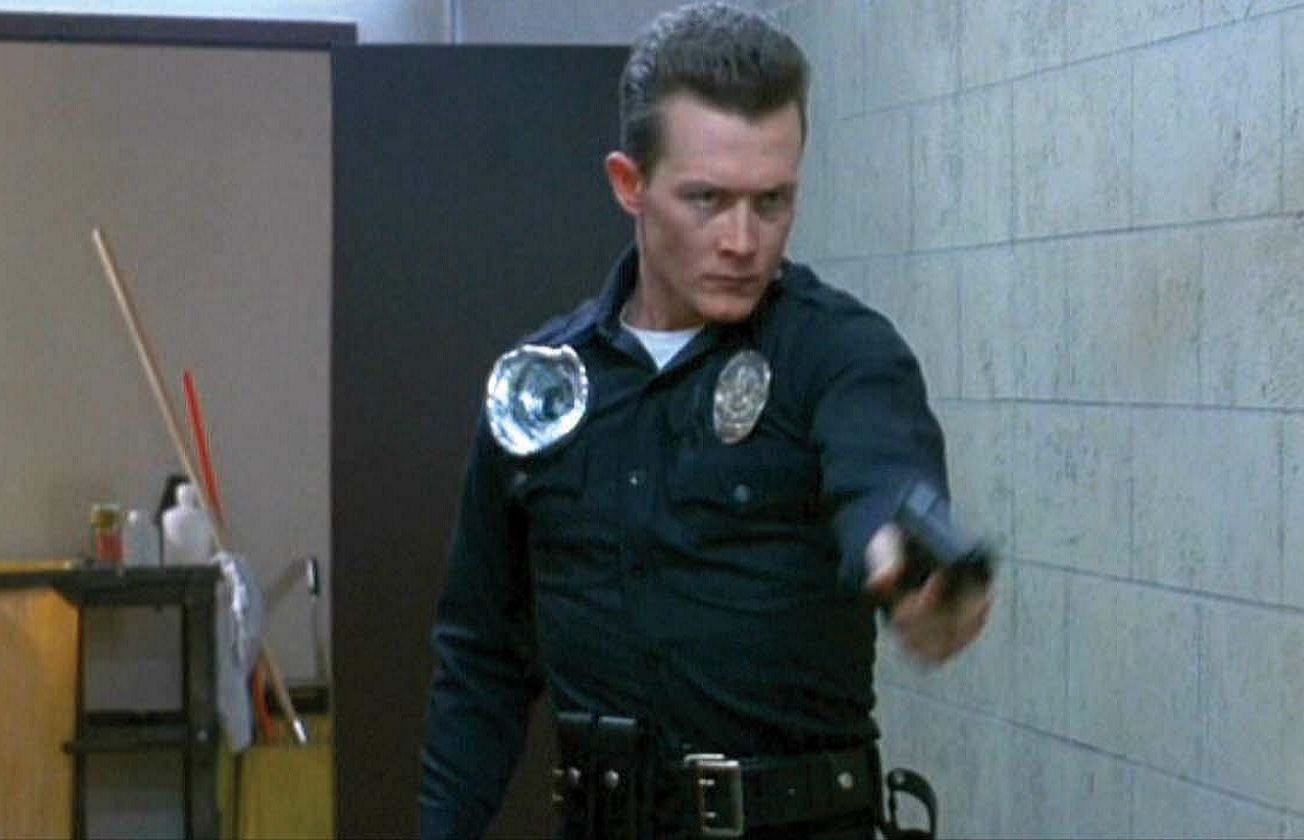
In the bad guy role this time around, Terminator 2 brought to attention a previously unknown Southern actor Robert Patrick whose only major role had been a small part as a terrorist in Die Hard 2 (1990). Robert Patrick has a startling presence in the film with slicked-back hair, protruding ears and a fox-like face that radiates a steely, cold emotionlessness. The images of he ruthlessly running towards Edward Furlong mechanically pumping a handgun and later throwing the much brawnier Arnold Schwarzenegger about are memorable.
The least credible part of the film – bar having a helicopter crash into the open rear door of an armoured van and the occupants of the van emerge unscathed – is the turning of Linda Hamilton into some kind of militant answer to the Gun Control Lobby. There would certainly be few sequels in which the central character undergoes such a startling change in character – for James Cameron, it seems that feminism equates with the right for women to be macho too. Alas Linda Hamilton is not a particularly great actress and, while the role startles with the sheer burned-out ruthlessness that Cameron invests it with, underneath one can see the relative blandness of Hamilton’s natural persona emerging from time to time.
In one interview, James Cameron called Terminator 2: Judgment Day a violent movie about peace. This does seem to be skirting the edge of pretension – sort of like saying that one can only be a little bit pregnant. Certainly, Terminator 2 sends out some odd messages – it arrays an extraordinary amount of artillery, firepower and explosions – all to make a film about peace; it harnesses the greatest sophistication of computer technology that was available to film at the time – all to make a film about defying the machine. And the theme about trying to prevent the nuclear holocaust came just a little too late. When James Cameron made The Terminator, nuclear war fears were topical due to Ronald Reagan’s massive re-escalation of the Cold War. Concern about nuclear war is a theme that features in several of Cameron’s films – The Abyss had aliens coming to demonstrate the follies of nuclear armament to the human race, while True Lies dealt with the theft of nuclear weapons, including the detonation of one in the Florida Keys. Even though Cameron brings nuclear fears even more so to the fore here – there is a stunning dream sequence where a children’s playground is crisped in slow-motion and an entire city flattened by a vast bomb blast – by the time of Terminator 2, both the Soviet Union and the Cold War were things of the past and the message seemed one that had come ever-so-slightly late.
The central characters in all of James Cameron’s film are engaged in an ultra-violent fight for their lives against overwhelming odds and usually technology gone wrong. Terminator 2: Judgment Day is the first of James Cameron’s films in which he stops in the midst of the fight to question the morality of survival. Terminator 2 is a film both socially and psychologically about pulling back from the brink of violence. Indeed, Terminator 2 is less a film about the fight for survival than it is one about finding a morality inside the ruthlessness of the all-out struggle that usually occurs in a James Cameron film – from John Connor teaching the Terminator the difference between killing and merely stopping people; Sarah’s pulling back from the abyss and deciding not to kill an innocent to prevent the oncoming future; to the haunting end realisation that even a nihilistic doomed future can be prevented – “If a machine, a Terminator, can learn the value of human life, maybe we can too. The future is not set. There’s no fate but that which we make for ourselves.” If occasionally Terminator 2: Judgment Day is a film that seems driven only by its own kinesis and the spectacularity of the stunts and effects that James Cameron arrays, it is these questions that make Terminator 2 thematically stronger than all of Cameron’s other films. Never, for instance, did we see Ripley in Aliens or Sarah Connor in the first film stopping to question the way in which they were forced to act.
As seems is the case with all of his films, James Cameron later released a special DVD edition containing scenes that were not in the original. These scenes include Michael Biehn’s reappearance to Linda Hamilton in a dream at the asylum, inspiring her to escape; more development of Joe Morton’s character and home life; a scene where a malfunctioning T-1000 accidentally develops the markings of a lamppost; scenes where it is explained how the future John Connor was able to tame The Terminator and switch on its learning mode; and a scene where Edward Furlong teaches the Terminator to smile.
This was followed by Terminator 3: Rise of the Machines (2003) was a further sequel, produced by Gale Anne Hurd and starring Arnold Schwarzenegger but made without James Cameron’s involvement; Terminator Salvation (2009) with Christian Bale as the adult John Connor; the disastrous Terminator Genisys (2015) with a return appearance from an aging Arnold Schwarzenegger; and Terminator: Dark Fate (2019) with return appearances from Arnold Schwarzenegger and Linda Hamilton. There was also the tv series Terminator: The Sarah Connor Chronicles (2008-9) featuring Lena Headey in the role of Sarah Connor and the animated tv series Terminator Zero (2024- ). Terminator 2 was parodied in Hot Shots! Part Deux (1993). Robert Patrick later made cameos as the T-1000 in both Wayne’s World (1992) and the Arnold Schwarzengger action movie spoof Last Action Hero (1993). In 2017, James Cameron re-released Terminator 2 in 3D.
James Cameron’s other films include:- Piranha II: Flying Killers/Piranha II: The Spawning (1981), Aliens (1986), the underwater alien contact film The Abyss (1989), the spy comedy True Lies (1994), the runaway success of Titanic (1997), the long-planned Avatar (2009). and its sequel Avatar: The Way of Water (2022). Cameron has also written the millennial virtual reality film Strange Days (1995), which was directed by his wife Kathryn Bigelow, and wrote/produced the manga adaptation Alita: Battle Angel (2019), as well as produced the near future tv series Dark Angel (2000-2), the remake of Solaris (2002), the rock diving survival film Sanctum (2011) and Cirque du Soleil: Worlds Away (2012). He also hosts and produces the tv documentary series AMC Visionaries: James Cameron’s The Story of Science Fiction (2018).
Trailer here