

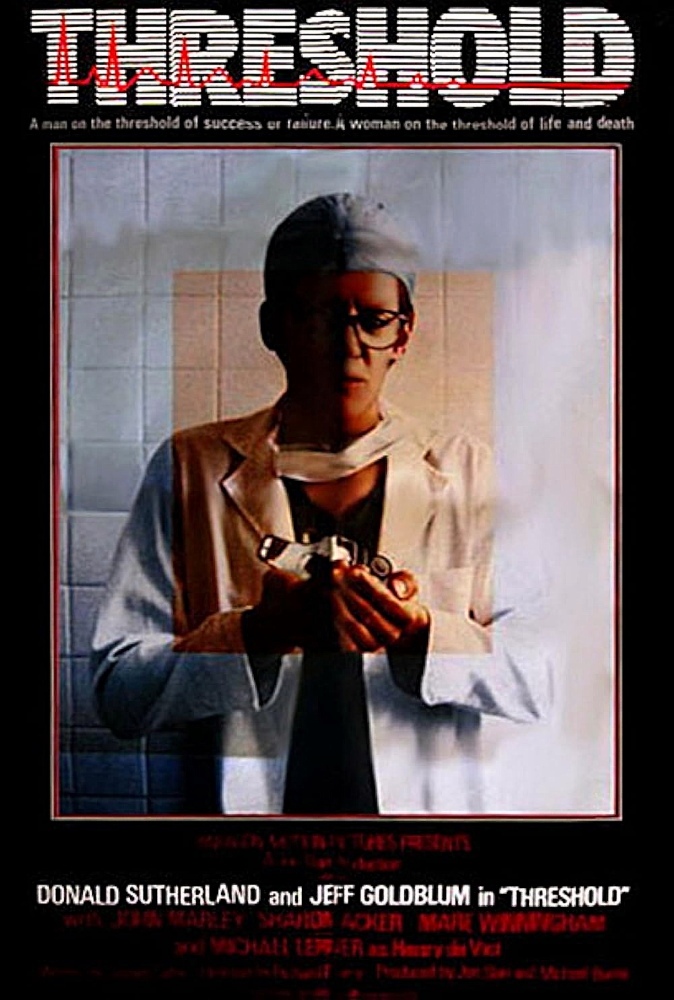
Crew
Director – Richard Pearce, Screenplay – James Salter, Producers – Michael Burns & John Slan, Photography – Michel Brault, Music – Mickey Erbe & Maribeth Solomon, Music Conductor – Charles Gross, Special Effects – Daniel Bezaire & Gordon J. Smith, Production Design – Anne Pritchard. Production Company – Paragon Motion Pictures.
Cast
Donald Sutherland (Dr Thomas Vrain), Jeff Goldblum (Dr Aldo Gehring), Mare Winningham (Carol Severance), Michael Lerner (Henry De Vici), John Marley (Edgar Fine), Allan Nicholls (Dr Rents), Sharon Acker (Tilla Vrain)
Plot
At a conference, Dr Thomas Vrain, one of the world’s top cardiac surgeons, meets Dr Aldo Gehring who claims to have come up with a workable design for an artificial heart. Vrain obtains funding and they start experiments to build the heart. Vrain wants to use Carol Severance, a young patient with a poor heart, as his first human subject, but the hospital board turns down his application. As Carol weakens, he is forced to operate to try and save her. During the middle of the operation however, her heart will not restart and so he makes a decision to implant the artificial heart.
Threshold is one of the few examples of science-fiction prediction. In fact, the film was so remarkably prophetic that its release was held up in the UK for two years after the real artificial heart developed by Robert Jarvik and implanted in 1982 beat the filmmakers to the punch. Indeed, the film’s extrapolative line is so close to the real thing and it takes such a realistic-seeming approach to the subject that one feels hesitant about classifying it as science-fiction.
For the most part, the film creates a convincing slice-of-life look at life in the hospital and into the research and development of an artificial heart. Donald Sutherland gives another of his effective absent-minded performances and radiates much in the way of warm understanding bedside manner, and paired against him is Jeff Goldblum giving another of his intense wired genius performances.
While this is all very convincing, it is also dramatically meagre – very little happens, the film is almost all slice-of-life patiently observed background detail – and it is not until almost the end that the film picks up any dramatic pace. Indeed, one wishes that Threshold would have dropped such a verite style of approach and gone for more of a melodramatic medical misadventure approach a la Coma (1978) or even a mad scientist effort like The Man They Could Not Hang (1939).
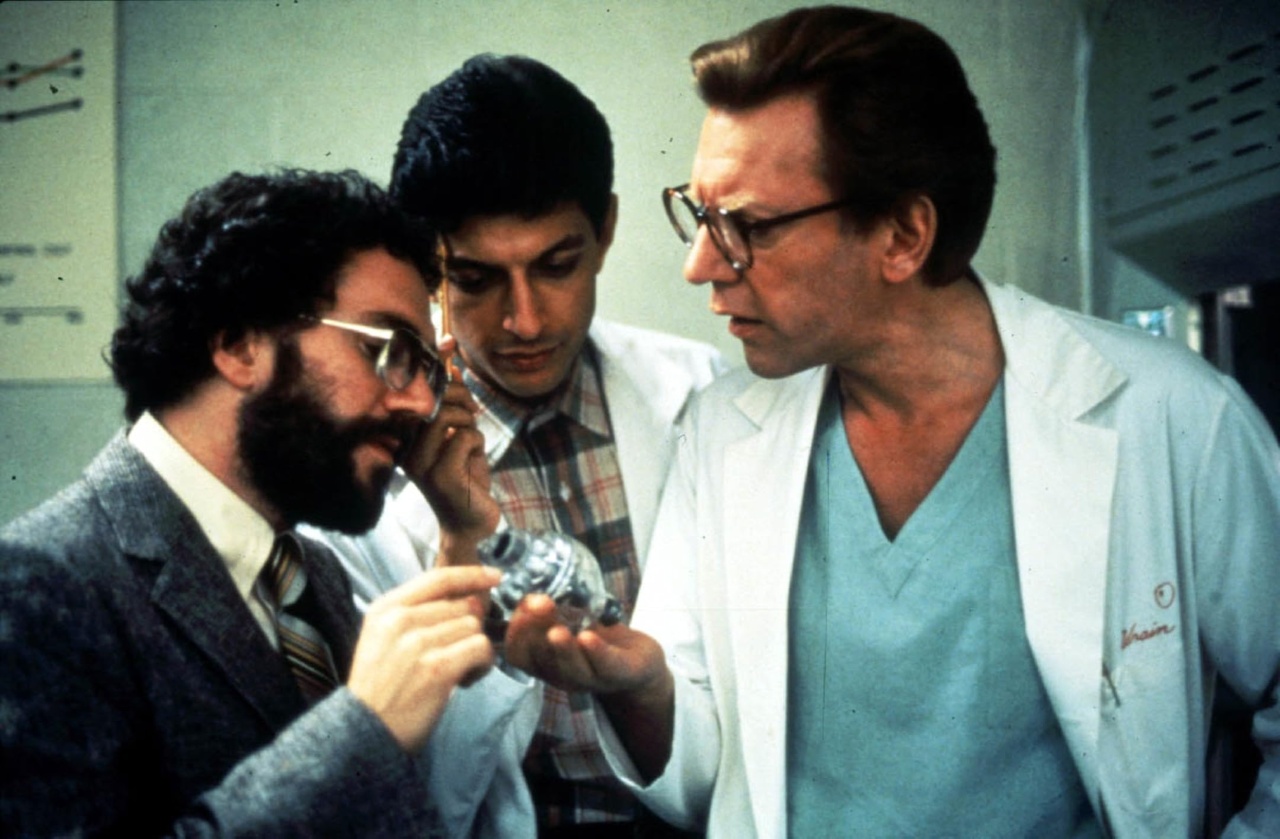
Threshold‘s greatest dramatic moment occurs during the implantation of the artificial heart – the film has built up such an authentic-seeming medical background that when it occurs there is no doubt that this is the way it should happen in real life, and yet there is the undeniably science-fictional thrill of seeing something that has not yet happened being done. Unfortunately, the film ends not long after that – its dramatic climax banally comes with heart recipient Mare Winningham’s merely finding the self-confidence to come out and face the world. In contrast to the likes of Coma and The Man They Could Not Hang, this is precisely the place the story should have chosen as its starting point.
American director Richard Pearce spent almost the rest of his career working in television. His other films of note were the socially conscious Country (1984), the thriller No Mercy (1986) and the comedy Leap of Faith (1992) with Steve Martin as a fake faith healer.