
Crew
Director – Alexander Singer, Teleplay – Jackson Gillis, Story – Irwin Allen & Rod Serling, Producer – Irwin Allen, Photography – Fred Jackman Jr, Music – Morton Stevens, Art Direction – Eugene Lourie. Production Company – Irwin Allen Productions/20th Century Fox.
Cast
Sam Groom (Dr Clint Earnshaw), Tom Hallick (Jeffrey Adams), Richard Basehart (Dr Joshua Henderson), Francine York (Dr Helen Sanders), Booth Colman (Dr Amos Cummings), Trish Stewart (Jane Henderson), Walter Brooke (Dr Stafford), Patrick Culliton (Clarence Younger), Dort Clark (Sharkey), Jon Cedar (Pegleg)
Plot
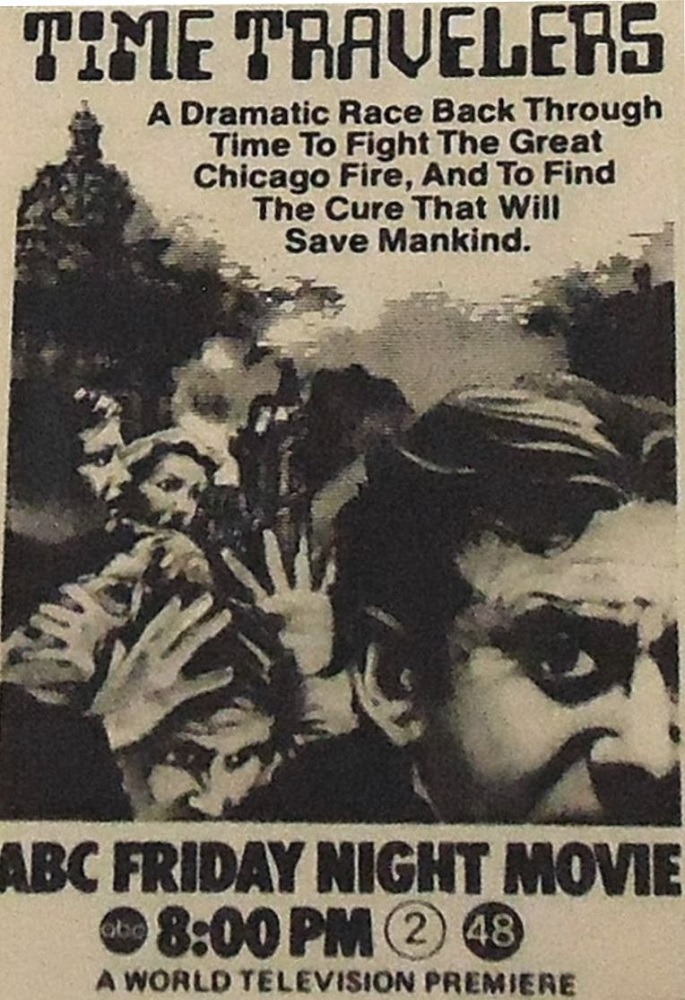
The world is afflicted by an epidemic and scientists are at a loss to find a cure for it. Research shows that Dr Joshua Henderson discovered a cure back in 1871 but this is believed to have perished in the Great Chicago Fire along with Henderson. Dr Clint Earnshaw is approached by scientists who have devised a time machine. They propose that Earnshaw and Jeffrey Adams go back in time to 1871 and obtain samples of Henderson’s cure. Earnshaw agrees and he and Adams step through the time portal into Chicago of 1871. However, a miscalculation means that they arrive only a single day, rather than a week, before the Great Fire began.
Producer and sometimes director Irwin Allen (1916-91) has developed a reputation for making bad science-fiction. Irwin Allen emerged in the late 1950s with various documentaries and then films like The Story of Mankind (1957), The Lost World (1960), Voyage to the Bottom of the Sea (1961) and Five Weeks in a Balloon (1962). Allen then moved into television, having great success as producer of tv series such as Voyage to the Bottom of the Sea (1964-68), Lost in Space (1965-68), The Time Tunnel (1966-67) and Land of the Giants (1968-70), which attained a notoriety among genre fans for their bad science and frequently ludicrous plots.
Allen made various other attempts to repeat the successes of these series and fired off various tv pilots that never made it, including the likes of City Beneath the Sea/One Hour to Doomsday (1971) and The Return of Captain Nemo/The Amazing Captain Nemo (1978), both of which failed on the small screen and were instead foisted off onto cinematic audiences. The Time Travelers was another of Irwin Allen’s tv pilots that failed to make it to a series. In the mid-1970s, Allen returned to cinema screens and had great success as producer-director with disaster movies such as The Poseidon Adventure (1972), The Towering Inferno (1974) and the notorious The Swarm (1978), among others.
The other interesting name on the credits of The Time Travelers is that of Rod Serling. It stretches the mind to think of Irwin Allen and Rod Serling collaborating on a project. It is almost impossible to think of two names so diametrically opposed in approach as Irwin Allen and Rod Serling when it comes to televised science-fiction. Rod Serling emerged as a writer in the days of live television where he won a number of Emmy Awards, but will always be remembered as the creator of tv’s The Twilight Zone (1959-64).
Where Irwin Allen specialised in science-fiction involving ridiculous rubber monsters and where high concept for Allen amounted to no more than having plots involving Nazi ghosts, interstellar cowboys and mermaids, Rod Serling specialised in a type of twist ending that subtly undermined prejudices and expectations. Like Irwin Allen, Rod Serling moved from tv work to feature films but where Allen’s subsequent feature film work is driven by spectacle and the arraigning of star power, Serling’s feature film works, which includes scripts for the likes of Seven Days in May (1964), Planet of the Apes (1968) and The Man (1972), is driven by often thoughtful liberal political message.
Expectedly, Rod Serling’s input raises The Time Travelers above the level of the typical Irwin Allen scenario and circumvents the usual bad plotting, bad science, illogical premises and ludicrous clichés that permeated Allen’s other tv work. Clearly, Irwin Allen construed The Time Travelers as being another variation on The Time Tunnel. With Rod Serling’s input, we at least get a passable time travel story.
However, in all other regards, The Time Travelers represents life as usual for Irwin Allen. The film is typically stolidly directed and acted. As with The Time Tunnel and some of Irwin Allen’s earlier films – most notedly the notoriously bad historical epic The Story of Mankind – Allen put the film together out of scrounged stock footage, in this case from 20th Century Fox’s In Old Chicago (1937), which was naturally enough about the Chicago Fire.
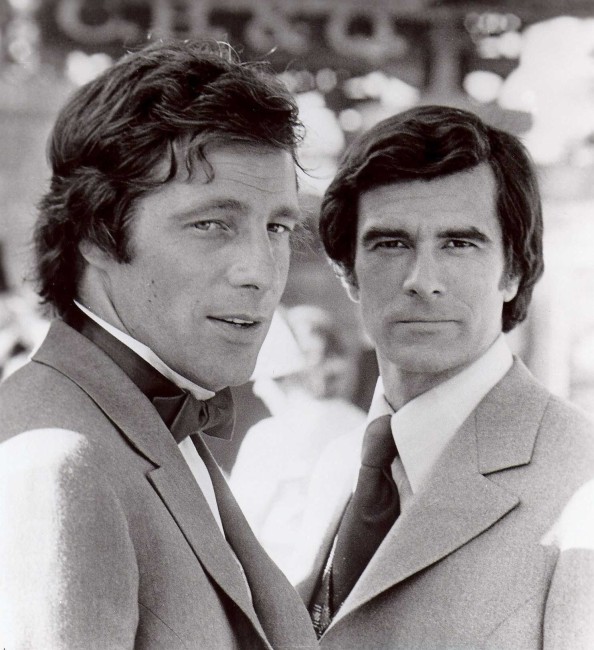
Irwin Allen also managed to recycle his casts between productions. Of the two lead actors here, Sam Groom had played a supporting role as a technician in The Time Tunnel, while Tom Hallick went on to become one of the heroes in The Return of Captain Nemo/The Amazing Captain Nemo. Alas, Groom and Hallick make forgettable leads. More memorable is Richard Basehart, Admiral Nelson in Allen’s Voyage to the Bottom of the Sea, who plays with entertainingly scenery-chewing regard as the 19th Century doctor.
The Time Travelers should not be confused with the early B movie The Time Travelers (1964).
Full film available here