

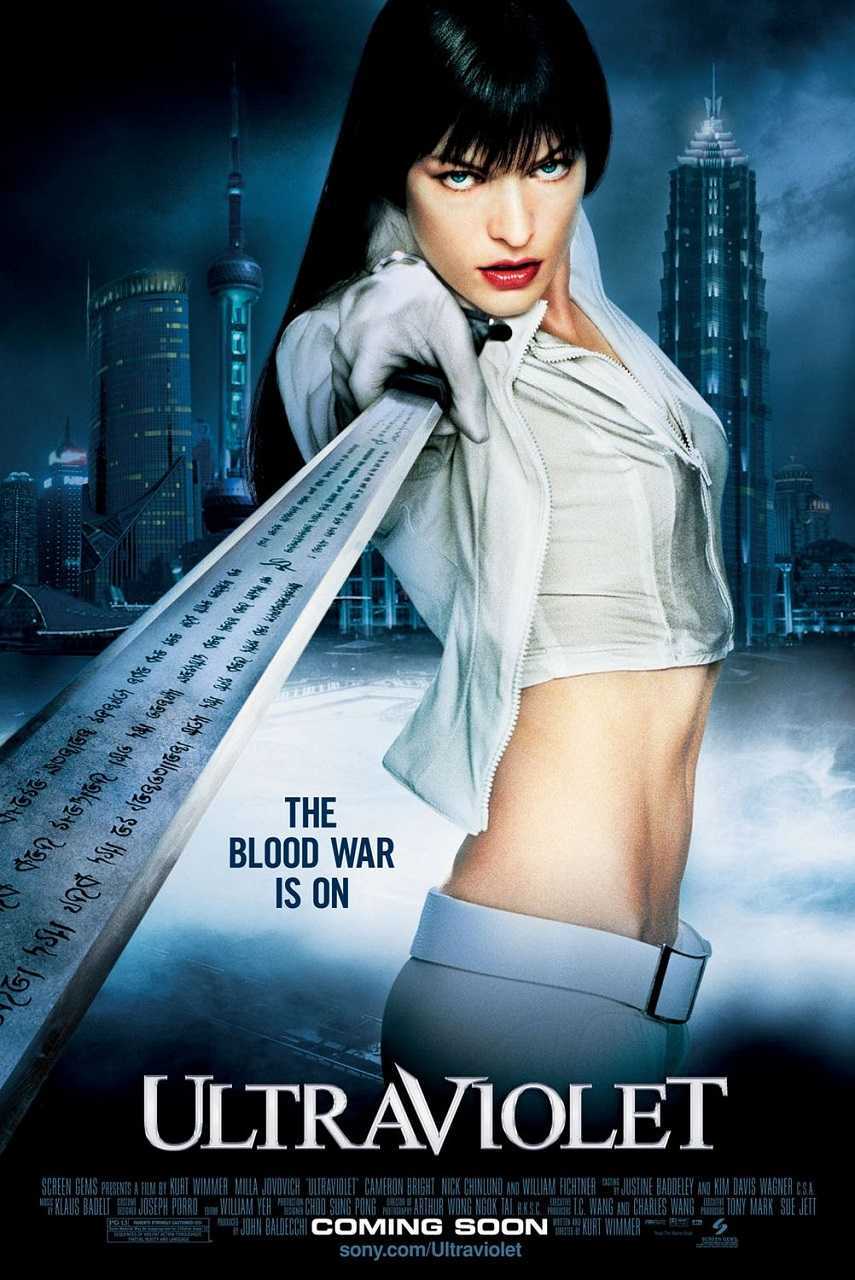
USA. 2006.
Crew
Director/Screenplay – Kurt Wimmer, Producer – John Baldecchi, Photography – Arthur Wong Ngok Tai, Music – Klaus Badelt, Visual Effects Supervisor – Victor Wong, Visual Effects – China Film Group Hualong Film Digital Production Co., Ltd., (Supervisors – James Feng & Fang Rongguo), CIS Hollywood (Supervisor – Ken Jones), Menford Electronic Art & Computer Design Co. Ltd., Production Design – Choo Sung Pong. Production Company – Screen Gems.
Cast
Milla Jovovich (Violet Song Jat Shariff), Cameron Bright (Six), Nick Chinlund (Vice Cardinal Ferdinand Daxus), William Fichtner (Garth), Sebastien Andrieu (Nerva)
Plot
It is in the future. Following an outbreak of the experimental HGV virus, some of the population have mutated into what has become known as Hemophages and have vampire-like characteristics. Most of the Hemophages were put in concentration camps by the human populace but those that have survived have formed a rebel underground fighting back against the totalitarian state ruled by Vice Cardinal Daxus. Violet Song Jat Shariff is a top agent of the Hemophage rebel underground. In an elaborate masquerade, Violet poses as a courier to get into Daxus’s headquarters to steal a valuable package on behalf of the underground. She then discovers that the package contains a human boy Six. Her controllers want Six eliminated as he is the carrier of a virus that will eliminate all the Hemophages when released. However, Violet refuses to carry out orders to kill an innocent boy. Instead, she goes on the run with Six, hunted by both the rebels and Daxus’s soldiers.
Ultraviolet was a big-budget independently made action/vampire film from Kurt Wimmer. Kurt Wimmer is shaping up as an interesting genre contributor. He began as a screenwriter, having turned out scripts for films like Double Trouble (1992), The Neighbor (1993), Relative Fear (1994), Sphere (1998), The Thomas Crown Affair (1999), The Recruit (2003) and the subsequent likes of Street Kings (2008), Law Abiding Citizen (2009), Salt (2010), Spell (2020) and the remakes of Total Recall (2012) and Point Break (2015). Wimmer then made his directorial debut with the revenge film One Tough Bastard (1996) and went onto direct the dystopian science-fiction film Equilibrium (2002), which received some modest acclaim in international release, and subsequent to this Children of the Corn (2020).
Ultraviolet – which should not be confused with the excellent British vampire-hunting tv mini-series Ultraviolet (1998) – falls into the post-millennial fad for films that might be best termed the cinematic equivalent of graphic novels. The Matrix (1999), with its stylish poses and the sublime cool of its Bullet Time moves, led the way. Indeed, The Matrix seems to have large influence over Kurt Wimmer who has appropriated Bullet Time moves for his own action style that he calls Gun Kata, which appears both here and in Equilibrium – the rather absurd notion that specially trained fighters can move in mathematically acute ways that will avoid bullets and allow multiple people shooting at them to hit each other instead.
Ultraviolet shares much, if not borrows outrightly, from a host of other films amid this Cinematic Graphic Novel fad. The film openly signals its lineage in the opening credits sequence, which mock Violet’s adventures up as a series of comic-book panels. The casting of Milla Jovovich also taps into the cult action heroine status that she has developed in films like The Fifth Element (1997) and Resident Evil (2002) and sequels. The Cinematic Graphic Novel fad has also been at the forefront of the new breed of Digital Backlot science-fiction films that create visions of the future entirely inside the computer – see other efforts like Casshern (2004), Immortal (ad vitam) (2004), Sky Captain and the World of Tomorrow (2004) and Renaissance (2006).
Milla’s abrupt changes of costume and hair colour remind something of the outlandish disguises adopted by Jennifer Garner in tv’s Alias (2001-6). Indeed, you could see Ultraviolet as being a combination of The Matrix and Alias – with vampires. You could also point to Aeon Flux (2005), which came out only three months before Ultraviolet. Aeon Flux and Ultraviolet have very similar plots concerning a lithe, sexy and ultra-tough heroine fighting on behalf of a rebel faction in a stylishly designed dystopian future where she also has a complex personal relationship with the dictator of the future.
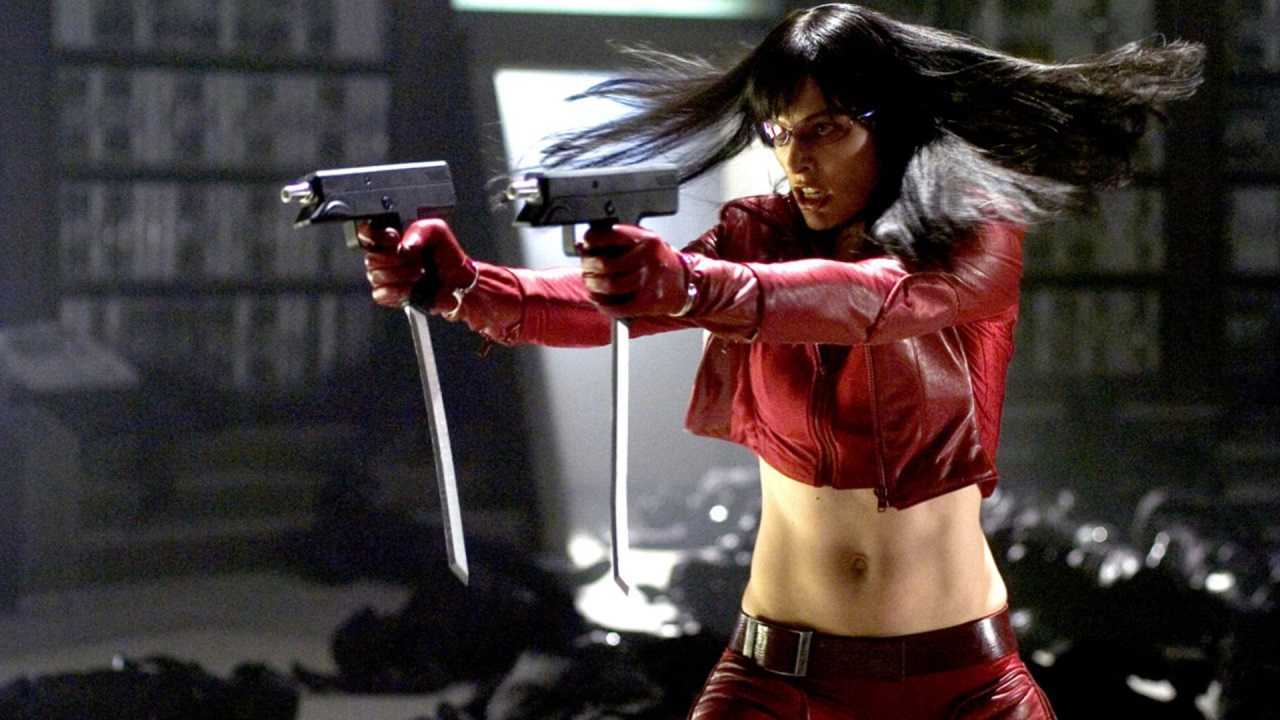
Kurt Wimmer loves action movie poses and invents an entire book of his own in Ultraviolet. His various Bullet Time-inspired and Gun Kata action sequences sing with an exhilarating visual kinesis. The results are undeniably spectacular, although at the same time are so preposterous as action sequences go as to enter into the realms of total fantasy. The most notable of these is a sequence where Milla Jovovich is engaged in heavy pursuit on a motorcycle and operates an anti-gravity device that allows her to race horizontally along the side of a building at a 90 degree angle to the street, before zooming vertically up the side of the building to the roof, smashing through a helicopter that tries to attack in mid-air and across through the windows of the building opposite, skidding through several offices before coming to a halt.
Some of the action sequences, while undeniably impressive in the moves that Kurt Wimmer and his fight choreographers coordinate, strain (if not completely rupture) the limit of the envelope in terms of heroic credibility – like having Milla Jovovich standing in the midst of gunfire and remaining untouched while she shoots down her opponents by the dozens as they seem to stand still to be attacked.
If nothing else, Ultraviolet is a marvel of design elements. Kurt Wimmer fills his sets with bold primary colours, clean antiseptic spaces and strong geometric patterns. Visually, the film has a unique colour scheme where even the faces of the protagonists have been washed out to the extent that they look airbrushed or like characters in a high-resolution videogame. There is something here akin to the remarkable Avalon (2001), which turned live-action actors into anime figures. The entire production crew went to Shanghai to shoot, taking advantage of the city’s natural futuristic architecture to achieve much of the film’s look.
The visual effects, which come from Hong Kong based Menford Electronic Art & Computer Design, are on the weak side and make many of the action sequences look for all the world like the visuals for a computer game. On the plus side, they are placed in the service of such a vibrant visual energy that one tends not to notice too much.
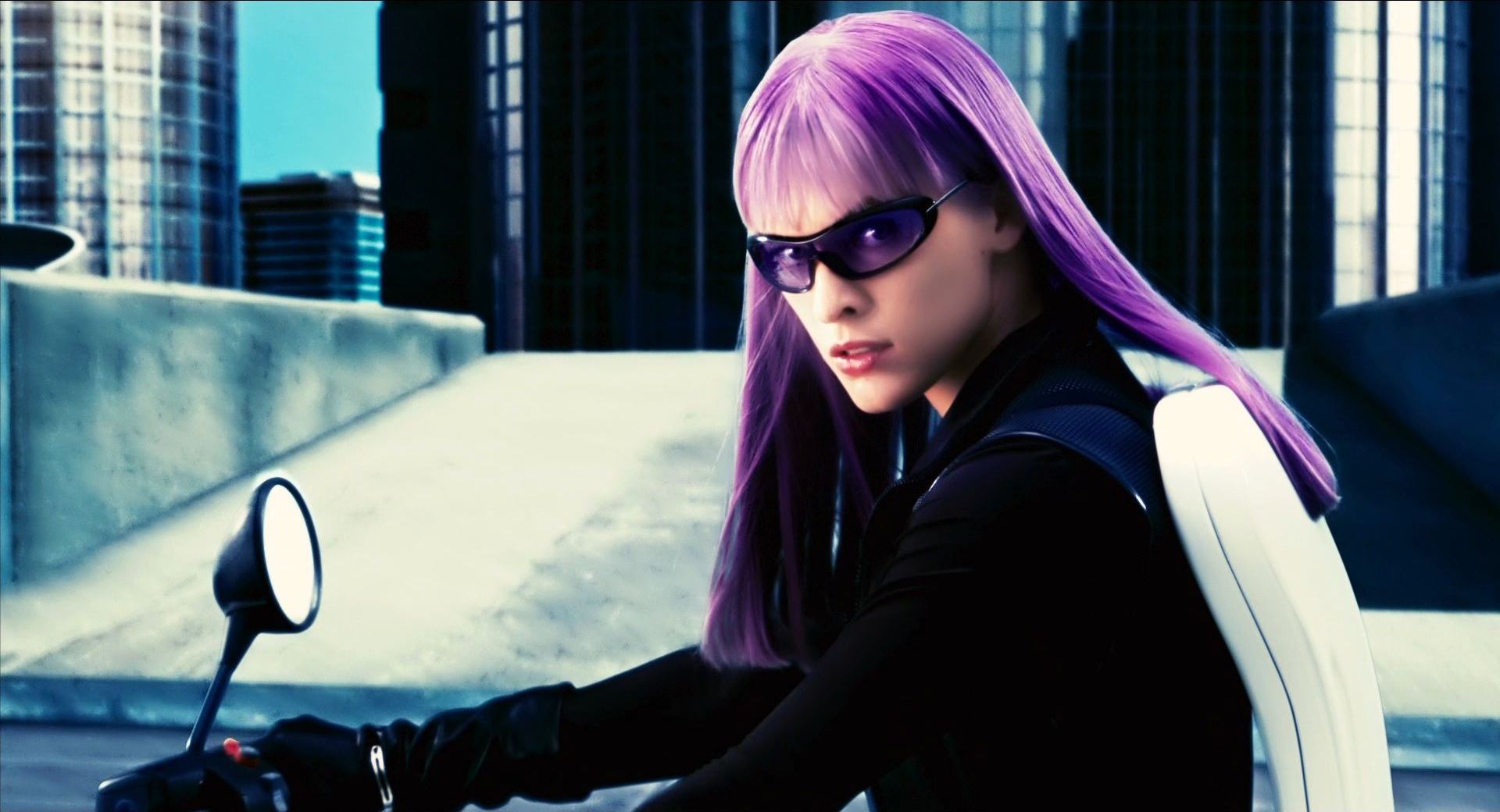
What one also liked about Kurt Wimmer’s design scheme is the amazing pieces of throwaway advanced technology he casually creates – in a step beyond the secretary’s nail changes we saw in Total Recall (1990), we get instant costume and hair changes; Milla Jovovich buys a disposable paper cellphone from a dispensing machine; and there is flat technology that allows weaponry to be compressed to a two-dimensional plane, even Cameron Bright to be compacted into a valise.
Visually, Ultraviolet is a totally unique film. It is also a comic-book of a film where Kurt Wimmer has made with no particular pretensions to intellectual profundity. Perhaps Ultraviolet‘s conceptual failing is that Kurt Wimmer only sees style, moves and exotic futuristic architecture as the sum of science-fiction. He makes a good case but having it all at the service of a strong story would have helped no end too.
This is perhaps not entirely Kurt Wimmer’s fault. Against Wimmer’s wishes, the distributors reportedly hacked something like twenty minutes of footage out of Ultraviolet – although only around five minutes of this missing footage appears in the dvd’s extras package. Most notable among the restored scenes is Wimmer’s longer opening scene that explains the background of the future and how the Hemophages were created from a virus and developed symptoms that resemble vampires. Contrasting the two openings, it becomes apparent that the distributors seem to have wilfully eliminated any reference to vampires from the film for some reason.
(Winner for Best Production Design at this site’s Best of 2006 Awards).
Trailer here