

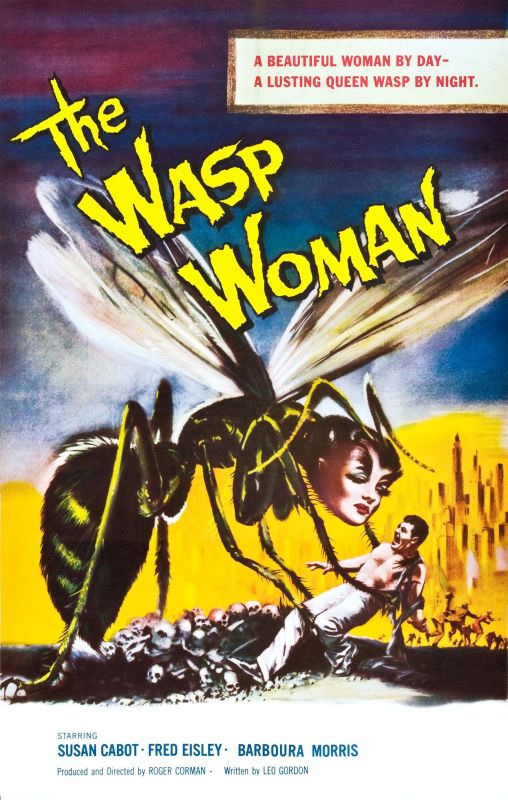
USA. 1959.
Crew
Director/Producer – Roger Corman, Screenplay – Leo Gordon, Story – Kinta Zertuche, Photography (b&w) – Harry C. Newman, Music – Fred Katz, Art Direction – Daniel Haller. Production Company – Filmgroup/Santa Clara.
Cast
Susan Cabot (Janice Starling), Fred Eisley (Bill Lee), Barboura Morris (Mary Dennison), Michael Marks (Dr Eric Zinthrop), William Roerick (Cooper), Frank Gerstle (Hellman)
Plot
In Manhattan, the beauty products company Janice Starling Enterprises is performing poorly because, some suspect, Janice is becoming too old and no longer presents an appealing corporate image. Janice agrees to fund Dr Eric Zinthrop’s research into royal jelly extracts from bees. He soon creates a serum that successfully rejuvenates a cat. Janice insists on trying the serum on herself. Afterwards everyone remarks how young she looks. However, the serum has an unforeseen side effect in turning Janice into a wasp creature that is driven to drink human blood.
The Wasp Woman is another of Roger Corman’s legendary B-budget films. Many of Corman’s B films made during the 1950s – in particular It Conquered the World (1956), Not Of This Earth (1957), Attack of the Crab Monsters (1957) and of course The Little Shop of Horrors (1960) – are zestfully made and often have a pulp delight that transcends the limitations and low expectations of the B-film. The Wasp Woman is one of Roger Corman’s more routine entries from this period.
The Wasp Woman was clearly made as a quickie designed to exploit the success of the previous year’s much better-budgeted human-insect mix-up film The Fly (1958). It is a passably well-made B movie but there is nothing remarkable to it. Most of the action is static and talky and the film drags, even though it only has a 73-minute running time. Indeed, The Wasp Woman is surely the first monster movie where the action is entirely limited to the confines of an office.
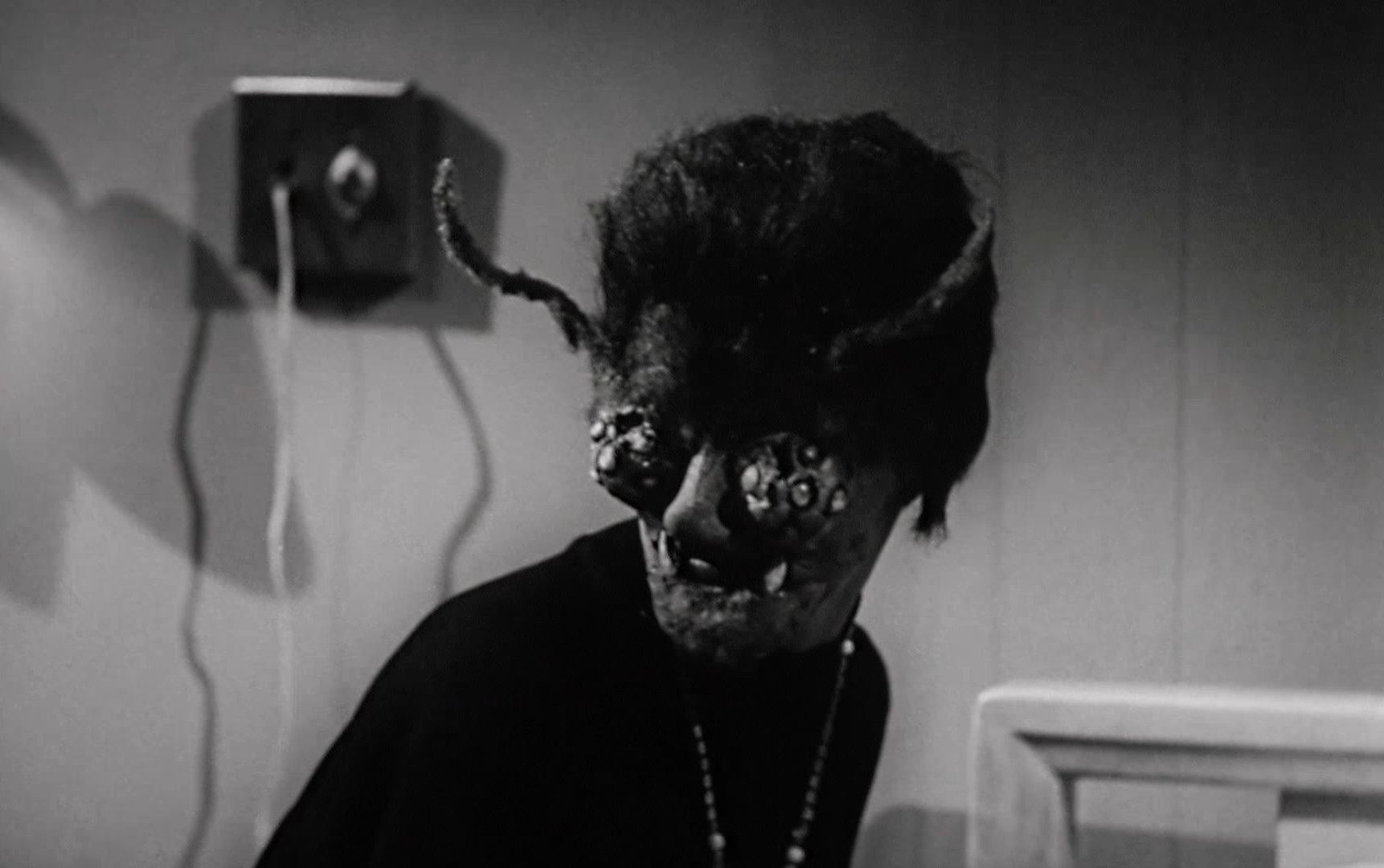
The monster mask looks cheap and obvious – Corman uses it for some routine jumps but not much. Half of the drama in the film takes place off-screen – including all the bee attacks and the scene where scientist Michael Marks is run down by a bus. The script has some fundamental confusions – for one, the rejuvenation serum is derived from bees, yet the film calls itself The Wasp Woman. For no clear reason, once transformed into a bee/wasp, the title character develops vampiric tendencies, something that neither creature displays in the real world.
Roger Corman later remade the film as part of a cable tv movie package entitled The Wasp Woman/Forbidden Beauty (1995), starring Jennifer Rubin in the title role, Daniel J. Travanti as the mad scientist, and directed by Jim Wynorski.
Roger Corman’s other genre films as director are:– Day the World Ended (1955), It Conquered the World (1956), Attack of the Crab Monsters (1957), Not Of This Earth (1957), The Saga of the Viking Women and Their Journey to the Waters of the Great Sea Serpent (1957), The Undead (1957), Teenage Caveman (1958), War of the Satellites (1958), A Bucket of Blood (1959), The House of Usher/The Fall of the House of Usher (1960), Last Woman on Earth (1960), The Little Shop of Horrors (1960), Creature from the Haunted Sea (1961), Pit and the Pendulum (1961), Premature Burial (1962), Tales of Terror (1962), Tower of London (1962), The Haunted Palace (1963), The Raven (1963), The Terror (1963), X – The Man with X-Ray Eyes (1963), The Masque of the Red Death (1964), The Tomb of Ligeia (1964), The Trip (1967), Gas; or It Became Necessary to Destroy the World in Order to Save It (1970) and Frankenstein Unbound (1990). Corman’s World: Exploits of a Hollywood Rebel (2011) is a documentary about Corman’s career.
Trailer here
Full film available online here:-